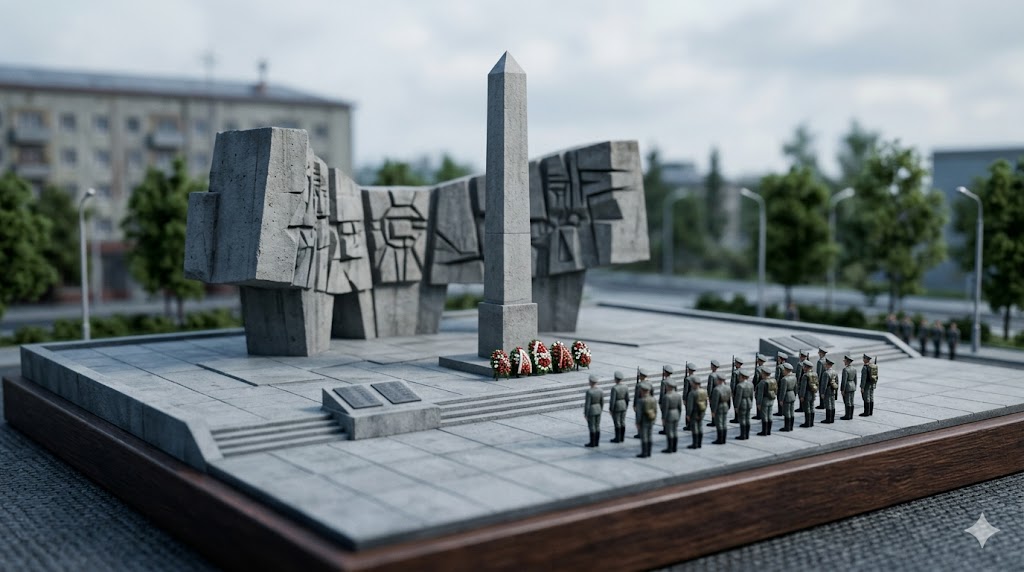
On April 27, North Korea opened a memorial museum for soldiers it had spent months pretending were never there. Kim Jong Un attended the ceremony in Pyongyang, laying flowers and placing soil at the memorial for North Korean troops killed while fighting in Russia’s war in Ukraine. Russian Defense Minister Andrei Beloussov stood beside him. In his speech, Kim called the dead soldiers ‘a symbol of the heroic march of the Korean and Russian peoples.’ South Korea’s intelligence service estimates that North Korea deployed approximately 15,000 troops to the front; around 2,000 did not return. Those 2,000 deaths became, yesterday, officially heroic.
For most of the period when those troops were fighting, North Korea denied they existed. When Seoul first disclosed the deployments, Pyongyang was silent. When satellite imagery and prisoner testimony began to emerge, there was still no official acknowledgment. The soldiers fought and died in a war their own government would not publicly claim them for. It was only in death — once the casualty numbers became too large to absorb quietly — that the state gave them a formal identity: heroes. They were unacknowledged while alive. They are celebrated now that they are dead.
The timing of the ceremony was deliberate. April 27 marks approximately one year since the conclusion of Russia’s operation to recapture the Kursk region — the operation in which North Korean troops were reportedly most heavily deployed. Russian officials, including State Duma Speaker Volodin and Defense Minister Beloussov, attended the Pyongyang ceremony. Two states stood together and said, in effect: we fought this together, and we are building something permanent to prove it. A treaty provides the legal architecture. A memorial provides the emotional architecture. An alliance that has both is much harder to dismantle.
The creation of a permanent memorial is not a grieving ceremony. It is an institutional act. Memorials fix events in national memory. They create narratives that future governments inherit. By building this museum, North Korea has made its military support for Russia into a permanent chapter of its national story — one that will be taught to schoolchildren, commemorated annually, and used to justify future decisions. The comprehensive strategic partnership treaty signed with Putin earlier this year was one pillar. The memorial museum is another. Together, they mean that the Russia-North Korea military relationship is now institutionalized in the deepest sense.
For Japan, the geography has not changed but its strategic weight has increased. The Korean peninsula is approximately 200 kilometers from Japan. North Korea’s missile tests have crossed Japanese airspace on multiple occasions. The country that launched those missiles has now formally acknowledged sending 15,000 soldiers to fight in a European war, sustained 2,000 combat deaths, and built a memorial honoring those deaths as heroism. Japan’s Foreign Ministry maintains a Level 4 travel advisory for all of North Korea, its highest designation, recommending evacuation. That designation reflects a threat that just became institutionally deeper.
The abductee issue is also affected, though less visibly. Japan-North Korea relations have had no meaningful diplomatic channel in recent years. The deeper North Korea’s ties to Russia — and the more those ties are enshrined as national heroism — the less leverage international pressure has. If Russia’s partnership guarantees North Korea’s economic lifeline through energy, weapons technology, and trade, the effect of Japanese and American sanctions is diminished. The families of abductees are aging. The diplomatic window that was already narrow has become narrower still.
Kim Jong Un’s speech contained more than the word ‘heroes.’ He reportedly said that the Korean people ‘will always support Russia’s victory.’ This is not diplomatic boilerplate. It is a message to the North Korean domestic audience: our involvement in Ukraine was correct. The memorial museum is the physical anchor of that message. A national narrative about heroic sacrifice in service of Russia is now being constructed. A narrative of that kind is also, always, a psychological preparation for the next mobilization.
There is a detail in the ceremony worth pausing on. Kim Jong Un reportedly picked up dirt and cast it over the remains of one dead soldier before laying flowers for the others. The gesture was choreographed for the cameras. But two thousand people went to a war in a country most of them had never seen, in a conflict their own government refused to acknowledge, and did not come back. Whether their families were told where they died, in a country where all information is controlled by the state — we do not know, and are unlikely to find out.
The memorial stands in Pyongyang now. As long as it stands, Russia’s war in Ukraine will have a North Korean chapter written into it. The question this raises — whether the next time Russia needs something from North Korea, this treaty, this precedent, and this museum make it easier for Kim to say yes — does not have a clear answer today. But the institutional framework is in place. The 2,000 who were sent somewhere without being officially acknowledged are now permanently, officially, heroes. The distance between those two facts — unacknowledged in life, enshrined in death — is worth measuring carefully, and not forgetting.
この記事を書いた人
灰島
30代の日本人。国際情勢・地政学・経済を日常的に読み続けている。歴史の文脈から現代を読むアプローチで、世界のニュースを考察している。専門家ではないが、誠実に、感情も交えながら書く。


コメント