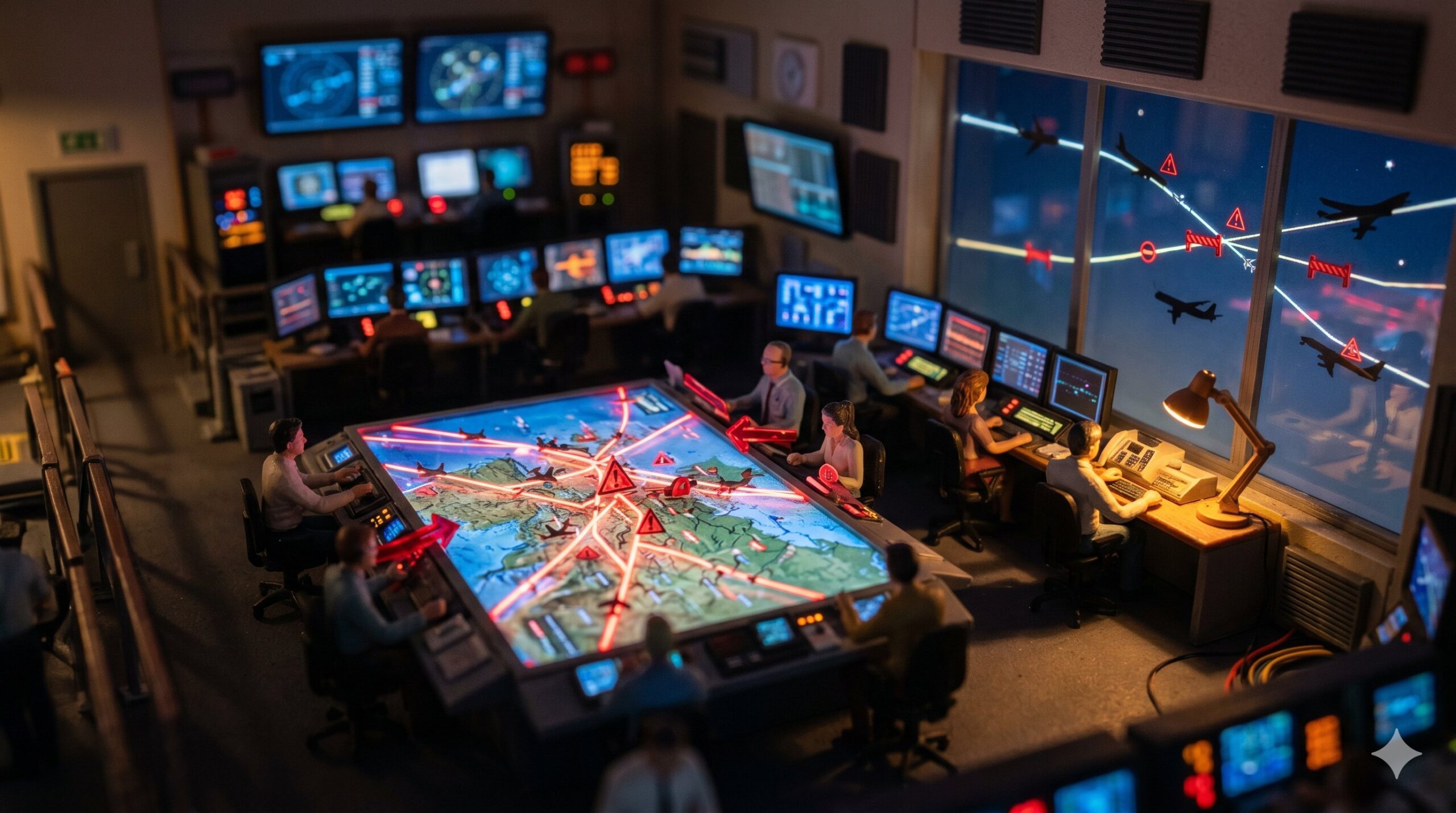
Invisible infrastructure is breaking silently. The closure of Middle Eastern airspace is forcing European-bound jet fuel into detours. The cost is steep enough to drain Europe’s entire kerosene reserves in just six weeks. Fatih Birol, the head of the International Energy Agency, issued a warning last week: without intervention, structural shortages in Europe’s aviation network will appear by the end of May. This is not merely a cost problem. It is the moment when human mobility itself becomes institutionally constrained.
Birol’s warning was strikingly specific. The “six weeks” deadline was grounded in precise calculations of European jet fuel stock depletion under current detour-flight conditions. This is not speculation. Using data on current Strait of Hormuz closure, expanding detour routes, and rising per-flight fuel consumption, the IEA projected that by late May, European operational reserves could fall below minimum safe levels. In plain terms: Europe’s airspace risks systemic shutdown before summer vacation season begins.
Why is this happening? To understand the IEA’s warning, we must first see where Europe’s energy supply had been coming from. Jet fuel transported through the Strait of Hormuz once represented roughly 75% of total European net imports. Before Iranian tensions closed Middle Eastern airspace, that single maritime corridor delivered 40% of all jet fuel consumed in European skies. One passage: an entire continent’s transportation.
The Strait’s scale cannot be overstated. Approximately 30% of all global seaborne oil transits this narrow passage. For Europe’s aviation sector, it represents the arterial backbone of fuel supply. On any normal day, hundreds of tankers move crude and refined products through these waters. Shut that passage, and the global fuel distribution system develops a critical bottleneck. For Europe specifically, closure means losing not just supply, but the redundancy and price stability that global circulation provides.
That passage is now completely sealed. The Strait of Hormuz lets no ships through. In CNBC’s reporting, the word “systemic” appears repeatedly. This is not an “isolated problem” but a “structural crisis.” The entire aviation industry is beginning to grasp that a single thread holding everything together has snapped.
Detour routing costs are quantifiable and steep. Standard Europe-to-Middle East-to-Europe routes span approximately 7,000 kilometers. Detour paths—across the Indian Ocean, around Africa, through Southeast Asia, and back—exceed 15,000 kilometers. That distance doubling translates directly to fuel consumption doubling. A single aircraft burns approximately 3,000 liters of additional fuel per detour flight. When hundreds of European-bound flights operate on detour routes simultaneously, the cumulative daily drain on European fuel stocks becomes visible: roughly equivalent to 2-3% of normal daily consumption, accelerated into shortage within weeks.
Jet fuel pricing has spiked acutely. Market prices reached $146.99 per barrel as of April 2026—double the $70 level of early 2025. Worse, spot prices (immediate delivery contracts) have surged past $150 per barrel as airlines scramble to secure current supplies while reserves dwindle. This price volatility feeds into the second-order crisis: higher costs trigger immediate capacity cuts, which further strains remaining infrastructure.
European airlines are already responding strategically. KLM, the Dutch carrier, announced the reduction of 160 flights next month. This represents roughly 1% of total European routes—a surgical cut to preserve overall operations. But simultaneously, the International Air Transport Association (IATA) forecasts that cascading flight cancellations due to jet fuel shortages will accelerate through May. KLM’s preemptive cuts are not isolated. They signal the beginning of coordinated industry contraction.
Summer travel season collides with fuel depletion. June through August represents peak aviation demand in Europe—when leisure travelers book international flights, when families coordinate vacations, when the continent’s tourism economy depends on full capacity. Yet the IEA’s six-week timeline points to late May as the critical inflection point. This means the transition from manageable shortage to systemic crisis will occur precisely when European airlines need maximum operational flexibility. The timing compounds the disaster.
This crisis is creeping quietly into Japanese daily life. All Nippon Airways (ANA) and Japan Airlines (JAL) will significantly raise fuel surcharges effective May 1. On Japan-Korea routes, JAL’s fee climbs from 3,000 yen to 6,500 yen; ANA’s from 3,300 to 6,700 yen. North American routes face worse pressure. A one-way charge jumps from $180 to $350. For a round-trip to London, the fuel surcharge alone reaches approximately 112,000 yen—about $740. For Japanese workers earning 2.5 million to 4 million yen annually, this represents a single transatlantic trip as a significant financial barrier.
Cargo and freight logistics face equivalent disruption. Jet fuel shortages do not affect only passenger aircraft. International cargo routes—carrying pharmaceuticals from Europe to Japan, electronics from Asia to Britain, perishables globally—operate on the same fuel constraints. As prices spike, cargo surcharges escalate proportionally. Japanese importers face cost increases on goods transiting European hubs. Consumer prices downstream will rise.
Asian aviation networks show early strain. Singapore, Bangkok, Hong Kong, and Tokyo hubs all feed into routes that historically used Middle Eastern corridors. With detours mandatory, fuel consumption rises across Asia-Pacific. Some carriers have already suspended lower-margin regional routes. The aviation network serving Southeast Asia is quietly beginning to retract.
Why does this qualify as “infrastructure breaking”? Jet fuel pricing operates within market mechanisms. European kerosene prices, like Japanese airfares, rise when supply falls—elementary economics. Yet hidden within that simplicity is a more troubling reality: individual mobility becomes collateral damage in international conflicts. People did not choose Middle East deterioration. They did not desire Strait of Hormuz closure. They did not foresee fuel shortages. Yet they are forcibly thrust into a world where airfare doubles. This is not market dynamics—it is structural violence.
The feedback loop is vicious and self-reinforcing. Detour-driven fuel consumption accelerates European depletion. Shrinking reserves drive prices higher. Higher prices force airlines to cut routes. Cancelled routes mean lost jobs in regional hubs and reduced passenger mobility. That immobility cascades: fewer tourists reach European regions dependent on air access, harming local economies. Economic contraction reduces ticket demand further, pushing more routes offline. The cycle feeds itself, grinding toward a new equilibrium at lower overall capacity.
Japan’s tourism and exchange ecosystem face secondary impacts. Japan’s “Cool Japan” tourism strategy depends on attracting European and British visitors. Doubled airfares reduce outbound travel from Europe. Japanese inbound tourism numbers will drop. Rural Japanese regions dependent on international visitor spending face contraction. Simultaneously, Japanese business travelers and students studying abroad encounter higher costs, reducing cross-border exchange programs. The intellectual and cultural spillovers of aviation—far less visible than the fuel prices themselves—diminish.
Two scenarios now divide the future. The optimistic path: Middle Eastern tensions ease by early June; the Strait of Hormuz reopens to limited traffic. European fuel imports resume their normal volumes by July. Reserve levels stabilize. Surcharges decline. Summer capacity returns. This scenario requires geopolitical de-escalation within weeks—possible but increasingly unlikely given current trajectory.
The second scenario is structural breakdown. If Middle East conflict persists or intensifies beyond June, airspace remains closed through summer. European aviation shrinks permanently. Regional routes suspended in May never resume—the economics no longer work. Once gone, route networks take years to rebuild. Local airports lose traffic, layoff staff, and reduce service. The absence becomes normal. Gradually, aviation access stratifies: premium passengers on major routes retain access; price-sensitive travelers lose it entirely. Eventually, whole populations in less-wealthy regions find no viable air connections exist. This is structural unfreedom—not market response, but systemic collapse.
Japan’s position in this crisis is asymmetric. Japan cannot influence Middle East geopolitics. Japan cannot reopen the Strait of Hormuz. Yet Japanese workers, businesses, and tourists absorb the full cost. A Japanese employee paying 112,000 yen more for a London flight had no say in Iranian tensions. A small tour operator in Okinawa watching European bookings evaporate bears no responsibility for the Strait’s closure. They are absorbing costs for a conflict they did not cause and cannot control.
The parallel to historical energy shocks merits attention. The 1973 oil embargo, the 1979 Iranian Revolution, Iraq’s 1990 Kuwait invasion—all disrupted global energy. Yet those crises stemmed from supply restriction: producers withheld output. This crisis is different. The oil still flows at normal volumes. The infrastructure simply cannot move it. Closing a physical chokepoint is arguably more durable than an embargo. Embargoes can lift. Militarized airspace is harder to reopen.
One question remains. The Middle East conflict was not chosen by Europeans, Japanese, or Americans. Yet its costs are enforced upon them through mechanisms as invisible and irresistible as gravity. Why should a Japanese worker pay double to reach London because of Iranian tensions? Why should a Japanese tourist family abandon European summer plans because Houthi forces control the Strait? Market mechanisms cannot explain this inequality. Individual effort cannot change it. Yet the worker, the family, the business owner must bear it.
This silent coercion is perhaps more pressing than visible conflict. Bombs and bullets are instantly recognizable as violence. Fuel surcharges, route closures, and reduced capacity appear as neutral market signals. But they are not. They are structural violence—the enforcement of costs onto populations who bear no responsibility and wield no control. When infrastructure breaks silently, the violence it unleashes is invisible. And invisible violence, precisely because it carries no name, often escapes scrutiny.
The deeper question is now being posed to the world. How much of global civilization rests on the assumption that one narrow strait in the Middle East will remain open? How much of personal freedom—the ability to board a plane and reach another continent—depends on the continued quiescence of a single geopolitical flashpoint? In 2026, we are learning the answer: more than we imagined. And the price of that knowledge is being paid by those furthest from the decisions that matter.
Historical precedent reveals the arc of such disruptions. The 1973 oil embargo did not merely spike prices temporarily. It restructured global energy systems permanently. New supply routes were developed. Strategic petroleum reserves were established. Energy efficiency standards were mandated. What appeared as a temporary shock became a permanent reset of infrastructure and policy. Today’s Strait of Hormuz closure may follow a similar pattern. What begins as a six-week shortage could evolve into a multi-year supply chain reorganization. European fuel distributors may establish African supply networks. Japan may pursue domestic biofuel development more aggressively. South Korea and India may accelerate alternative energy transitions. A single chokepoint’s closure could cascade into decades-long industrial reorganization.
The secondary market effects are already materializing. Oil futures markets are pricing in sustained supply disruption. Airlines have begun hedging fuel costs for the next fiscal year, locking in elevated prices that cascade to ticket purchasers. Insurance companies are recalculating risk models for international routes. Pension funds that held aviation stocks are reviewing exposure. The financial system, sensing structural risk, is already repricing assets. Individual workers buying airline tickets are facing surcharges that reflect not just current costs but market expectations of future disruption.
Japan’s government response offers instructive constraints. Tokyo has announced no emergency stimulus for aviation. Instead, the government’s approach emphasizes “monitoring” and “coordination with industry.” This reflects political calculation: direct subsidy might provide short-term relief but would distort markets and create moral hazard. Airlines that receive government support may delay necessary efficiency measures, entrench themselves, and become dependent on future subsidies. Better, Tokyo reasons, to let market forces operate and allow efficient carriers to thrive while inefficient ones contract. Yet this market-based approach imposes real hardship on workers and consumers in the short term.
The distributional effects are deeply unequal. A business executive at a major corporation can likely still afford London trips, even at doubled fares. A midcareer professional with modest income must either forego the trip or incur significant personal financial strain. Young adults planning gap-year travels find their plans economically infeasible. Retirees expecting to visit grandchildren abroad face a hard budget constraint. The effective result: air travel access stratifies by income level. This stratification is not new—premium cabin passengers have always faced different constraints than economy travelers. But the current crisis accelerates and deepens that stratification.
One more observation on invisible infrastructure. Modern civilization depends on countless such thin points: the Malacca Strait for global shipping; undersea fiber-optic cables for digital communications; a few chip fabrication facilities for semiconductor supply. Each of these chokepoints carries systemic risk. Most exist because they are economically optimal—more efficient than alternatives. But that efficiency creates fragility. When catastrophic failure risks are low, efficiency wins. When a failure occurs, the full cost of that fragility becomes visible. Hormuz closure is one such moment of visibility. Others will follow.
ANA and JAL surcharge specifics reveal the precise burden. Japan-Korea routes: JAL’s surcharge rises from 3,000 yen to 6,500 yen per round trip; ANA’s from 3,300 to 6,700 yen. For business travelers making weekly trips between Tokyo and Seoul, the monthly surcharge reaches approximately 25,000-27,000 yen—equivalent to a monthly restaurant budget for a modest diner. North American routes face steeper pressure. One-way surcharge climbs from $180 to $350—a 94 percent increase. A round-trip to Los Angeles now carries approximately $700 in fuel surcharge alone. For annual visitors (visiting family, business meetings), the annual surcharge cost exceeds $1,000 per person. A family of four visiting North America faces nearly $3,000 in fuel surcharge costs alone, before airfare, accommodation, or meals.
Japan’s inbound tourism strategy faces existential challenge. Japan has invested 15 years in marketing itself as a tourist destination—anime tourism, temple tourism, culinary tourism, countryside tourism. The government’s “Visit Japan 2030” initiative targets 80 million annual foreign visitors by 2030 (current: ~35 million). That target assumed stable airfare levels. Doubled fuel surcharges change the calculation for price-sensitive travelers. A young European backpacker budgeting $2,000 for a Japan trip must now allocate $300-400 of that just to airfare surcharge—leaving less for accommodation and food. Some travelers will defer their Japan trip until fares normalize. Tourism-dependent rural regions in Japan will see summer booking cancellations cascade. Rural tourism businesses operating on tight margins may collapse. Small family-run inns, restaurants, and tourist attractions face sudden revenue loss.
The Hormuz Strait’s historical role in global politics cannot be ignored. Since the 1956 Suez Crisis, this passage has been the subject of intense diplomatic attention. The Strait’s navigational rights are protected under international law as a chokepoint vital to global commerce. Every nation with naval capacity has maintained military presence in the region to ensure freedom of passage. That entire framework of guaranteed access has now failed. A single geopolitical actor—in this case, Iranian authorities or Houthi forces allied with Iran—can now unilaterally shut down European fuel access for months on end. The principle of freedom of navigation, which has been foundational to post-WWII international order, is being tested.
Longer-term supply chain adaptation will reshape global fuel logistics. If the Strait remains closed beyond July, European refineries and fuel distributors will accelerate alternative sourcing. Investment in African fuel supply networks will accelerate. South American biofuel facilities will expand. North American shale production will increase. Over 18-24 months, Europe’s fuel supply diversifies. That diversification reduces future vulnerability to Hormuz closure. But it also means that once-cheap Middle Eastern fuel becomes proportionally less important to Europe’s energy mix. The geopolitical realignment that follows—Europe less dependent on Middle Eastern suppliers, more dependent on African and American producers—will reshape international relations and trade balances for decades.
One more layer: the labor market disruptions in aviation hubs. European cities like Frankfurt, Amsterdam, and London depend on aviation as a major employment sector. When flights are cancelled en masse, airport staff see hours cut. Ground crews are laid off. Catering companies lose contracts. Hotels near airports see occupancy collapse. Taxi and transportation services lose revenue. Regional economies that depend on aviation income face sudden contraction. Some workers will find jobs in other sectors. Others will exit the labor market, taking early retirement or shifting to lower-wage work. Permanently displaced workers represent human waste—potential economic output that will never be realized.
The financial markets are repricing global risk in real time. Stock prices for airlines have fallen sharply. Insurance companies rewriting coverage terms for international routes. Pension funds reassessing exposure to energy-sector volatility. Credit markets are pricing in higher default risk for airlines with thin margins. The Strait’s closure isn’t just a physical disruption; it’s a signal to capital markets that long-assumed geopolitical stability is fragile. That signal changes how capital is allocated globally. Riskier geopolitical regions become more expensive to invest in. Stable regions attract capital at lower cost. The result: money flows away from the Middle East, toward geopolitically safer regions. That reallocation of capital affects everything from job creation in developing nations to government debt financing costs.
Tourism economics will suffer acutely in the short term. Greece depends on summer tourism for roughly 15% of government revenue. Spain, Portugal, Italy—all deeply dependent on summer European and American visitors. Doubled airfares reduce travel. Hotel occupancy rates collapse. Restaurant demand falls. Seasonal workers face reduced hours and lower wages. Small family-owned hospitality businesses—which operate on thin margins—may not survive a summer with 30% lower revenue. Some will close permanently. That closure means not just job loss but cultural loss—family businesses with decades of history disappear.
The final observation concerns the asymmetry of burden. The geopolitical leaders making decisions that closed the Strait will not board expensive flights or miss vacations. Military commanders directing ship movements will not face reduced hours or lost employment. Government ministers will travel by government aircraft at subsidized costs. The burden falls exclusively on ordinary people: workers, families, small business owners, tourists, students. This is the essence of structural violence—costs imposed on those with no voice in decisions and no power to resist them. The Strait closure is not a natural disaster. It is a human-made consequence of political conflict. Yet those who bear its costs had no role in creating that conflict. That imbalance is both economically inefficient and morally indefensible.
For now, the observational stance is the only honest one. The Strait remains closed. Detours continue. European reserves deplete. Japanese surcharges take effect. The IEA’s six-week timeline ticks down toward May’s end. Whether this becomes a short-term shock or a structural realignment remains undetermined. What is certain: the fragility of global supply networks, taken for granted for decades, has been exposed. And that exposure, once achieved, cannot be unseen. It will shape policy, investment, and risk calculation for years to come. The cost of that exposure falls most heavily on those furthest from the decision-making centers that matter.
この記事を書いた人
灰島
30代の日本人。国際情勢・地政学・経済を日常的に読み続けている。歴史の文脈から現代を読むアプローチで、世界のニュースを考察している。専門家ではないが、誠実に、感情も交えながら書く。


コメント