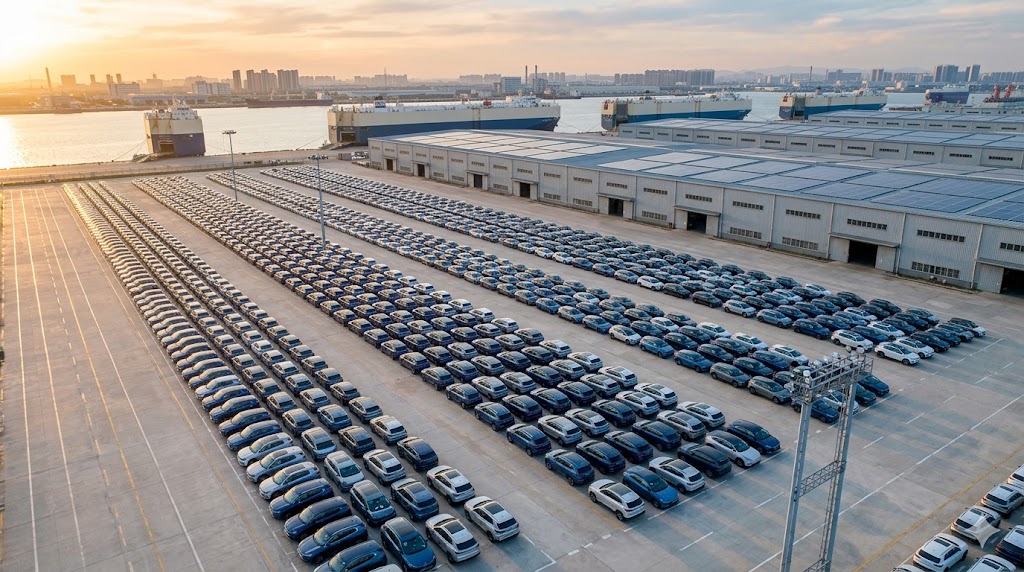
At the Beijing Auto Show this April, BYD made a declaration that the entire automotive world could not ignore. In a hall full of journalists and competitors, BYD executive Stella Li stated simply: “We are already a global company.” This was not corporate bravado. The numbers back it up. BYD’s annual sales volume surpassed Tesla in 2025, making it the world’s largest seller of battery electric vehicles by volume. According to Bloomberg reporting, BYD is accelerating its push into Europe, Southeast Asia, and Latin America heading into 2026. What interests me more than the fact that BYD passed Tesla is what it intends to do with that position.
A 38.1 percent European Union tariff has done nothing to slow BYD’s advance into the continent. BYD’s European sales tripled in 2025 despite that punitive barrier. The reason comes down to vertical integration. While most automakers source their battery cells from Panasonic, Samsung SDI, or LG Energy Solution, BYD manufactures its own cells through its subsidiary BYD Dynamics and assembles them using its proprietary Blade Battery technology. Since batteries account for an estimated 40 percent of an electric vehicle’s production cost, controlling that piece of the supply chain in-house creates a degree of pricing flexibility that cannot be replicated by purchasing from the outside. The tariff wall that was supposed to protect European and other automakers has proven less of an obstacle than expected, because BYD’s cost base was structured to withstand exactly this kind of pressure.
Geopolitical tensions around the Strait of Hormuz have created an unlikely tailwind for BYD. Each time military posturing between Iran and Western powers unsettles energy markets, European governments accelerate their push away from fossil fuels. Each acceleration brings renewed subsidies, tax incentives, and regulatory mandates for EV adoption, and BYD is positioned to absorb the benefit of every euro directed at that transition. There is a strange logic at work: geopolitical instability in oil-producing regions directly strengthens the case for electrification, which in turn strengthens the most cost-competitive EV manufacturer. The company that benefits most from the world’s energy anxiety turns out to be headquartered in Shenzhen.
BYD has stopped being an automaker in any conventional sense and become something closer to an energy ecosystem. Its residential battery storage product, the BYD Battery Box, is selling well in Germany as part of integrated home solar-plus-storage systems. The company manufactures city buses and commercial trucks, operates charging infrastructure networks, and produces display panels for smartphones. Buying a BYD vehicle is increasingly less like purchasing a car and more like subscribing to a comprehensive energy management platform. The vehicle is the entry point. What waits further in is a business that spans home energy management, charging billing systems, and fleet operations — a platform play dressed as an automaker.
Ironically, the Trump administration’s tariff policy created indirect advantages for BYD. Tesla was forced to concentrate management resources on defending its US market position and pricing, which reduced its bandwidth for international expansion. At the same time, higher tariffs on EV components inside the United States gave American automakers less incentive to accelerate their own electric vehicle transitions. A policy intended to protect domestic industry ended up constraining the agility of the very companies it was supposed to help. BYD, positioned outside the US market, watched from a distance as its primary global competitors were slowed by the policies meant to keep them out.
Ford CEO Jim Farley’s statement that BYD is the real competitor deserves to be taken seriously. Ford has spent more than a century competing against General Motors, Toyota, and Volkswagen. Suddenly the name at the top of its threat list belongs to a company that barely registered on American automotive radar a decade ago. Farley’s words were both an acknowledgment of vulnerability and a warning to an industry that had perhaps been slow to accept the full implications of what was happening. Recognizing a competitor clearly and responding to it effectively are different challenges, but at least Ford appears to have its eyes open.
As someone who watches Japan’s industrial trajectory closely, I find myself looking at these numbers with a particular kind of chill. Toyota continues to hold ground through hybrid and plug-in hybrid technology, and it has not been left entirely behind. Honda and Nissan have begun a collaborative EV effort. But the share of pure battery electric vehicles in total sales remains comparatively low across Japanese automakers. The strategy of funding the EV transition from hybrid profits is coherent in principle. The risk is in the assumption about how long the transition period will last. If markets move toward BEV faster than planned, the runway for that strategy shrinks. The question of whether the scheduled transition timeline matches the market’s actual tempo is one that deserves more explicit scrutiny than it tends to receive.
What is happening in Southeast Asia right now may be the clearest signal of what comes next for Japan. In Thailand, BYD became the top-selling foreign car brand in 2024. A BYD factory has begun operations in Indonesia. Its presence in Malaysia, the Philippines, and Vietnam is expanding rapidly. These markets were built around Japanese automotive exports for decades. The dealer networks, service infrastructure, and parts supply chains across the region were constructed around the assumption that Japanese vehicles would remain dominant. The erosion of that dominance is not merely a distant sales statistic. It threatens the entire regional supply chain, from local parts suppliers to Japanese component manufacturers to the employment that depends on those relationships.
The battery technology gap is not something that narrows quickly through investment alone. BYD’s Blade Battery entered mass production in 2020. Six years of production data, iterative cost reduction, and yield improvement know-how represent an accumulation that capital cannot simply purchase and deploy. Every few months, the promise of solid-state batteries resurfaces as Japan’s path to a comeback. That technology may yet deliver. But between now and then, BYD continues to capture markets with current-generation lithium-ion technology. Betting on a future technology while losing present-day market share requires an explicit and honest accounting of the risks involved, which is not always the conversation being had.
Japan did this exact thing once. In the 1970s and 1980s, Japanese automakers entered the American market with affordable, reliable vehicles and steadily dismantled the positions that GM and Ford had held for generations. The journey from being dismissed as ‘cheap Japanese cars’ to becoming the global benchmark for quality was built on kaizen, lean manufacturing, and an unrelenting focus on process improvement. What BYD is doing today is structurally very similar. The difference is that the new paradigm is electrification, and the ingredients now include government subsidies at a scale that dwarfs anything Japan used, proprietary data from tens of millions of connected vehicles, and manufacturing scale achieved at speed. The patient, methodical approach that once defined Japanese industrial strategy is being executed by someone else, on a larger stage, with more resources behind it.
The Chinese government has poured an estimated 300 billion dollars into its EV industry over the past decade. This is not industrial policy in the conventional sense. It is an energy security strategy. The objective is to reduce dependence on imported oil through electrification while simultaneously capturing global market share in the technology that will replace oil-powered vehicles. Those two objectives reinforce each other, and both are being served simultaneously. When national strategic intent and industrial competitiveness align and move in the same direction, the resulting momentum operates at a different level from ordinary corporate competition. Analyzing BYD’s rise as a business story, without the state strategy dimension, produces an incomplete picture that leads to incomplete responses.
The question I keep returning to is where Japan intends to compete. Not every market segment needs to be contested against BYD directly. High-value segments, specific technical niches, and regional differentiation strategies remain viable. But the decision about where to fight and where to concede cannot be made through drift. It requires explicit choices, made consciously, and supported by coherent industrial policy. The history of industries that woke up late to a structural shift is long and not particularly cheerful. Whether Japan’s automotive sector is writing a new chapter in that history, or managing to avoid the pattern, is something that deserves more direct and honest discussion than it is currently getting.
BYD’s European strategy relied on more than just competitive pricing. The company chose to enter high-EV-penetration markets first — Norway, the Netherlands, and Germany — and build reputation through actual ownership experience and word of mouth. Models including the Atto 3, Seal, and Dolphin were brought to European consumers alongside partnerships with local charging infrastructure providers and a deliberate effort to build dealer networks with service quality standards closer to what Japanese brands had established. The intent was to dismantle the ‘cheap Chinese car’ perception systematically. That effort has, to a considerable degree, succeeded.
Battery recycling and resource circularity become increasingly important as the EV transition deepens. BYD’s primary chemistry is lithium iron phosphate, which reduces dependence on cobalt and nickel. From a resource procurement risk perspective, this is a structural advantage over competitors using nickel-based chemistries. BYD has also developed programs to repurpose used vehicle batteries as stationary energy storage systems, extending battery life cycles and integrating the entire lifecycle into its business model. As EV adoption accelerates, battery disposal and reuse will become significant social and regulatory challenges. BYD is already building the capability to be part of that solution, which suggests a planning horizon that extends well beyond the next product cycle.
The intensity of competition inside China is precisely what has made BYD capable of competing globally. China’s EV market is the world’s largest and simultaneously its most fiercely contested. NIO, Xiaomi’s EV unit, Li Auto, and Huawei-affiliated vehicles are among dozens of technically sophisticated competitors spanning every segment from budget to luxury. Only automakers that survive this environment have the operational resilience to expand internationally. In this sense, the domestic Chinese market functions as the qualification round for global competition. BYD is performing on the international stage in part because it has won through the hardest possible preliminary heat.
The electrification of transportation is redrawing the map of the energy industry itself. Oil companies are managing for long-term demand decline and accelerating business transformation. Several petrostates are rushing economic diversification strategies. Meanwhile, electricity infrastructure faces a surge in demand, creating substantial opportunity for power companies and transmission grid operators. As EVs proliferate, new interests form around the supply of charging electricity — who controls the energy that flows into hundreds of millions of vehicles becomes a significant question. BYD’s aggressive move into charging infrastructure suggests it understands exactly this dynamic and intends to be a player in that emerging structure rather than a passive vehicle manufacturer.
The impact on Japan’s component suppliers may ultimately be more severe than the impact on finished vehicle manufacturers. Japan’s automotive strength lies not only in its carmakers but in the dense layer of small and medium-sized manufacturers supplying engines, transmissions, and precision components. Electrification reduces demand for engine-related parts faster than it reduces demand for finished vehicles. This means the blow to component suppliers may arrive before the blow to the carmakers they supply. Japan’s Ministry of Economy, Trade and Industry and industry associations are designing transition support programs, but the difficulty is that effective program design requires a credible estimate of how long the transition period will last. BYD’s acceleration carries the risk of shortening that window considerably.
The reasons Japanese consumers have been slow to adopt EVs also deserve clear-eyed attention. Charging infrastructure remains inadequate in many residential contexts, particularly for the large proportion of Japanese who live in apartments without dedicated parking. Range anxiety, purchase price premiums, and the inconvenience of public charging during long trips all combine to create genuine friction. These are not irrational concerns — they reflect real constraints. But low domestic adoption also means Japan’s EV learning curve lags, the software and service industries around EVs develop slowly, and the cumulative gap in EV-related innovation widens. Infrastructure and demand reinforce each other in both directions: they can create virtuous cycles or vicious ones. Which direction Japan goes is not predetermined, but it is being determined now.
The deeper story behind BYD’s rise is about how industries are built, not just how companies compete. Most industries in most countries develop through market competition among private actors. What China did with its EV industry was different in degree and in kind. The state identified electrification as a strategic priority, coordinated investment across the entire value chain from raw material processing through battery chemistry to manufacturing and charging infrastructure, and sustained that commitment for over a decade. Subsidies, preferential land allocation, research grants, procurement mandates — the toolkit was comprehensive and it was used consistently. The result is an industrial base in EVs that cannot be attributed to market forces alone. Understanding this is prerequisite to any serious response, because a purely market-based answer may be insufficient to the nature of the challenge.
The software dimension of the EV transformation is one where the competitive dynamics are least clear. Modern electric vehicles are essentially software platforms that happen to have wheels. Over-the-air updates, driver assistance systems, in-vehicle entertainment and navigation, fleet management and energy optimization — these functions are increasingly what distinguishes vehicles and what generates recurring revenue after the initial sale. Tesla built its reputation on this model. Chinese EV brands, including BYD but also NIO and Li Auto, have invested heavily in software capability. Japanese automakers have historically been stronger in hardware than software. How that gap is addressed — through internal development, partnerships, or acquisitions — will shape competitive positions in ways that are not fully captured by current sales figures.
The question of what happens to the global auto industry over the next decade is genuinely open. It is not predetermined that BYD will dominate every market. Regulatory environments can change, technology trajectories can shift, and competitive positions that seem entrenched sometimes erode rapidly. Toyota has surprised observers before and may do so again. The solid-state battery transition, if it materializes on a useful timeline, could reset some of the cost and performance parameters. Trade policy will continue to intervene in ways that are difficult to predict. What is certain is that the outcome will be shaped by decisions being made now — in boardrooms, in government ministries, in engineering labs, and in consumer choices. The companies and countries that are honest with themselves about where they stand are the ones best positioned to navigate what comes next.
I write about this not as a neutral observer but as someone who watches Japan’s economic future with real concern. Japan’s manufacturing sector has been the foundation of its prosperity for generations. The automotive industry sits at the center of that foundation. The stakes of getting this transition wrong extend well beyond any individual company’s balance sheet. They reach into employment, regional economies, the tax base, and the long-term structure of Japan’s trade position. The conversation about how Japan navigates the EV era deserves more urgency and more honesty than it sometimes receives in the spaces where these decisions are actually made. Whether that urgency arrives in time is the question that will be answered not in the next earnings call but in the decade we are already living through.
One dimension of the BYD story that receives less attention than it deserves is the role of data. BYD has sold tens of millions of vehicles over the past several years, many of them connected. The data generated by those vehicles — driving patterns, charging behavior, battery performance under varying conditions, climate responses, software usage — represents an accumulation that companies entering the EV space later simply cannot replicate by building better hardware. Machine learning models trained on that volume of real-world operational data can improve battery management, predictive maintenance, and autonomous driving functions in ways that matter to consumers and that compound over time. The data flywheel that tech companies built in social media and search is being replicated in the physical world through connected vehicles, and BYD is among the companies with the largest installed base from which to spin it.
There is a version of this story that ends better for Japan’s automotive industry than the current trajectory suggests. It requires being honest about the gap, making deliberate choices about where to invest, and accepting that some markets and segments may not be winnable in the near term. It also requires the kind of coordination between government industrial policy and corporate strategy that Japan has historically been capable of, even if that capability has not always been exercised at the right moment. Whether that capacity is mobilized with the urgency the situation demands is something that will be visible in decisions made over the next two to three years. The window is not closed. But it is narrower than it was, and it is narrowing. That is the most honest thing I can say about where things stand.
There is also a generational dimension to how this transition is being perceived. Younger consumers in Southeast Asia, Europe, and increasingly within China itself do not carry the same brand loyalties that older car buyers developed over decades of ownership. For a 25-year-old in Bangkok or Jakarta buying their first vehicle, the relevant question is not which heritage brand they are choosing but which connected platform offers the best combination of price, software features, and running costs. BYD has designed its newer models with exactly this buyer in mind. The emotional and historical associations that have benefited Japanese brands for generations are worth less to buyers who have no history with those brands. This generational reset in consumer preferences is a structural shift that occurs slowly and then, when it tips, very quickly. Several Southeast Asian markets may already be past the tipping point.
The decade ahead will not lack for turning points. Battery breakthroughs, regulatory pivots, geopolitical realignments, and consumer behavior shifts will all create moments where competitive positions can change rapidly. The companies and countries that position themselves well for those moments are the ones paying honest attention now. That is the only real advantage available at this stage of the race.
この記事を書いた人
灰島
30代の日本人。国際情勢・地政学・経済を日常的に読み続けている。歴史の文脈から現代を読むアプローチで、世界のニュースを考察している。専門家ではないが、誠実に、感情も交えながら書く。


コメント