“Extremely unlikely”. That is how US President Trump characterized the possibility of extending the US-Iran ceasefire on April 21. Vice President Vance and Special Envoy Wittcoff, stationed in Reykjavik, have continued negotiations following the first round of talks on April 11. But the gap remains unbridged—on Iran’s nuclear program and the status of the Strait of Hormuz. The deadline expires Wednesday evening. If no extension is reached, US military airstrikes will resume.
Iran’s Foreign Ministry is silent. “There are currently no plans for renewed negotiations with the United States.” This single sentence reveals that talks have reached a de facto deadlock. The 21-hour dialogue in Islamabad on April 11-12 failed to produce agreement. Shortly after, US military assets seized an Iranian-flagged tanker in the Indian Ocean. In response, Iran has hinted at re-closing the Strait of Hormuz.
This is where Japan’s story begins. If the ceasefire collapses and the Strait closes again, approximately 20% of global crude oil trade will be cut off. Japan sources 95% of its crude oil from the Middle East, nearly all of which passes through Hormuz. That means our gasoline, our power plant fuel, our aircraft. Every drop depends on passing through this narrow waterway to reach Japan.
Numbers alone obscure the reality. When Hormuz closed in 2024, Asia’s LNG spot prices surged 140% or more. That was not an abstract commodity spike—it arrived as a spike in your household electricity bill. ANA and JAL announced fuel surcharges doubling from May onward. A round-trip to Los Angeles now carries an additional 112,000 yen in fuel surcharge alone. Next month, sales executives planning overseas trips and families booking Golden Week vacations face sudden price shocks beyond their control.
Where does that oil go? Japan, China, India, and South Korea together consume 75% of the Middle East’s crude output and 59% of its LNG. Hormuz is not a distant news headline—it is the artery directly connecting to Asia’s economic heartbeat. Clogged arteries first manifest as price inflation, then as supply shortages. Jet fuel is already priced at $146.99 per barrel, a significant rise from March averages.
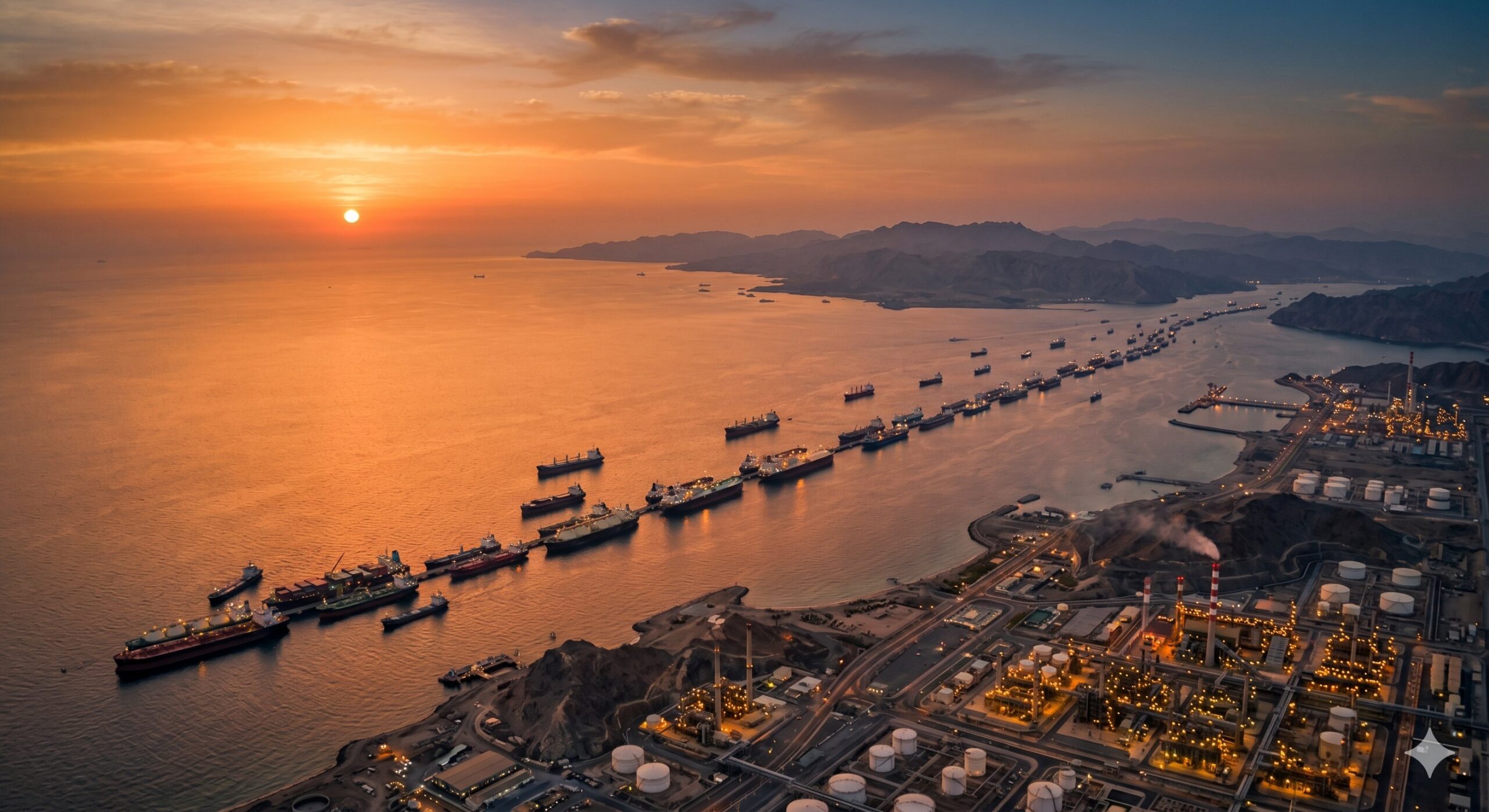
What is the Strait of Hormuz, precisely? A narrow waterway 190 kilometers in length, connecting the Gulf of Oman to the Persian Gulf. At its narrowest point, the width measures just 2 miles—3.2 kilometers. This sliver of ocean has become the linchpin of global energy security. On one side lies Iran; on the other, Oman. Through this passage, approximately 210,000 barrels of crude oil flow daily. That represents roughly 20 percent of all global crude oil trade. Imagine representing Earth’s oil supply as five fingers on a hand—one full finger moves through this single strait every single day.
The historical precedent is unmistakable. The Tanker War of the 1980s occurred in these exact waters during the Iran-Iraq conflict. Both nations attacked vessels transiting Hormuz. Crude futures exceeded $150 per barrel (in values of that era), and the global economy convulsed. Policymakers who remember that lesson now sense the possibility of history repeating itself. The parallels are unmistakable and deeply unsettling. Oil-dependent economies—Japan foremost among them—understand the costs with visceral clarity. That historical trauma shapes every calculation in current negotiations.
The US position deserves to be understood. The Trump administration remains unyielding on Iran’s nuclear development. Iran has accelerated uranium enrichment and heightened the risk of military application after withdrawing from JCPOA. For Washington, this is an intolerable threat. Applying military pressure to guarantee Hormuz’s “neutrality” is a strategically coherent American calculation. Yet simultaneously, this pressure inflames Iranian anger and complicates negotiation further. The US calculus rests on deterrence: nuclear capability in Iranian hands threatens regional stability, threatens American allies, threatens the global order.
Japan’s energy structure is particularly fragile. Japan currently depends on the Middle East for approximately 95 percent of its crude oil imports. The breakdown runs as follows: Saudi Arabia (36%), United Arab Emirates (26%), Iraq (14%), Iran (6%), and others (17%). All of it passes through Hormuz. That means every gasoline pump in Japan, every power plant’s fuel, every aircraft refueling at Narita or Kansai—99-plus percent depends on this single chokepoint. Liquefied natural gas (LNG), by contrast, flows primarily from Australia (39.7%), Malaysia (14.8%), and Indonesia, with only 6.3% via Hormuz. Yet if the entire LNG market tightens, Japan enters a bidding war for supplies, and costs spike regardless of geography.
Understanding Japan’s nuclear restart schedule is essential. Japan currently supplies roughly 18 GW of electricity from four operating plants: Kashiwazaki-Kariwa (Niigata), Takahama (Fukui), Ikata (Ehime), and Genkai (Saga). If Hormuz disruption lifts oil prices, thermal power plants face margin compression, creating pressure to substitute nuclear capacity. Government targets call for 15-20 additional GW by 2030. Yet regulatory approval requires 6-12 months. Wednesday’s deadline arrives in hours. No restart timeline can be compressed to meet it.
Observe current gasoline prices closely. On April 22, Japan’s national average stands at 179 yen per liter. Fuel surcharges compound that burden. ANA and JAL have announced that from May 1 onward, Los Angeles route surcharges will reach 112,000 yen per round-trip passenger. For business travelers and holiday planners using Haneda Airport, this additional cost is far from trivial.
The electricity cost cascade is even more severe. Japan’s thermal power generation expenses tie directly to crude prices. During 2024’s Hormuz closure, LNG spot prices surged more than 140 percent. During that period, Kansai Electric’s rates rose 2,000-3,000 yen monthly per household. If a similar spike recurs, Japan faces aggregate household burden exceeding 1 trillion yen monthly nationwide.
Logistics costs for imported goods will rise sharply. Japan imports 60 percent of its food and 70 percent of its apparel. International logistics run on tankers and container vessels. Ships unable to transit Hormuz reroute via Africa’s Cape of Good Hope, adding approximately 8,000 kilometers. Fuel consumption jumps. Transit time extends 2-3 weeks. During that interval, markets operate on fears of inventory shortage, and overall prices face upward pressure. Supply chain disruptions cascade through manufacturing sectors. Japanese companies with global supply networks face compounding delays and cost explosions.
Iran’s argument also carries weight and history. Iran is incensed that the US unilaterally abandoned the 2015 JCPOA agreement. Economic sanctions afterward devastated Iran’s economy. From Tehran’s perspective, the US is the treaty violator. Iran’s nuclear acceleration becomes defensive retaliation. Iran’s foreign reserves have shrunk; inflation exceeds 40 percent; unemployment has reached 20 percent. Iran attributes these conditions to US policy. Finding incentive to compromise in negotiations thus becomes impossible. When one side believes itself the wronged party, negotiations become transactional discussions of the injured party’s minimum demands.
OPEC member state behavior is unpredictable. Saudi Arabia and UAE are ostensibly US allies. Yet both conduct profitable trade with Iran. Saudi Arabia has adopted OPEC production cuts to maintain high crude prices. If US airstrikes resume, Iranian oil facilities could be damaged. Global supply would contract further, and Saudi sale prices would climb. Economically, escalation benefits Saudi Arabia. This web of conflicting incentives will dominate oil market behavior going forward.
But Japan faces a genuine dilemma. We stand caught between these two sides. We depend equally on US nuclear non-proliferation doctrine and Iran’s assertion of national sovereignty. We cannot endorse either party’s “justice.” Instead, we must confront reality as it truly is.
That reality looks like this. If the ceasefire extends, current price trends stabilize. Airlines hold fuel surcharges steady. Gasoline prices decline gradually. But this stability remains fragile. If negotiations stall, the same crisis repeats in three months or six. The underlying problem—Iran’s nuclear development—remains unresolved. Market participants understand this clearly.
Alternatively, airstrikes resume. The Strait becomes a de facto conflict zone. Insurance premiums for transit skyrocket. Tankers refuse passage or reroute. Oil supply tightens rapidly. Crude could exceed $200 per barrel. Shockwaves ripple globally. Japan’s gasoline climbs above 200 yen per liter. Electricity costs surge. Food and commodity logistics costs spike across the board. Supply chain disruptions cascade through manufacturing sectors. Japanese companies with global supply networks face compounding delays and cost explosions.
Market reactions signal the stakes. Crude futures now trade at $146.99 per barrel. If the ceasefire collapses, prices could exceed $160 within hours. Should crude remain above $150 for a month, global economic growth contracts measurably. GDP declines 1-2 percent; unemployment rises. Manufacturing-heavy Japan bears this inflationary pressure poorly. The Bank of Japan has already raised rates; further hikes prove difficult. Japan thus faces a scenario where inflation control becomes nearly impossible.
In any scenario, Japan remains passive. Our household budgets and economic trajectories are unilaterally shaped by US-Iran negotiations beyond our control. This asymmetry reflects decades of post-war energy policy locked into Middle Eastern dependence. Australian LNG expansion, renewable energy buildout, fusion technology development, geothermal strengthening—all advance at glacial pace.
Should we expect government intervention to help? METI is considering releasing strategic oil reserves. Japan maintains 122 days’ worth, which can ease near-term price pressure. But what is truly needed is not “reserves”—it is structural transformation. Reserves merely buy time. Japan has occupied the same risk architecture for over 40 years.
At the individual level, agency is almost nonexistent. Reduce short-distance travel. Lower gasoline consumption. Cut electricity use. Such “frugality” eases household strain. Yet it leaves Japan’s overall energy dependency unchanged. Power companies and oil corporations respond under government directives. Citizens can only exert influence indirectly—through voting and tax policy.
Japan’s diplomatic position is exceptionally delicate. Japan is a US treaty ally while maintaining 60-plus years of economic ties to the Middle East. Iran, Saudi Arabia, UAE, Qatar—energy trade with each nation underpins Japanese prosperity. Officially, government must express “US support.” Beneath the surface, Tokyo surely explores channels to maintain Iran relations. Can Japan function as a neutral mediator, dampening both sides’ tensions? That question tests the true capacity of Japanese diplomacy.
What should we actually observe? First: the outcome Wednesday night. Extension or deadlock? That determines Hormuz’s navigability next week. Second: if strikes resume, does Iran actually close Hormuz, or merely threaten it? The scope and duration of closure reshape market reactions dramatically. Third: OPEC members’ response. Saudi Arabia and UAE face conflicting loyalties. This complex position determines actual oil market tightness. Fourth: Japan’s behind-the-scenes diplomatic maneuvering. Is Tokyo speaking quietly to Tehran? Are backchannels being activated? The subtlety of Japan’s diplomatic messaging often reveals more than official statements.
The insurance markets are already pricing risk. Shipping insurance premiums for high-risk areas have climbed 300-400% in recent days. This tells us what market professionals truly believe about the probability of closure. These professionals stake capital on their assessments. Their behavior is more truthful than any official statement from government or corporation. Watch the insurance markets; they reveal reality.
The insurance markets are already pricing risk. Shipping insurance premiums for high-risk areas have climbed 300-400% in recent days. This tells us what market professionals truly believe about the probability of closure. These professionals stake capital on their assessments. Their behavior is more truthful than any official statement from government or corporation. Watch the insurance markets; they reveal reality before governments acknowledge it.
The 1980s Tanker War offers historical precedent. During the Iran-Iraq conflict, both nations systematically attacked merchant vessels transiting the Persian Gulf, targeting oil tankers and cargo ships. That eight-year struggle cost thousands of lives and destroyed hundreds of vessels. Tanker insurance premiums spiked 400-500 percent. Shipping companies rerouted around Africa, adding three weeks to transit times and consuming additional fuel. Oil prices climbed to $150 per barrel in today’s currency. The Tanker War’s lesson is clear: once weaponized, maritime routes become unpredictable killing zones. Recovery takes years, even after hostilities cease.
Japan’s Strategic Petroleum Reserve (SPR) carries 122 days of supply. In absolute terms, this provides a cushion. But that reserve was designed for temporary disruptions—not multi-month closures. If released at current burn rates, the 122-day supply would be exhausted in roughly 90 days if Hormuz closure persists beyond May. After those 90 days, Japan faces genuine scarcity. No alternative source of crude can be activated quickly enough. Saudi Arabia and UAE could increase production slightly, but they cannot double or triple output overnight. The structural reality: Japan has designed its energy strategy around “Hormuz remains open.” Closure exposes that strategy’s fragility.
Nuclear restart acceleration is now politically inevitable. The Kashiwazaki-Kariwa complex in Niigata could theoretically restart additional reactors within 12-18 months if regulatory approval accelerates. The potential capacity gain: 8-10 gigawatts. This would offset roughly 15-20 percent of Japan’s current thermal power dependency. Yet nuclear restarts face political resistance—local communities demand safety guarantees, which take time. The irony is cruel: the very energy security crisis that argues for accelerated nuclear deployment makes communities more fearful of nuclear risk. Political paralysis meets physical urgency.
Asian LNG markets experienced 140 percent price spikes during the 2024 Hormuz closure. That spike represented an increase in regional LNG costs of roughly $50-60 billion monthly across Japan, China, India, and South Korea combined. The impact cascaded through every downstream industry: petrochemicals, plastics, fertilizers, electricity generation. Fertilizer prices spiked, increasing food production costs. Plastic manufacturing became uneconomical for lower-margin products. The shock rippled through global supply chains for months. Reoccurrence would inflict similar harm. Japanese chemical manufacturers already operate on compressed margins from previous crises. Another margin-eroding shock could trigger bankruptcies in specialized chemical sectors.
Japan’s diplomatic bind is nearly insoluble. As a US treaty ally, Japan is expected to support American pressure on Iran over nuclear development. As an energy-dependent nation, Japan has profound interest in Middle Eastern stability and de-escalation. Japan simultaneously hosts American military bases (which target Iranian interests) while depending on Iranian goodwill to maintain energy supply relationships. This contradiction—allied to one party’s military adversary while dependent on that adversary’s energy exports—places Japan in an untenable position. Japan’s government can influence neither outcome. The most Tokyo can do is maintain quiet channels to Tehran while publicly supporting Washington. This diplomacy of contradiction characterizes modern Japan’s role as a wealthy, militarily aligned, energy-dependent nation.
Specific price impacts are already quantifiable. A one-yen change in crude prices translates to roughly 0.5 yen per liter of gasoline at the pump. At current crude levels ($147/barrel), a spike to $200/barrel would add roughly 80 yen per liter—pushing retail gasoline toward 260 yen. For Japanese families, that translates to an additional ¥4,000-6,000 monthly in gasoline spending. For electricity, a similar calculation applies: every $10 rise in crude translates roughly to 50-100 yen per kilowatt-hour in thermal generation costs. Aggregated across Japan’s thermal fleet, that’s a national monthly cost increase of roughly ¥200-300 billion. This money is extracted from the broader economy and transferred to oil exporters—money that could have purchased other goods or invested in productive capacity.
Long-term structural solutions for Japan remain underfunded. Hydrogen infrastructure, battery technology, synthetic fuels—these alternatives exist but remain embryonic. Government funding for alternative energy is substantial but still inadequate relative to the scale of Japan’s dependence. The gap between investment and actual commercialization stretches across years or decades. Japan cannot escape Hormuz vulnerability within relevant timescales.
What happens if the crisis extends beyond one ceasefire cycle? If extended negotiations fail repeatedly, markets will price in permanent Hormuz uncertainty. This permanent uncertainty becomes the new baseline. Oil prices remain elevated indefinitely. Japan’s economy adapts to a permanently higher energy cost structure. Manufacturing margins compress. Export competitiveness declines. The damage spreads slowly but relentlessly through the economy.
Beyond the ceasefire timeline lie deeper structural questions. How long can this particular negotiation framework sustain? Sooner or later, one party will declare the conversation exhausted. When that moment arrives, market participants must calculate the true probability of Hormuz closure. History suggests closure is unlikely—Iran understands that extended blockade invites overwhelming US military response, potentially destroying Iran’s oil infrastructure for years. Yet Iran also understands that the mere threat of closure yields negotiating leverage. This asymmetry—extreme cost of action versus value of threat—defines the negotiation dynamic.
The evolution of Japanese diplomatic messaging will offer clues. Official statements remain opaque. Yet subtle shifts in language reveal strategic positioning. If Japan begins emphasizing “constructive dialogue” or “mutual understanding,” that signals behind-the-scenes engagement with both parties. If language becomes more US-aligned and sharper against Iran, that signals Japan has chosen sides. Monitor official statements; they encode diplomatic reality.
What happens beyond the Strait is not distant “politics”—it is our daily “economics.” It arrives as a line item in household budgets and paychecks. The deadline is Wednesday evening. Only hours remain. What lies ahead will unfold before us, and we can only observe it carefully.
The 1980s Tanker War offers a grim historical parallel. Between 1984 and 1988, during the Iran-Iraq War, both sides attacked commercial shipping in the Persian Gulf in what became known as the Tanker War. More than 400 vessels were struck, insurance premiums for Gulf transits soared, and the United States eventually deployed its navy to escort reflagged Kuwaiti tankers through the strait. That intervention, Operation Earnest Will, was the largest naval convoy operation since the Second World War. The current situation carries echoes of that era, but with a crucial difference: the global economy is far more integrated now than it was four decades ago, and the downstream effects of any sustained disruption propagate faster, farther, and deeper than they did in the 1980s. Japan, which was already heavily dependent on Middle Eastern crude in the 1980s, has only grown more exposed since then, and the diversification efforts that followed the first oil shock of 1973 have proven insufficient against a full closure scenario.
Japan’s strategic petroleum reserve is a buffer, not a solution. The country maintains roughly 230 days of oil reserves when public and private stockpiles are combined, one of the largest reserves per capita among IEA member states. In theory, this provides a generous cushion against short-term supply disruptions. In practice, the calculus is more complicated. Drawing down reserves is a psychological signal to markets that the situation is serious enough to require emergency measures, which can paradoxically push prices higher by confirming the severity of the crisis. Moreover, reserves are finite and replenishing them after the crisis requires purchasing oil at whatever the post-crisis market price happens to be, which could be substantially higher than the pre-crisis level. The Japanese government has so far refrained from tapping its strategic reserves in response to the Hormuz closure, choosing instead to accelerate nuclear restarts and negotiate alternative supply agreements with producers outside the Gulf region. Whether that restraint can hold as the ceasefire deadline passes without extension remains one of the most consequential energy policy questions of the spring.
The nuclear restart pathway is accelerating under crisis pressure. Japan’s post-Fukushima caution toward nuclear power has collided with the reality of energy insecurity in a way that is reshaping the political landscape around atomic energy. The Kishida and subsequent administrations had already begun the slow process of restarting reactors that met upgraded safety standards, but the Hormuz crisis has compressed the timeline dramatically. Kashiwazaki-Kariwa, one of the world’s largest nuclear power stations with a capacity of over 8 gigawatts, is now on an expedited review track. If Japan successfully restarts 15 to 20 gigawatts of nuclear capacity over the next two to three years, the country’s LNG demand could fall by 10 to 15 million tonnes annually, equivalent to roughly 15 to 20 percent of its pre-crisis imports. That would fundamentally alter Japan’s energy security profile, reducing its exposure to maritime chokepoints and giving it negotiating leverage it currently lacks. The irony is painful: it took a foreign military crisis to accomplish what domestic energy policy had been unable to achieve for over a decade.
The ripple effects reach every household in Japan through channels that are both visible and invisible. The visible channel is gasoline prices, which have already risen significantly and will climb further if the strait remains closed. Japanese drivers are paying more at the pump, and the government’s fuel subsidy program, which had been gradually wound down, is now under pressure to be reinstated or expanded. The less visible channel runs through electricity bills, food prices, and the cost of virtually every manufactured good that depends on petrochemical inputs. Japan imports not just crude oil and LNG through the Middle East corridor but also naphtha, which feeds the petrochemical industry that produces plastics, synthetic fibers, and pharmaceutical precursors. A sustained Hormuz closure would therefore affect not just energy prices but the broader cost structure of the Japanese economy, compounding the inflationary pressures that the Bank of Japan has been carefully managing as it navigates its own historic exit from ultra-loose monetary policy.
この記事を書いた人
灰島
30代の日本人。国際情勢・地政学・経済を日常的に読み続けている。歴史の文脈から現代を読むアプローチで、世界のニュースを考察している。専門家ではないが、誠実に、感情も交えながら書く。

コメント