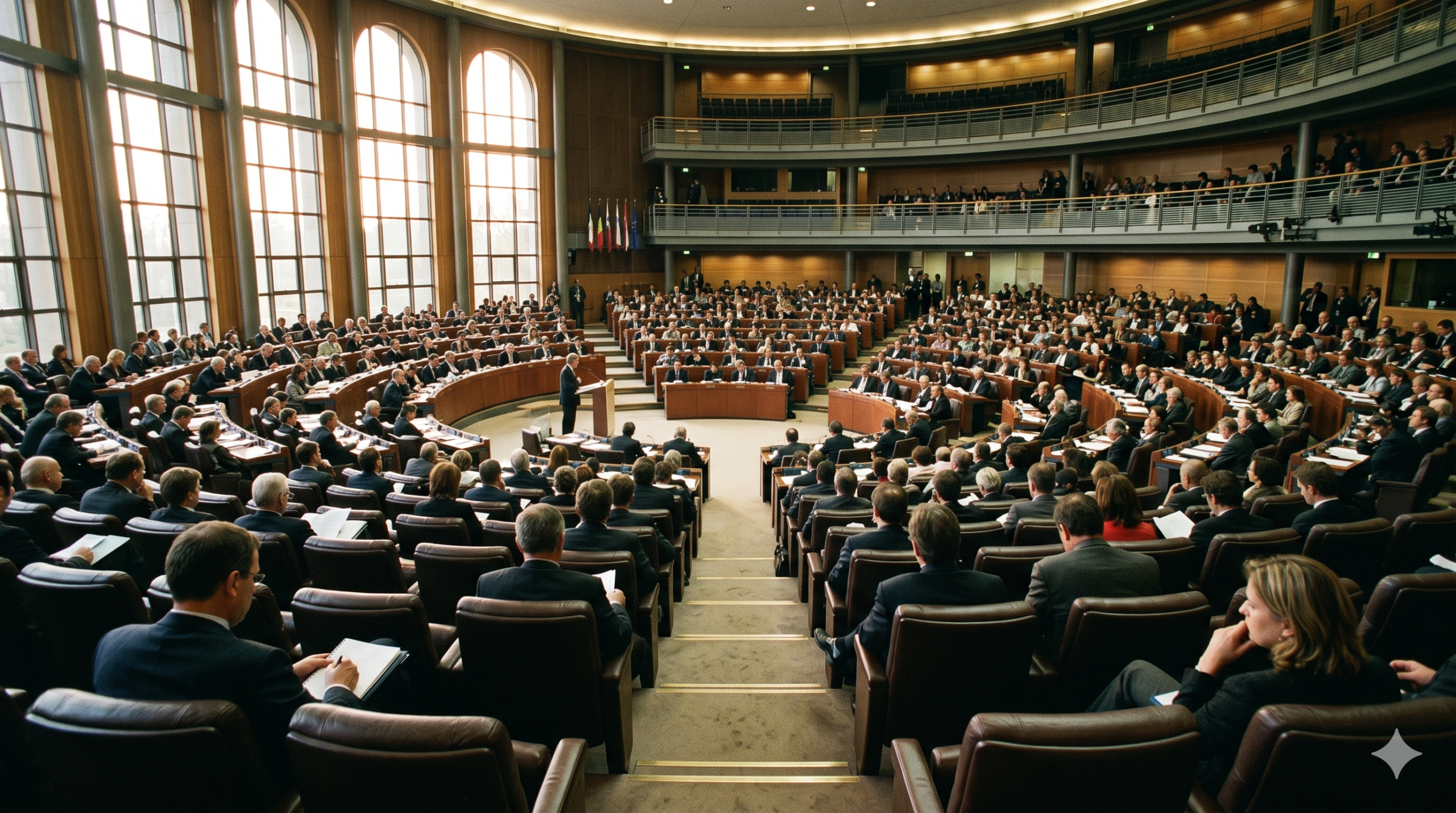
In July 2016, the British House of Commons voted 472 to 117 to renew the Trident nuclear submarine program. What made this vote remarkable was not the outcome itself but the fact that a majority of Labour Party MPs voted in favor, directly contradicting their own party leader Jeremy Corbyn’s call for nuclear disarmament. For Britain’s left, maintaining nuclear deterrence was not a matter of ideology but of responsibility. I have been following the anti-base movement in Okinawa for this series of articles, and when I revisited this British vote in that context, I felt a kind of vertigo. The word “left-wing” means profoundly different things depending on which country you are standing in.
When Keir Starmer became Prime Minister in July 2024, he left no room for ambiguity. “Our commitment to nuclear deterrence is absolute,” he declared. “Our commitment to NATO is unshakeable.” He pledged to raise defense spending to 2.5 percent of GDP, exceeding NATO’s 2 percent target, and committed to annual Ukraine aid of 3 billion pounds, approximately 6,100 billion yen. It was not the Conservative Party but Labour that made this pledge. For Britain’s left, national defense was not the right’s domain to concede. It was a responsibility that belonged to them.
The transformation in Germany was even more dramatic. On February 27, 2022, SPD Chancellor Olaf Scholz delivered his “Zeitenwende” speech to the Bundestag, announcing an immediate increase in defense spending to over 2 percent of GDP. By 2024, Germany achieved the 2 percent mark for the first time in 32 years. Polls showed 78 percent of Germans supporting the increase. The SPD had built its identity on Ostpolitik and dialogue with the East, yet when Russia invaded Ukraine, it shifted gears without hesitation. The underlying recognition was stark: a party that refuses to invest in deterrence cannot credibly govern a nation.
France’s left has treated nuclear deterrence as sacrosanct for decades. Under President Mitterrand from 1981, the Socialist government maintained and strengthened France’s nuclear force de frappe, comprising five nuclear submarines and 34 Mirage bombers. Nuclear modernization spending grew at nearly double the rate of overall defense increases. France kept its distance from NATO’s integrated command structure but never questioned its place within the Western alliance. Even the French Communist Party softened its NATO withdrawal stance during the Eurocommunism movement of the 1970s. In France, being left-wing and supporting nuclear deterrence were never contradictory propositions.
South Korea’s progressive camp makes the contrast with Japan even sharper. As the Sasakawa Peace Foundation’s analysis shows, South Korea’s progressive party, the Democratic Party of Korea, does not even call for the withdrawal of US forces from the peninsula. They support the US-Korea alliance and multilateral security frameworks. The concept of “self-reliant defense” championed since Roh Moo-hyun’s presidency refers not to independence from America but to strengthening Korea’s own defense capabilities within the alliance. Korean progressives share the North Korean threat assessment with the Western alliance and consider the American partnership indispensable. Right next door to Japan, there exists a left-wing movement that pursues progressive values while remaining firmly anchored in the Western security architecture.
Against this global backdrop, the Japanese Communist Party’s position stands out as singular. The JCP’s party platform explicitly states the goal of “abrogating the Japan-US Security Treaty through the procedures of Article 10.” The party advocates the gradual dissolution of the Self-Defense Forces, proposing a three-stage process. First, halting overseas military legislation and pursuing disarmament before abrogation. Then, democratizing and drastically shrinking the SDF after abrogation. Finally, implementing Article 9 of the Constitution in full through national consensus. As far as I have been able to determine, the JCP is the only major left-wing party in any developed nation whose platform calls for withdrawal from the Western alliance system. While Labour pledges absolute loyalty to NATO, the SPD leads Germany’s military buildup, the French Socialists guard the nuclear sanctuary, and Korean progressives uphold the US-Korea alliance, Japan’s Communist Party alone continues searching for an exit from the Western order.
Japan’s Social Democratic Party has likewise struggled to release its grip on unarmed neutrality. Having historically held that the SDF is unconstitutional, the SDP reversed course in 1994 when Prime Minister Murayama declared the SDF constitutional and committed to the Japan-US security alliance as part of a coalition government. But in 2004, party leader Mizuho Fukushima called for a return to unarmed neutrality, swinging the party back to its original stance. This oscillation between accepting reality in power and retreating to ideals in opposition devastated the party’s credibility as a coherent political force. Yet at its core, the belief that a nation can be protected without arms remains an extraordinarily isolated position among the developed world’s left-wing movements.
Why has Japan’s left remained in this unique position? One structural factor is the absence of Eurocommunism. In the 1970s, European left-wing parties definitively broke from Soviet-style communism and established for themselves the logic of opposing Eastern threats as members of Western democracy. Italy’s Berlinguer, Spain’s Carrillo, and France’s Marchais won domestic political legitimacy by distancing themselves from Moscow. The Japanese Communist Party did not participate in this transformation. It maintained the anti-imperialist line inherited from the Sino-Soviet split era, making departure from the Western order itself the core of its political identity.
The second factor is the poverty of governing experience. Labour governed under Blair and Starmer. The French Socialists held the nuclear codes under Mitterrand. The SPD produced chancellors in Schroeder and Scholz. Governing means confronting the realities of national defense. Even as a left-wing leader, you must accept the nuclear launch codes, decide whether to ship weapons to allies under attack. The accumulation of such experience built the confidence that the left, too, is a responsible actor in defense policy. Japan’s left, apart from the brief Murayama cabinet, has almost none of this experience. The result has been a permanent opposition stance that stops at “against” without presenting viable alternatives.
The comparative politics of parties may explain part of this story, but there is another layer. Japan’s left-wing exceptionalism has a dimension that party politics alone cannot account for. It is embedded in the very structure of Japan’s postwar discourse. Understanding this requires stepping back into history.
The occupation-era controls on public discourse are historically documented. GHQ/SCAP’s Civil Information and Education Section undertook from October 1945 to reshape Japanese public consciousness through newspapers, magazines, radio, and film. The concept of “WGIP,” or War Guilt Information Program, was first articulated by journalist Etsuro Eto in 1989, and there is genuine scholarly debate about whether certain key documents remained in draft form and how far the program’s influence actually reached. What is not debated is that the Press Code, SCAPIN-33, prohibited criticism of SCAP, suppressed reporting on atomic bomb damage, and subjected even private correspondence to censorship. These are facts preserved in historical records.
The critical question is what happened after the occupation ended. With the San Francisco Peace Treaty’s entry into force in 1952, the occupation ended and the Press Code expired. Japan regained its sovereign freedom of expression. Yet the historical narrative framework established during the occupation continued, voluntarily. The Ienaga textbook lawsuits, filed in 1965 and concluded in 1997, fought for 32 years over textbook screening standards, but the system’s basic architecture inherited the occupation-era design. Then from the 1980s onward, major media outlets began functioning as active agents in reinforcing this historical framework. The occupier’s pressure was gone, but the framework persisted through voluntary perpetuation by Japanese institutions. This voluntariness is precisely what makes the phenomenon impossible to dismiss as mere external imposition.
The Asahi Shimbun’s reporting on the Yoshida testimony is the emblematic case. In September 1982, the Asahi published Seiji Yoshida’s testimony claiming he had forcibly conscripted women on Jeju Island to serve as comfort women. In 1992, the Sankei Shimbun raised doubts. In 1997, the Asahi itself ran a feature acknowledging the questions around its veracity but did not retract. The formal retraction came in August 2014, a full 32 years after the initial publication. During those three decades, the Yoshida testimony circulated domestically and internationally as established fact, forming the backdrop for the 1993 Kono Statement and the 1996 UN Coomaraswamy Report. A single newspaper’s reporting cultivated the soil for a diplomatic crisis over 32 years.
The Yasukuni controversy reveals the same structural mechanism. Class-A war criminals were enshrined at Yasukuni in October 1978. The following year, reporting made this publicly known. Yet between 1979 and July 1985, successive prime ministers made 21 visits to Yasukuni, receiving zero official protests from China or South Korea. The diplomatic crisis materialized in 1985. The Asahi published a feature on the Yasukuni problem on August 7. China’s government issued its first official expression of concern on August 14. Prime Minister Nakasone conducted his first official visit on August 15. What shattered seven years of silence was not the discovery of new facts but the convergence of media framing and political declaration.
The origin of the Neighboring Countries Clause is perhaps the most striking example. In June 1982, a Nippon Television reporter filed a story claiming that the Ministry of Education had ordered textbooks to replace “aggression” with “advance” in describing Japan’s wartime actions. In reality, the Ministry had done the opposite, instructing publishers to change “advance into North China” to “aggression against North China.” The reporting was factually inverted. Nevertheless, China and South Korea protested based on this erroneous report. Chief Cabinet Secretary Miyazawa issued a statement, and textbook screening standards were amended to include a provision requiring “necessary consideration” for historical events in relations with neighboring Asian countries. This clause, institutionalized on the basis of a factual error, has functioned as a self-censorship mechanism in Japanese textbook screening for over 40 years. Once a system is established, the erroneous circumstances of its creation fade from collective memory, and the system becomes an unquestioned premise.
What I want to identify is the structural pattern common to all these cases. Diplomatic crises did not arise because facts were discovered. They arose when the timing of media coverage and political declarations converged. The enshrinement of Class-A war criminals went unprotested for seven years. The Yoshida testimony went unretracted for 32 years. The Neighboring Countries Clause was established on the basis of a false report. In each case, the decisive factor was not the weight of the facts themselves but how those facts were presented, by whom, and when others chose to react.
The occupation-era educational reforms carried both benefits and costs. The abolition of the Imperial Rescript on Education and the enactment of the Fundamental Law of Education represented a shift from state ideology to critical thinking, introduced coeducation, and moved from imperial historiography to a plurality of perspectives. These opened Japanese society. At the same time, critics point out that the abrupt elimination of moral values embedded in the Rescript, such as filial piety, friendship, and civility, created a vacuum in moral education. Whether the Diet’s unanimous vote to abolish the Rescript in 1948 was truly free of occupation pressure remains debated. Where one places the weight depends entirely on where one stands. I see no value in choosing only one side.
Let me return to the question I began with. Why does Japan’s left alone, among all left-wing movements in the developed world, maintain a commitment to withdrawal from the Western alliance? On one level, this is a story about party politics: the absence of Eurocommunism, the lack of governing experience, the continuation of an anti-imperialist line. On another level, it is a story about a historical narrative framework formed during the occupation and voluntarily perpetuated after independence through media and education, a framework in which “Japan is the perpetrator, and therefore should not bear arms” became an axiom of public discourse. These two layers reinforce each other. The left’s advocacy for disarmament drew moral legitimacy from the narrative labeled masochistic historiography. And that narrative was sustained by decades of reporting from left-leaning media.
I do not call this structure good or evil. I am looking at it as a structure. When Labour MPs voted to renew Trident, they judged that the left bears responsibility for defending the nation. When Scholz declared a Zeitenwende, he judged that the left must respond to changes in the security environment. Japan’s left has consistently reached a different judgment. I do not possess the authority to determine which judgment is correct. But the fact that Japan’s judgment is unique among developed nations deserves, at minimum, accurate recognition.
I wish neither to dismiss WGIP as conspiracy theory nor to overstate it as the cause of everything. Occupation-era controls on discourse are documented historical facts. But their direct coercive power ended in 1952. It is the subsequent seven decades, during which Japanese media, intellectuals, and educators voluntarily perpetuated and strengthened the framework, that more urgently demands explanation. Why did the frame persist after the external pressure disappeared? I do not have a simple answer to that question.
What I see from my vantage point, having followed the Henoko protests, is the far end of these layered structures. At Henoko, there are people driven by environmental conviction, people asserting Okinawa’s right to self-determination, and people opposed to the Japan-US security framework itself. Their motivations differ. But when they converge under the banner of opposition to US military bases, their movement proceeds with the question of national defense responsibility held permanently in parentheses. These parentheses are unique to Japan’s left. They do not exist in Labour, in the SPD, or in Korea’s Democratic Party.
Where, then, did these parentheses come from? The JCP’s decision not to join Eurocommunism. A historical narrative framework formed during the occupation and voluntarily sustained after independence. Textbook screening standards institutionalized on the basis of an erroneous report and maintained for over four decades. A newspaper article that remained unretracted for 32 years, cultivating diplomatic soil underneath. A seven-year silence broken not by the emergence of facts but by the timing of media coverage and political declarations. Each of these is an individually verifiable historical fact. Their accumulation produced the present, a present in which, among the world’s left-wing movements, Japan alone stands in a fundamentally different place.
I cannot bring myself to declare this present wrong. Japan’s left has its own logic drawn from history. The memory of war, the reality of perpetration, the catastrophe of nuclear weapons, the imperative of reconciliation with Asian neighbors. These experiences are real, and no one has the right to deny that the ideal of disarmament was born from them. But simultaneously, we must acknowledge that this ideal is not shared by the left in any other developed nation. The same word “left-wing” describes politicians who embrace nuclear weapons in Britain, expand the military in Germany, guard the nuclear sanctuary in France, and uphold the US alliance in Korea. They accepted the responsibility of defense not because they drifted rightward. They did so because they concluded that protecting their citizens with their own hands is a left-wing mission within the reality of the security environment.
The peculiarity of where Japan’s left stands casts a shadow not only over Henoko but over the nation’s entire security policy landscape. A perpetual opposition that offers “against” without alternatives, a legislature where substantive defense policy debate occurs only within the ruling party: this structural deficit degrades the quality of democratic discourse on national security. While left-wing parties elsewhere demonstrate governing capability by presenting credible defense policies that offer voters real choices, Japan’s opposition has failed for decades to transcend simple opposition. I feel I must continue digging at the roots of this failure for some time yet.
The education reforms of the occupation era carried consequences that reach forward into the present. The abolition of the Imperial Rescript on Education and the promulgation of the Fundamental Law of Education marked a genuine opening of Japanese society. The shift from state-mandated moral instruction to education fostering critical thinking, the introduction of coeducation, and the move from the singular lens of imperial historiography to a plurality of historical perspectives were substantial achievements. Yet scholars have noted that the abrupt elimination of the moral values embedded in the Rescript, values like filial piety, friendship, and civility, left a vacuum in moral education that took decades to fill. Whether the Diet’s unanimous vote to abolish the Rescript in 1948 was entirely free of occupation pressure remains a live scholarly question. Where one places the weight between liberation and loss depends entirely on where one stands. I find no value in choosing only one side.
There is a deeper pattern here that connects the political and the historical-narrative dimensions of Japan’s left-wing exceptionalism. The left’s advocacy for disarmament drew moral legitimacy from the historical narrative that scholars and critics have termed masochistic historiography. That narrative, in turn, was sustained in public discourse by decades of reporting from media organizations whose editorial positions aligned with the left’s political program. The political stance and the historical narrative reinforced each other in a cycle that has continued for over seven decades. This is not conspiracy. It is structure. And structures, once established, are remarkably resistant to change even when the original conditions that created them have long since disappeared.
Consider what this means in concrete political terms for Japan’s democracy. In Britain, voters can choose between a Conservative government and a Labour government, and both will maintain nuclear deterrence and NATO membership. The argument is about how much to spend, where to deploy, which alliances to prioritize, not whether to have a defense policy at all. In Germany, voters choosing between the CDU and the SPD are choosing between different defense policy emphases, not between defense and no defense. In Japan, voters choosing between the LDP and the opposition encounter a fundamentally different landscape. The opposition’s largest ideological components, the JCP and the SDP, offer not alternative defense policies but the rejection of defense policy as traditionally understood. This means that the democratic debate over how Japan should defend itself takes place almost entirely within the ruling party and its coalition partners. The opposition does not provide the kind of credible alternative that forces the government to sharpen and improve its own defense thinking.
The consequences of this structural deficit are not theoretical. When a nation’s security policy is debated only within one political camp, the quality of that debate suffers. Assumptions go unchallenged. Alternatives are not stress-tested. The public is deprived of the education that comes from watching serious people disagree seriously about serious matters. In Britain, the Labour opposition’s defense policy team shadows the government’s every move, producing detailed alternative proposals that force the government to justify its choices. In Japan, the opposition’s contribution to defense debate too often consists of categorical opposition that the government can dismiss as unserious. The result is a defense policy that has fewer checks and less democratic accountability than it would if Japan’s left participated in defense discourse the way every other developed nation’s left does.
I want to be precise about what I am not saying. I am not saying that Japan’s left is wrong to value peace or to remember war. Those values are honorable and necessary. I am not saying that the occupation-era narrative was entirely fabricated or that every concern raised about Japan’s wartime conduct is illegitimate. The historical record contains genuine atrocities that deserve remembrance and reckoning. What I am saying is that the specific configuration of Japan’s left, the combination of alliance rejection, military dissolution, and unarmed neutrality as core platform commitments, is unique among developed nations and that this uniqueness has identifiable structural causes rooted in postwar history. Understanding those causes does not require endorsing either the left’s position or its critics’ position. It requires seeing the structure clearly.
この記事を書いた人
灰島
30代の日本人。国際情勢・地政学・経済を日常的に読み続けている。歴史の文脈から現代を読むアプローチで、世界のニュースを考察している。専門家ではないが、誠実に、感情も交えながら書く。


コメント