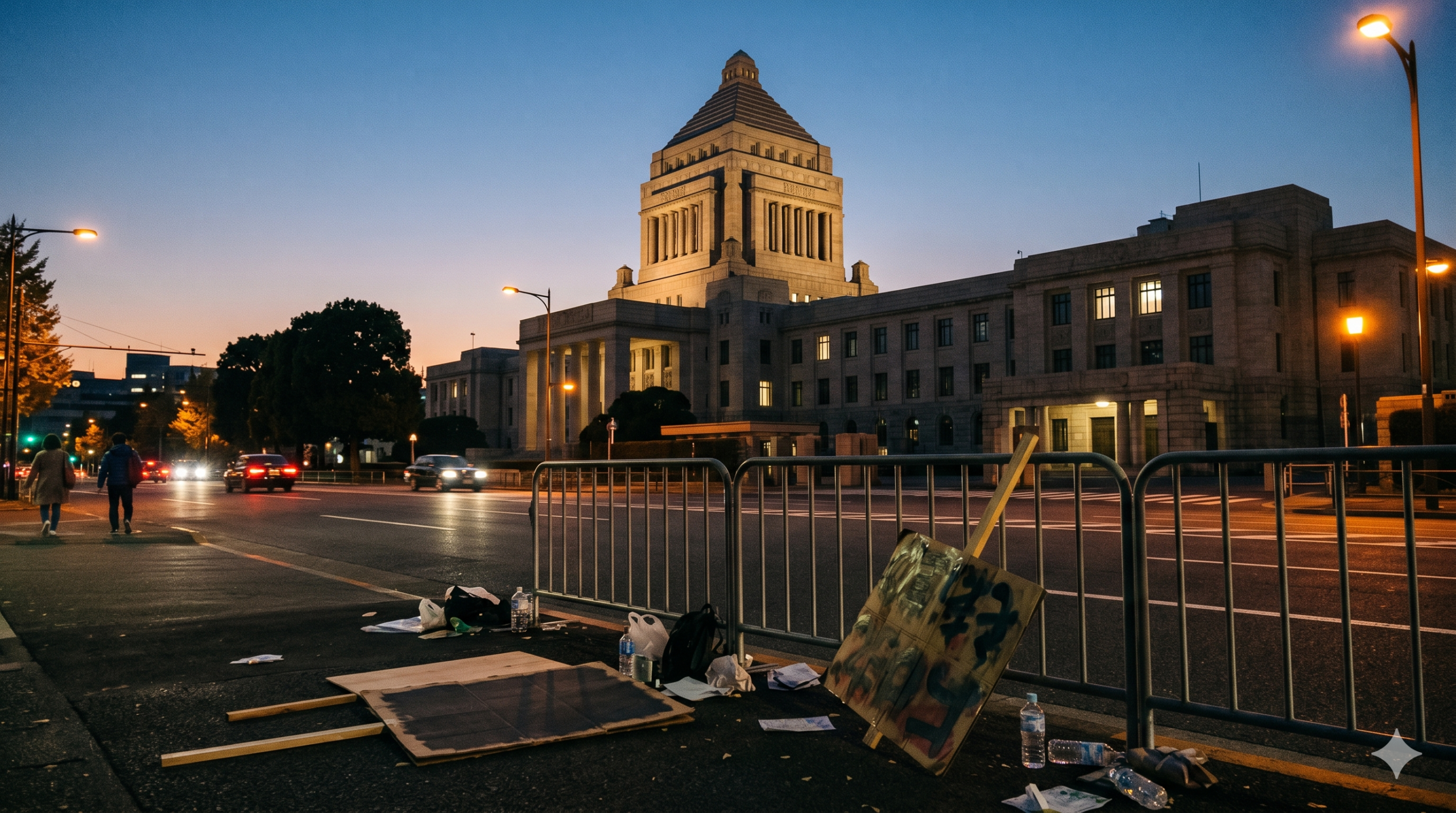
Over the past decade, the phrase “Japan is becoming a country that wages war” has been repeated with extraordinary regularity. The 2015 security legislation, the 2013 State Secrecy Act, the 2017 conspiracy law, the doubling of defense spending to two percent of GDP, and the acquisition of counterstrike capabilities — each time one of these policies reached the floor of the Diet, the same language filled the streets. “War legislation.” “Conscription is coming.” “The death of press freedom.” “A surveillance state.” “The return of militarism.” I am not writing this article to mock these predictions. I am writing it because when predictions fail and the same words recur without correction, the structure behind that recurrence deserves examination.
The security legislation — formally the Legislation for Peace and Security — was enacted on September 19, 2015. The Japanese Communist Party launched a massive opposition campaign under the label “war legislation” and organized a petition drive targeting 20 million signatures. Protesters filled the streets around the National Diet, with organizers claiming approximately 120,000 participants. The slogans were unequivocal: Japan would be able to fight wars alongside the American military anywhere in the world. The Japan Peace Studies Association raised the possibility of conscription. The Tokyo Bar Association issued a statement declaring the legislation unconstitutional. “The blood of Self-Defense Forces personnel will be spilled” and “young people will be sent to battlefields” became daily refrains.
Ten years have passed since that enactment, and it is time to check the predictions against reality. Conscription has not been introduced. The government has formally stated that conscription would violate Articles 13 and 18 of the Constitution and that no reinterpretation is possible. The most prominent overseas deployment of the Self-Defense Forces was the South Sudan PKO mission from 2012 to 2017, during which combat casualties were zero. New missions — “rush-to-rescue” and “joint defense” authorities — were granted in November 2016, but neither was applied in an actual combat situation. The activities consisted primarily of facility construction, road repair, and maintenance of United Nations compound grounds.
But accepting the “zero” at face value alone would be intellectually dishonest. Clashes did occur in South Sudan, and a former PKO member wrote in a published account that conditions on the ground constituted what he considered effective combat. The Ministry of Defense’s “activity log problem” — in which field reports were alleged to have been handled in politically convenient ways — left fundamental questions about transparency unresolved. The fact of zero combat casualties is confirmed, but whether the process that produced that fact was entirely free of distortion remains a separate and open question. What I want to say here is that simplifying the record into “the left was completely wrong” is itself a form of rhetoric.
The Act on the Protection of Specially Designated Secrets was enacted in 2013 and came into force in 2014. More than 3,000 researchers issued statements of opposition, warning that the law was “reminiscent of the prewar government” and constituted “the path to a secret state and a military state.” The Tokyo Shimbun drew comparisons to the Peace Preservation Law, and the fear that “press freedom will be destroyed” and “an Orwellian surveillance state will emerge” became widely shared.
Eleven years after implementation, the application of the law to news organizations has been effectively zero. Reports from the Cabinet Office’s Independent Inspector General of Public Records Management show no significant change in the volume of reporting before and after the law’s enactment. No security clearance evaluations have been applied to journalists. The law itself stipulates “sufficient consideration for the freedom of reporting and newsgathering” and protects “newsgathering for public interest purposes as legitimate professional activity.” The structural comparison to the Peace Preservation Law does not hold: that law criminalized political thought and political activity themselves, while the secrecy act penalizes only the leaking of specifically designated secret information in the areas of defense, diplomacy, public safety, and nuclear security. The legal architectures are fundamentally different. “The return of the Peace Preservation Law” has not materialized as a legal reality.
The conspiracy law — formally the Act on Punishment of Preparatory Acts for Terrorism and Other Organized Crimes — came into force in July 2017. The Japan Federation of Bar Associations warned that 277 target offenses had no connection to terrorism and that citizens could be arrested merely for discussing a protest at a tax office. Communist Party legislator Sohei Nihi argued that “at the discretion of police, uninvolved citizens would be deeply harmed.” The fear of ordinary citizens being arrested and of internal freedom of thought being violated spread widely.
Here I must write honestly: verification of the conspiracy law is currently impossible. The Ministry of Justice maintains an information page on the law, but no regular statistical reporting on the number of prosecutions or convictions exists in publicly available form. Reports of ordinary citizens being arrested under the law cannot be confirmed in open sources. But neither can the claim that “the number is truly zero” be confirmed, nor can the possibility of suppressed data be ruled out. The law served as the requirement for Japan’s ratification of the Palermo Convention — the UN Convention against Transnational Organized Crime — and Japan acceded to that convention in August 2017. But the operational reality after that accession remains opaque. The non-disclosure of statistics itself may be the law’s most significant problem. I can only write “I do not know.” And I believe writing “I do not know” honestly is the integrity this article requires.
The target of raising defense spending to two percent of GDP drew accusations of “a return to militarism” and “the same pattern as prewar wars of aggression.” Testing this claim requires international comparison. According to the Nikkei, as of 2025, 31 NATO member states had achieved the two-percent-of-GDP threshold, with the NATO average reaching approximately 2.5 percent. Poland stands at 4.48 percent, Lithuania at 4.0 percent, Estonia at 3.38 percent, and the United States at 3.22 percent. Japan’s 2027 target of 2.0 percent falls below the NATO average and is roughly half of what Eastern European nations spend. The Hague Defense Investment Plan adopted by NATO in June 2025 sets a target of five percent of GDP by 2035. Within this landscape of numbers, I want to think carefully about what it means to call Japan’s two percent “militarism.”
The acquisition of counterstrike capability — formerly called “enemy base attack capability” — follows the same structural pattern. The Japan Federation of Bar Associations argued in a December 2022 opinion paper that striking enemy bases “violates the exclusively defense-oriented posture rooted in Article 9 of the Constitution”, and the Communist Party called it “the complete abandonment of exclusively defense-oriented policy.” But international comparison shifts the frame. The United States deploys Tomahawk cruise missiles with ranges exceeding 1,600 kilometers. The United Kingdom has used its Storm Shadow missiles in operational combat in support of Ukraine. France deploys SCALP-EG, South Korea maintains ground-attack missiles with ranges exceeding 500 kilometers, and Australia is acquiring JASSM and LRASM systems with ranges over 930 kilometers. Japan plans to deploy 400 Tomahawk missiles between 2026 and 2027. Among NATO member states, the possession of long-range precision strike weapons is standard equipment. Japan’s acquisition is not a novel threat but a belated convergence with the international norm.
Having laid out these facts, what I truly want to examine is a different question. Why do the same rhetorical formulas recur even after the predictions they embody have failed? Ten years after the security legislation, eleven years after the State Secrecy Act, neither “Japan became a country that wages war” nor “press freedom died” has been confirmed as fact. Yet each new policy change resurrects the same language. This phenomenon requires analysis, not derision.
One hypothesis is that the rhetoric exists not for policy critique but for mobilization. Phrases like “oppose war” and “protect peace” function as emotional symbols independent of the specific content of the policies they are directed against. As instruments for assembling demonstrators, accumulating petition signatures, and drawing media attention, these words have been remarkably effective. The 120,000 people who gathered outside the Diet in 2015 are evidence of that mobilizing power. The problem is that language optimized for mobilization is structurally unsuited for policy verification. The label “war legislation” draws crowds, but it exists independently of the work of tracking how the law’s provisions have actually been applied.
A second structural pattern is the deliberate maintenance of conflation: “abandonment” confused with “expansion,” “militarism” confused with “alignment with international standards.” The complete abandonment of an exclusively defense-oriented posture and a gradual expansion within that posture’s framework are entirely different phenomena, but the rhetoric of the opposition movement does not distinguish between them. The fact that defense spending falls below the NATO average coexists with the characterization of that spending as “the return of militarism,” and the contradiction, even when pointed out, goes uncorrected. The reason it goes uncorrected is presumably that correction would reduce the rhetorical intensity needed for mobilization. Accuracy and mobilizing power are often in a trade-off relationship, and movements tend to choose mobilizing power.
The echo chamber problem cannot be ignored. An analysis by the Nikkei confirmed that left-leaning account networks show a pronounced tendency toward mutual following within their own communities. As Toyo Keizai Online reported, social media creates structural conditions in which users are prone to the illusion that their own opinions represent the majority view. Nikkei xTECH found that journalists’ own timelines were heavily skewed. The label “war legislation” was mutually reinforced within left-leaning communities and became entrenched without exposure to external verification. The fact that failed predictions do not register as corrective information is because the communities that share those predictions are insulated from the outside.
The aspect of this article I wanted to handle most carefully is the opacity of the conspiracy law. For the security legislation and the State Secrecy Act, there are grounds for saying “the predictions were wrong.” For defense spending and counterstrike capabilities, international comparison provides an objective yardstick. But the conspiracy law is different. As long as statistics are not published, it is impossible to determine from the outside whether “there are no problems, so the law has not been applied” or “there are problems, so the data is being concealed.” This opacity makes it impossible either to fully dismiss the left’s concerns or to validate them. I can only write that I do not know. And I believe that writing “I do not know” honestly is this article’s integrity.
The mechanism by which political dissent is silenced through the label of “war endorsement” poses a serious problem for democracy. People who support increasing defense spending are not “war enthusiasts.” People who favor the acquisition of counterstrike capability are not “militarists.” Yet in certain political spaces, the mere act of supporting these policies has been treated as morally suspect. As NIRA’s research observes, policy-making in the social media era exhibits a tendency toward “affective polarization.” In conditions of affective polarization, it is not the quality of a policy that comes under attack but the moral character of the people who support it. This is not debate. It is exclusion dressed as debate.
I should add, however, that the same structural problem exists on the right. Mocking the left’s failed predictions and concluding “this is why you cannot trust the left” is the mirror image of the same structure. Analyzing why predictions failed, examining what was correct and what was wrong item by item — this work is uncomfortable for both the left and the right, because verification does not permit the narrative that “our side was entirely correct.” The activity-log controversy around the security legislation left questions about governmental transparency. The non-publication of conspiracy law statistics represents a failure of administrative accountability. I cannot say “the left was entirely wrong,” nor can I say “the right was entirely right.” Continuing to stand at that point of irreducibility is, I believe, the most honest posture available to me.
The revision of Japan’s arms export principles drew accusations of “becoming a merchant of death.” But the reality of the revision centers on defense cooperation. Japan’s co-development of the next-generation fighter aircraft with the United Kingdom and Italy under GCAP, the transfer of patrol systems to the Philippines, and the export of F-35 components all take place within frameworks of security cooperation with allied and partner nations. The image evoked by “merchant of death” is of a state indiscriminately selling weapons to parties in conflict, but Japan’s defense equipment transfers are strictly limited by recipient and conditioned on not contributing to international conflict. I want to measure the distance between the image that rhetoric paints and the reality of institutional design with precision.
The United Kingdom’s case provides a useful reference point for this discussion. The UK Labour Party has traditionally occupied a social democratic position, emphasizing nuclear disarmament and peaceful diplomacy. Yet the United Kingdom under Labour governance has set defense spending at 2.5 percent of GDP. It has supplied Storm Shadow cruise missiles to Ukraine, where they have been used in combat operations. Is there a mainstream view among Labour supporters that their country has become militarist? There is not. The British example demonstrates that the scale of defense spending and militarism are not automatically connected concepts. When Japan’s political left claims that “two percent of GDP equals militarism,” applying that same logic to the United Kingdom would make the Labour government a militarist regime. Few would accept that conclusion.
Another function of these predictions is that they contain built-in explanations for their own failure. When war does not occur under legislation you labeled “war legislation,” the reservation “it simply hasn’t happened yet” or “when conditions align, it will inevitably happen” activates automatically. The predictions are designed with an unfalsifiable structure. “It hasn’t happened yet” is logically correct. The probability of war tomorrow is not zero. But if that logic is followed consistently, every prediction is forever “not yet disproven,” and the act of verification itself becomes meaningless. I feel a quiet frustration at the way this immortal rhetoric corrodes political discourse. It transforms what should be a testable hypothesis — “this law will lead to war” — into an article of faith that no amount of contrary evidence can dislodge.
There is a further dynamic worth noting: the point at which opposition itself becomes the objective. As Toyo Keizai Online has observed, the influence of social media on politics has reached a scale that cannot be ignored. The size of a demonstration, the number of petition signatures, the reach of a hashtag — these are measured as “results” of the movement in their own right. But “having raised a voice of opposition” and “having changed policy” are separate matters. 120,000 people gathered against the security legislation, but the bill passed. 3,000 researchers opposed the State Secrecy Act, but the law was implemented. The fact that opposition movements have not altered policy outcomes poses a question to the strategy of the movements themselves. Mobilizing power without persuasive power does not translate into electoral numbers within a democracy.
The generational dimension adds complexity to this analysis. A Kobe Shimbun survey of university students found that younger Japanese approach politically charged social media content with more skepticism than their elders often assume. Students expressed awareness that “their thinking might become biased” through exposure to algorithmically curated political content. This self-awareness among younger voters suggests that the emotional mobilization techniques that worked in 2015 may have diminishing returns. A generation that has grown up understanding social media’s mechanics may be less susceptible to unfalsifiable sloganeering than the generation that preceded it. If so, the absence of rhetorical self-correction on the left is not merely an intellectual problem but an electoral one — a failure to speak to voters who have already learned to question the framing they encounter online.
The 2026 anti-constitutional-revision rallies illustrate both the continued vitality and the continued limitations of this rhetorical approach. According to the Tokyo Shimbun, demonstrations took place at over 160 locations nationwide, with approximately 30,000 participants gathering near the National Diet. These numbers demonstrate that the infrastructure of the peace movement remains intact and that its capacity to mobilize bodies in physical space is considerable. What the numbers do not demonstrate is that the movement’s arguments are reaching beyond its existing base. The echo chamber research suggests they are not. The mobilization is impressive as an organizational achievement, but its political impact is bounded by the very rhetorical strategies that make mobilization possible — strategies that prioritize emotional resonance within the group over evidential persuasion directed at those outside it.
What I have been thinking about throughout this Henoko series is the structure of the Okinawa base problem. And as part of that structure, how the rhetoric of the opposition movement has functioned is a theme that cannot be avoided. The prediction that “Japan is becoming a country that wages war” has deeply permeated the anti-base movement at Henoko. The logic of opposing base construction and the logic of opposing the security legislation were unified through the medium of the word “war.” But when “becoming a country that wages war” has not materialized as fact, what happens to the persuasive power of the opposition movement that depended on that language? This is a question that the movement itself must confront.
The failure of a prediction is not, in itself, something to be ashamed of. Feeling alarm at changes in the security environment, being vigilant against the abuse of power — these are healthy functions of democracy. The problem is the failure to revise predictions after they have proven wrong. When a law you called “war legislation” has not caused a war in ten years, the next step is to analyze why your forecast was incorrect, not to shout the same words again. This deficit of self-correction may be the single most important reason that Japan’s political left continues to lose the trust of voters.
If that is so, then what I should look at next is what consequences this failure to self-correct is producing on the ground at Henoko. I will continue to pursue that question through this series.
この記事を書いた人
灰島
30代の日本人。国際情勢・地政学・経済を日常的に読み続けている。歴史の文脈から現代を読むアプローチで、世界のニュースを考察している。専門家ではないが、誠実に、感情も交えながら書く。


コメント