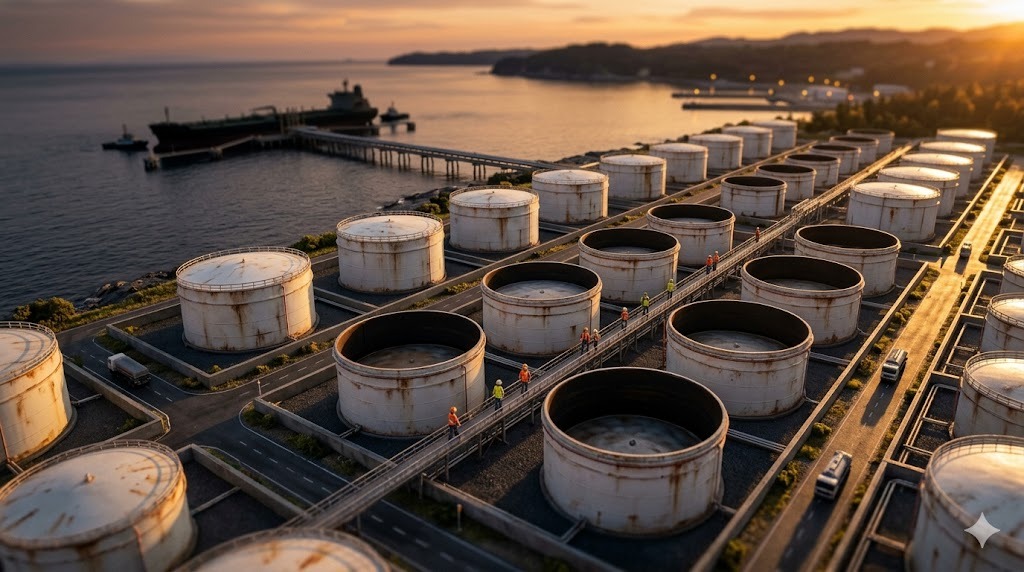
Japan’s oil reserves are being drawn down, barrel by barrel. On March 16, 2026, the Japanese government began releasing approximately 80 million barrels of crude oil from combined national and private strategic reserves, equivalent to 45 days of domestic consumption. Prime Minister Sanae Takaichi announced the decision on March 11, making it the largest single reserve release in Japan’s history, dwarfing the 25 days’ worth released after the 2011 Great East Japan Earthquake and nuclear disaster. The breakdown was 15 days from private-sector reserves, drawn from the inventories held by Japanese oil companies and refiners under government mandate, and one full month from national government stockpiles stored in underground caverns and above-ground tank farms at strategic locations across the Japanese archipelago. Within a week, Tokyo commodity exchange gasoline futures dropped 3 percent, suggesting the market had registered the signal. Japanese refiners began drawing on the released crude immediately, with the first shipments reaching domestic processors within days. The physical availability of oil on Japanese soil provided a tangible buffer against the supply panic that was gripping markets worldwide. But how long the calming effect would last was anyone’s guess. Analysts at Nomura Securities warned that the release was necessary but insufficient, describing it as a tourniquet on a wound that requires surgery. (The Japan Times: Japan begins its largest-ever oil release)
Japan’s move was the opening act of the largest coordinated reserve release in the history of the International Energy Agency. On March 11, all 32 IEA member nations agreed to release a total of 400 million barrels, more than double the 182.7 million barrels released following Russia’s full-scale invasion of Ukraine in 2022. It was only the sixth coordinated release since the IEA was founded in 1974 in the wake of the first oil crisis, and it was by far the largest. Japan’s 80 million barrel contribution represented 20 percent of the total, second only to the United States in volume. Japan was not merely a participant in this coordinated effort. It was the catalyst and driving force behind its unprecedented scale. Prime Minister Takaichi’s announcement of Japan’s unilateral release came before the IEA coordination was finalized, and her initiative was widely credited with accelerating the collective decision. In the G7 leaders’ call that followed, Takaichi pressed strongly for coordinated energy supply stabilization, projecting an image of Japan as an active energy security actor rather than a passive consumer. Germany had initially shown caution about the scale of the proposed release, but Japan’s willingness to move first and move big created a bandwagon effect that brought European nations along. (IEA: Largest ever oil stock release)
The scale of the release was dictated by the scale of the disruption. On February 28, 2026, the United States and Israel launched a major air campaign against Iran, killing Supreme Leader Ali Khamenei. Iran’s Islamic Revolutionary Guard Corps retaliated by declaring the Strait of Hormuz closed and attacking commercial shipping. Roughly 20 percent of the world’s oil supply and a large share of global LNG flows transit this narrow waterway. Its effective closure sent energy markets into the most severe panic since the first oil shock of 1973. Brent crude surged toward 120 dollars per barrel. The IEA’s March report documented a supply loss of 10.1 million barrels per day, the largest single disruption in petroleum market history. For Japan, which imports approximately 90 percent of its crude oil through Middle Eastern routes, this was the materialization of the worst-case scenario that defense white papers and energy strategy documents had discussed for decades but never expected to see in reality. What had been a planning exercise for the Maritime Self-Defense Force, including Hormuz minesweeping contingencies practiced in joint drills with allied navies, was now an operational crisis unfolding in real time. The speed with which the scenario moved from theoretical to actual caught even well-prepared Japanese policymakers off guard. Within 48 hours of the IRGC’s declaration, shipping insurance rates for Persian Gulf routes became prohibitive, and the first tankers began the long, costly reroute around the Cape of Good Hope at Africa’s southern tip, adding three weeks and enormous cost to every shipment. For Japan, whose refineries operate with relatively thin inventory buffers compared to their American and European counterparts, even a few weeks of disrupted supply can force production cutbacks and spot-market purchases at crisis-inflated prices. (Euronews: IEA approves largest-ever oil reserve release)
Four hundred million barrels sounds enormous until you measure it against daily global consumption. The world uses approximately 100 million barrels of oil every day. To put that in perspective, the entire 400-million-barrel coordinated release, the largest in the IEA’s 52-year history, would be consumed by normal global demand in less than a work week. The entire coordinated release represents roughly four days of global demand. The purpose of strategic releases, of course, is not to physically replace the lost supply for any sustained period. It is to send a signal to markets, calm speculative buying, and demonstrate that governments are prepared to act in coordination. The signaling effect is real but inherently diminishing. The first release carries the greatest psychological impact. Each subsequent one produces less reassurance, because markets understand that the remaining stockpile is shrinking with every intervention. After the March release announcement, Brent crude retreated from 119 dollars to approximately 95 dollars. The mechanism worked. But Al Jazeera’s analysis captured the fundamental limitation precisely: strategic oil releases can calm markets, but they cannot reopen the Strait of Hormuz. (Al Jazeera: Strategic oil release may calm markets but cannot fix Hormuz)
On April 10, Japan confirmed a second release. Prime Minister Takaichi announced that an additional 20 days’ worth of reserves would be made available beginning in early May. As of April 7, Japan held 228 days of oil reserves, including 143 days in the public stockpile. After the initial 45-day release, the buffer remained substantial. A further 20-day drawdown would bring the total to approximately 208 days. The IEA’s minimum requirement for member nations is 90 days, so Japan would still be well above the floor. But the trajectory is what matters. If the blockade persists and releases continue at this pace, Japan’s reserve cushion will erode rapidly through the second half of the year. Reserves are, by definition, a finite resource, and replenishing them requires the very sea lanes that are currently closed. If the monthly drawdown pace continues, Japan’s reserves could approach the IEA minimum by year’s end, leaving virtually no buffer for any additional supply shock from other regions. (The Japan Times: Takaichi confirms release of more oil reserves)
Japan’s energy import structure is the most vulnerable among major advanced economies. Roughly 90 percent of Japan’s crude oil comes from the Middle East, and a significant share of its liquefied natural gas arrives from Persian Gulf producers. The concentration of the nation’s energy lifeline on a single maritime chokepoint has been identified as a structural risk for decades. After the 2011 Fukushima nuclear disaster, the share of nuclear power in Japan’s electricity mix collapsed, increasing dependence on fossil fuel imports rather than reducing it. Renewable energy has grown but accounted for only about 24 percent of electricity supply as of 2025. The remaining majority depends on oil, natural gas, and coal transported by tanker and LNG carrier across oceans. Thermal power generation accounts for roughly 70 percent of the total electricity supply, with most of its fuel imported. Japan’s energy self-sufficiency rate hovers around 13 percent, a statistic that reads like a footnote in peacetime but becomes a national security threat in wartime. Japan has staked its survival on the ability to import energy. The premise of that ability is freedom of navigation, a pillar of the international order that is now being tested in the most direct way since the tanker wars of the 1980s. The difference is that in the 1980s, the strait was contested but never fully closed. Today, commercial transit has effectively ceased, and the alternative routes add weeks and billions in costs that cascade through every energy-dependent supply chain in the Japanese economy. (ISVD: Japan’s Structural Vulnerability in Energy Security)
Japan’s Ministry of Foreign Affairs has raised travel advisory levels across the Middle East. Iran is at Level 4, the highest category, advising immediate evacuation. The UAE, Bahrain, Kuwait, Qatar, Jordan, and Oman have been raised to Level 2, advising against non-essential travel. Parts of Saudi Arabia carry similar warnings. JETRO confirmed that the advisory upgrades came immediately after the US-Israeli strikes on Iran. Approximately 30,000 Japanese nationals reside in the Middle East region, and ensuring their safety and potential evacuation depends on the same maritime and air corridors that are currently disrupted. The government faces the simultaneous challenge of protecting its citizens abroad and securing its energy supply at home, both of which depend on access to a region that is now a war zone. Communications with Iran, where internet and international phone service remain severely disrupted, present an additional operational challenge for consular protection. Japanese companies with operations in the Gulf states face difficult decisions about maintaining staff in the region. Several major trading houses have already relocated non-essential personnel to Singapore and Dubai alternatives, while construction and engineering firms with active contracts in Saudi Arabia and the UAE are operating with skeleton crews. The dual pressure of protecting citizens and securing energy supply reveals a deeper truth about Japan’s Middle East entanglement: the same geography that provides the nation’s energy also hosts its workers, its investments, and its diplomatic relationships. When that geography becomes a war zone, every dimension of the relationship is disrupted simultaneously. The Middle East is not merely a fuel station for Japan. It is an economic ecosystem in which Japanese capital, labor, expertise, and diplomatic relationships are deeply embedded. The war has destabilized all of these connections at once, creating a compound crisis that no single ministry or agency is equipped to manage alone. (MOFA: Middle East situation advisory)
The market effect of the March release has already faded. Oil prices, which briefly calmed after the coordinated release, climbed back to 95 dollars per barrel by mid-April, erasing most of the gains from the coordinated release. On April 19, a new confrontation between Iranian and American forces in the Strait of Hormuz stranded tankers and sent prices higher again. Markets are beginning to price in a prolonged blockade, and the shock-absorbing capacity of reserve releases is visibly diminishing. Among market participants, the central question has shifted to when and at what scale a second coordinated release will be organized. But each successive release reduces the remaining stockpile across all participating nations, and markets understand this arithmetic. The psychological power of the tool weakens with each use. This is the fundamental paradox of strategic reserves as a policy instrument: they are most powerful when they are full and unused, serving as a deterrent against panic. The act of using them, while necessary in a crisis, simultaneously reduces their future deterrent value. Each barrel released is a barrel that cannot be released again until the sea lanes reopen and new shipments arrive. Bloomberg’s analysis noted that Japan’s contribution remains second only to the United States in scale, but the focus has already shifted to the question of what comes after the second release. (Bloomberg: Japan’s oil reserve release second largest)
The structural question is whether Japan uses the time bought by reserves to make lasting changes. Reserve releases are emergency medicine, not treatment. Rebuilding Japan’s energy security over the medium to long term requires diversification of supply sources, acceleration of nuclear reactor restarts, further expansion of renewable energy, and reducing LNG procurement dependence on the Middle East. Expanded LNG imports from Australia, Canada, and the United States have been discussed for years, but securing long-term contracts and building receiving terminals takes time that Japan may not have. On nuclear power, the 2024 revision of the Basic Energy Plan strengthened the commitment to reactor restarts, but local government consent processes and safety reviews remain formidable barriers. Offshore wind is planned at scale, but most commercial operations are not expected before the 2030s. Energy conservation measures are also under consideration, including electricity saving requests to industry, promotion of public transportation, and restrictions on government building climate control, but aggressive demand suppression risks undermining the economic recovery that Japan has been painstakingly building after decades of stagnation. Japan’s legendary transformation into an energy-efficient economy after the 1970s oil shocks, when industrial energy intensity dropped by more than 30 percent in a decade, may offer a historical template. Japanese manufacturers invented just-in-time production partly as a response to energy costs, and the entire culture of mottainai, of not wasting resources, was reinforced by the experience of supply vulnerability. But today’s context is fundamentally different. The economy is mid-recovery after three lost decades, wages are finally rising for the first time in a generation, and additional cost burdens could break the virtuous cycle before it fully forms. None of these options provides an immediate answer to the crisis at hand. The gap between what Japan needs now and what its energy transition can deliver is measured in years, not months. This gap is the central strategic vulnerability that the Hormuz crisis has exposed, and it will not be closed by any single policy measure. It requires a comprehensive, politically difficult rethinking of Japan’s entire energy architecture, one that treats energy security not as an appendix to economic policy but as its foundation. The Ministry of Economy, Trade, and Industry has reportedly begun drafting an emergency energy security white paper that would lay out accelerated timelines for nuclear restarts and renewable deployment, but whether Japan’s consensus-driven political system, with its complex web of local government approvals, regulatory reviews, and public consultations, can move fast enough to match the pace of a wartime energy crisis remains a deeply uncertain question. History suggests that Japan is capable of extraordinary transformation under pressure. The post-war economic miracle, the response to the 1970s oil shocks, and the resilience shown after the 2011 triple disaster all demonstrate a national capacity for adaptive response that few countries can match. But each of those transformations took years to fully realize. The Hormuz crisis may not grant that luxury of time.
Japan’s leadership has been internationally recognized, but it reflects vulnerability as much as strength. The country that depends most heavily on Middle Eastern energy among all advanced economies is the one that must draw down the most reserves. Japan’s 80 million barrels dwarfs the United Kingdom’s 13.5 million barrel contribution. The scale of Japan’s commitment is both a demonstration of responsible international leadership and an expression of how acutely the crisis threatens its national interest. But the initiative had real diplomatic impact. By moving first with a large unilateral commitment, Japan accelerated the IEA coordination process and created momentum that pulled initially cautious European governments into the collective action. Japan’s profile in energy diplomacy is higher now than at any point in recent decades. The question is whether Tokyo can translate this crisis-born prominence into lasting institutional influence within the IEA and broader energy governance frameworks. If it can, the Hormuz crisis, for all its costs, may mark the beginning of a new era in which Japan plays a central rather than peripheral role in shaping global energy security architecture. The alternative, in which Japan’s leadership moment fades once the crisis subsides and the structural vulnerabilities remain unaddressed, would represent a tragic waste of the credibility that the 80-million-barrel commitment has earned. (The Japan Times: Japan promises 80 million barrels)
The next chapter will be defined by what Japan does with the time its reserves have bought. If the additional 20-day release proceeds in May, Japan’s reserves will stand at approximately 208 days, still more than double the IEA minimum of 90 days. But if the blockade lasts six months, that margin narrows quickly. Simulations of a year-long closure scenario, conducted by the Institute of Energy Economics Japan, suggest that the country would face severe constraints across its entire energy supply chain. Electricity generation would need to be rationed in peak summer months, industrial production in energy-intensive sectors like steel, chemicals, and automotive manufacturing would face mandatory curtailments, and household energy costs could rise by 30 to 50 percent. The social and political consequences of such a scenario, including the potential for public anger and loss of confidence in government, are difficult to model but impossible to ignore. The question that matters most to the Japanese public, to businesses planning their next quarter, to families budgeting for summer electricity bills, is not how many days of reserves remain. It is how the country plans to survive when those reserves run out. The 45-day release was an expression of resolve. The next move must be an expression of strategy. Reserves can only buy time. What Japan does with that time will determine the future of its energy security. And as long as the war continues on the other side of the Strait of Hormuz, the clock does not stop. Every day that passes without a resolution to the Hormuz blockade is a day closer to the point where reserves alone can no longer sustain the economy. Japan has demonstrated that it can act decisively in a crisis. The harder question, and the one that will matter far more in the long run, is whether it can act strategically in the interval between crises, building the diversified, resilient energy infrastructure that would make the next Hormuz scenario, whenever it comes, survivable without reaching for the reserves at all. The 80 million barrels Japan committed to the world market were not just oil. They were a down payment on a future that Japan has not yet built. Japan’s energy security is caught between a structural problem it has not yet solved and a wartime emergency it cannot control. In that double bind, the question is not how many cards remain in the hand but what will be left when the last card has been played.
この記事を書いた人
灰島
30代の日本人。国際情勢・地政学・経済を日常的に読み続けている。歴史の文脈から現代を読むアプローチで、世界のニュースを考察している。専門家ではないが、誠実に、感情も交えながら書く。


コメント