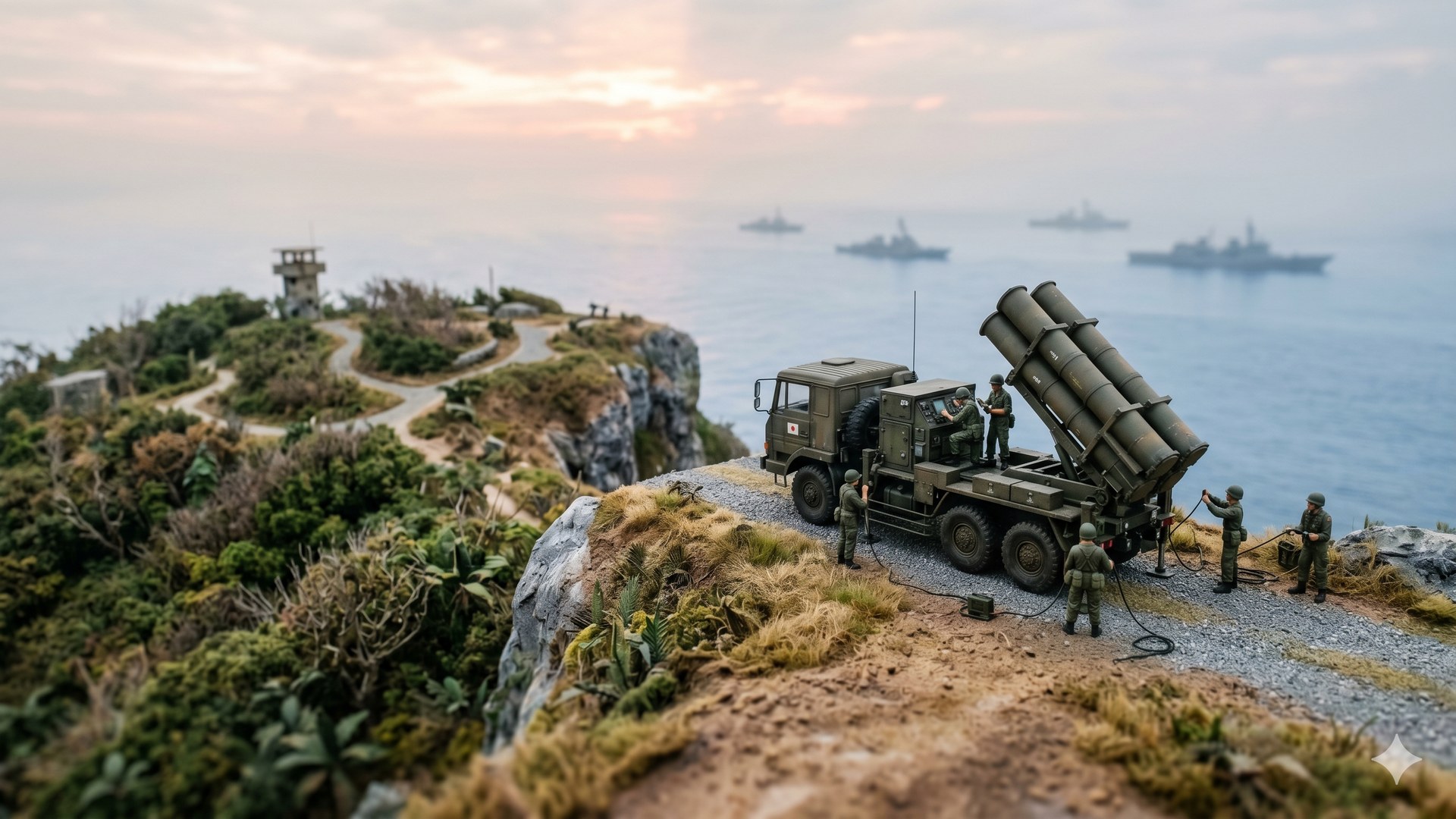
During the US-Philippine joint military exercise “Balikatan 2026” conducted from March through April 2026, Japan’s Self-Defense Forces participated for the first time at 1,400-person scale, conducting live-fire exercises with Type 88 anti-ship missiles. This event represents far more than “expanded military exercises”—it signifies Japan undertaking, for the first time since World War II’s conclusion, “overseas combat deployment.” It constitutes an extraordinarily significant milestone potentially producing fundamental transformation in Japanese defense policy and East Asian geopolitical dynamics.
Japan’s Self-Defense Forces have operated within a “defense-only” framework consistently throughout the postwar era. Overseas military activities remained strictly limited to “non-combat operations.” Even during Iraq deployment, activities were confined to “non-combat regions” under “humanitarian reconstruction support” pretexts. Afghan activities similarly were designated as “rear-area support.” In essence, Japan’s SDF avoided “firing weapons on foreign territory” for 75 consecutive years.
Type 88 anti-ship missile live-fire at Balikatan 2026 breaks that 75-year “taboo.” While framed superficially as “strengthened defense cooperation with the Philippines,” the substantive meaning runs deeper: Japan has officially begun recognizing “armed force possibilities in the South China Sea.”
The South China Sea represents an extraordinarily important geopolitical space through which approximately 30% of global maritime trade transits. Competing sovereignty claims collide over this domain. China asserts sovereignty over vast areas called the “nine-dash line.” Conversely, the Philippines, Vietnam, and other Southeast Asian nations assert their own sovereignty claims. These territorial collisions have already provoked multiple “dangerous incidents,” with armed conflict possibilities continuously rising.
Japan holds no direct territorial claims in the South China Sea. However, Japan imports the majority of Middle Eastern crude oil and energy resources through this sea-space. Thus “freedom of navigation” in the South China Sea constitutes Japan’s existential national interest. Should the South China Sea fall under “single great power (Chinese) dominance,” Japan’s energy security faces fundamental threat.
Japan’s military participation in Balikatan 2026 should be interpreted as a “military statement of intent” to protect this “freedom of navigation.” In other words, Japan transmitted a political message: “We accept the possibility of armed force use in the South China Sea.” This transformation represents one of Japan’s most fundamental postwar diplomatic shifts.
However, behind this transformation lies not Japanese “choice” but rather “constrained circumstances.” China’s rapidly intensifying military power, hardening sovereignty assertions in the South China Sea, and deepening US-China confrontation compel Japan toward “active participation” rather than “passive response.”
Behind Japan’s decision lies also pressure from “strengthened” US alliance relationships. Trump administration “Indo-Pacific Strategy,” Biden administration continuity and intensification, and current administration continuation of consistent “China strategy”—within this trajectory, the US has consistently demanded “more active Japanese military engagement.” Balikatan 2026 participation represents a “response” to those demands.
Japanese military deployment in the South China Sea generates multiple concerns. First, the Chinese government interprets this deployment as “Japanese participation in US anti-China encirclement strategy.” Official Chinese statements claiming “Japan threatens regional peace” have already been issued. Such “mutual recriminations” escalate tensions further.
Second, Southeast Asian nations face “complex positions.” These countries maintain deep economic ties with China while experiencing security threats from territorial collisions. They simultaneously support US and Japanese “China strategies” while wishing to avoid relationship deterioration with China—facing true contradiction. Japanese military deployment may sharpen this “contradiction.”
Third, Japan faces domestic “pacifism” versus “realism” conflict. Balikatan 2026 participation generates Japanese domestic concerns about Japan “walking the path toward militarism.” For older Japanese citizens particularly, “overseas combat unit deployment” invokes prewar Japanese imperialist expansion imagery.
Yet from deeper perspective, Japan’s choice may have been “unavoidable.” Within global economic systems, nations like Japan—“island countries with scarce resources”—must incorporate “military force use” into strategic options to “protect existential national interests.” For 75 years, Japan avoided this “militarization” through “economic growth” and “US military protection.” But under current “US-China confrontation” circumstances, that “avoidance strategy” becomes increasingly unsustainable.
What impact does Japanese participation in Balikatan 2026 have on East Asia’s “balance of power”? Short-term symbolic meaning: “alliance strengthening” between US and Japan. Long-term probability: China will generate countermeasures. China will likely intensify South China Sea presence and escalate military “coercion.”
Furthermore, when Japan breaks such “precedents,” it opens doors to “expanded future military activities.” “Once done, how far next” logic exerts strong pressure in military policy. Even if Balikatan 2026 becomes positioned as “limited South China Sea exercises,” futures may demand “Taiwan Strait military engagement” or “further western expansion.”
Japanese national strategy shows accelerating “militarization” inclination. Increased defense spending, advanced equipment, and now “overseas combat deployment” all suggest Japan walks toward “military great power” status. Whether this path “strengthens Japanese security” or “further elevates regional tensions” remains unclear.
Balikatan 2026 certainly represents a “historical watershed moment.” Yet whether this watershed turns “positive direction” or “negative direction” cannot be determined at this point. Determination comes later—five, ten, or more years hence—when Japan’s choices reveal their “consequences.”
この記事を書いた人
灰島
30代の日本人。国際情勢・地政学・経済を日常的に読み続けている。歴史の文脈から現代を読むアプローチで、世界のニュースを考察している。専門家ではないが、誠実に、感情も交えながら書く。


コメント