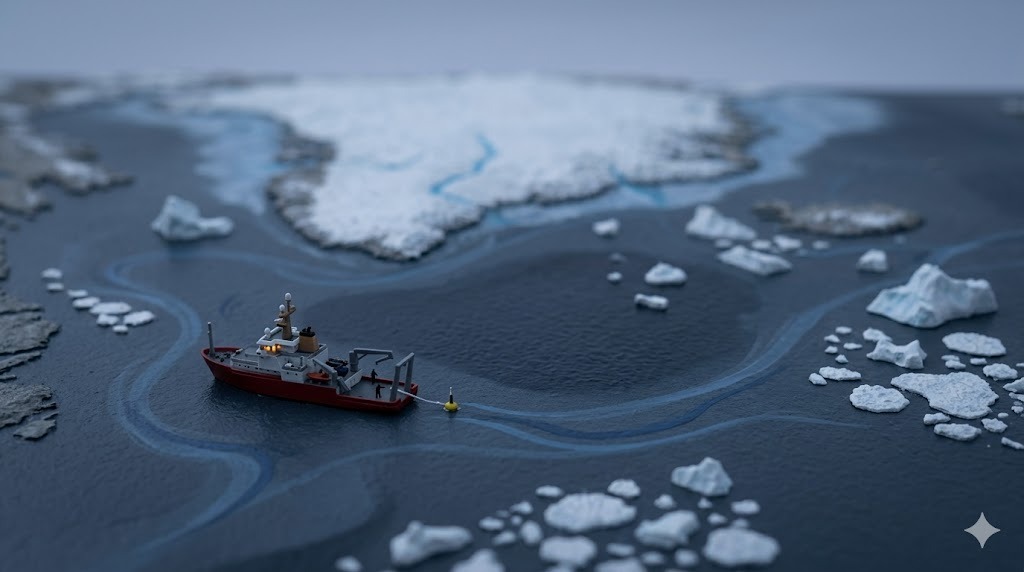
An international climate research report released in early April 2026 revealed that the Atlantic Meridional Overturning Circulation (AMOC) is weakening at a pace 60% faster than traditional climate models predicted. This circulation system—a massive “ocean bloodstream” flowing from North Atlantic depths toward the South Atlantic—represents Earth’s most critical mechanism for maintaining Europe’s temperate climate. Its decline signifies far more than corrected scientific observations; it indicates humanity’s fundamental understanding of planetary environmental processes has lagged dangerously behind reality.
AMOC decline stems from North Polar freshwater infusion. Accelerating ice sheet melting across Greenland and the Arctic introduces enormous freshwater volumes into the North Atlantic. Ocean water density depends on salinity concentration; freshwater input lowers density. When density decreases, water no longer sinks. AMOC operates through a “thermohaline circulation”—cold, salty water sinks in the North Atlantic, flows southward along the ocean floor, rises at the equator, and returns north at the surface. Freshwater infusion brakes this circulation.
Conventional climate models predicted this freshwater process “linearly.” The assumption was that if ice sheet melting increased by one meter annually, AMOC decline would follow proportionally. Reality proves more complex. Ice sheet melting contains “acceleration mechanisms.” As melting advances, ice surface elevation drops, exposing it to warmer atmospheric layers. Exposed ice melts faster. Further melting creates “glacier lakes” where meltwater accumulates, subsequently flowing seaward. These “positive feedbacks” cause acceleration.
The 60% faster AMOC decline rate compared to traditional projections suggests these positive feedbacks are now active. The ongoing process has entered “self-acceleration” stages. Greater freshwater supply from ice melting accelerates AMOC decline, which further accelerates ice melting—a vicious cycle.
AMOC decline inflicts severe climate consequences for Europe. Without the warm ocean currents (Gulf Stream) AMOC conveys, European climate would cool significantly. British and Scandinavian winters could become several degrees colder. Snowfall would increase, agricultural production decline. Simultaneously, altered North Atlantic wind patterns would shift tropical rainfall distributions. Saharan regions might see increased precipitation while Amazonian rainfall could decrease.
More concerning is the possibility these climate changes occur “abruptly.” Climate science employs the “tipping point” concept—beyond a critical threshold, climate systems undergo rapid, irreversible change. Multiple research institutions now suggest AMOC’s tipping point may arrive “mid-century.” In other words, by 2050, AMOC could become completely dysfunctional.
Complete AMOC failure represents far more than “climate change”—it constitutes “structural shock” to human socioeconomic systems. European agriculture developed through adaptation to current climate. Rapid cooling following tipping point arrival would devastate grain production. Additionally, North Atlantic sea level rise patterns would shift. AMOC weakening causes water to “accumulate” in the North Atlantic, accelerating relative sea level rise at coastlines. European and African coastal cities would simultaneously face both “cooling” and “sea level rise.”
Japan faces non-negligible impacts. AMOC decline could affect North Pacific ocean current patterns. Japanese winter monsoons might intensify, bringing increased snowfall and temperature drops. Should Kuroshio current paths shift, Japanese fishing grounds would transform rapidly. Pacific saury already face persistent scarcity; AMOC-driven current changes could worsen this further.
Current international climate change mitigation frameworks insufficiently account for such “accelerating changes.” The Paris Agreement targets limiting warming to 2 degrees, yet concrete inter-nation commitments remain inadequate. More problematic: policymakers inadequately recognize how difficult reversing systems already moving toward tipping points becomes.
AMOC decline may already constitute an “irreversible” century-scale process. Even if humanity completely stopped greenhouse gas emissions today, AMOC decline might continue. Freshwater input from ice melting may have already reached “critical thresholds.”
Confronting this reality, international society may need allocating more resources toward “climate adaptation” and “damage response.” Europe already considers AMOC decline scenario reconstruction of “food security” and “energy security.” Such reconstruction demands enormous capital investment, necessarily fostering “inter-nation competition.”
More severe: climate change from AMOC decline accelerates “geopolitical conflict.” North European climate cooling favors Russian Arctic strategy. African rainfall pattern shifts further destabilize already-fragile regional politics. Climate change becomes not merely an “environmental problem” but a new arena for “geopolitical competition.”
Scientifically, the 60% faster AMOC decline rate emphasizes climate science’s “humility” and “uncertainty.” Predicting complex, nonlinear system futures proves inherently difficult, with enormous uncertainty ranges. Yet policymakers must make “present choices” within this uncertainty.
At this moment, in the North Atlantic’s depths, vast invisible transformations occur. Salinity decreases, current speeds slow, deep waters stagnate. All simultaneously. 2026 observational data demonstrates humanity hasn’t “competed” against climate change but merely “chased” after climate system transformations. How much time remains before tipping point arrival? The answer may already measure in “decades.”
この記事を書いた人
灰島
30代の日本人。国際情勢・地政学・経済を日常的に読み続けている。歴史の文脈から現代を読むアプローチで、世界のニュースを考察している。専門家ではないが、誠実に、感情も交えながら書く。

コメント