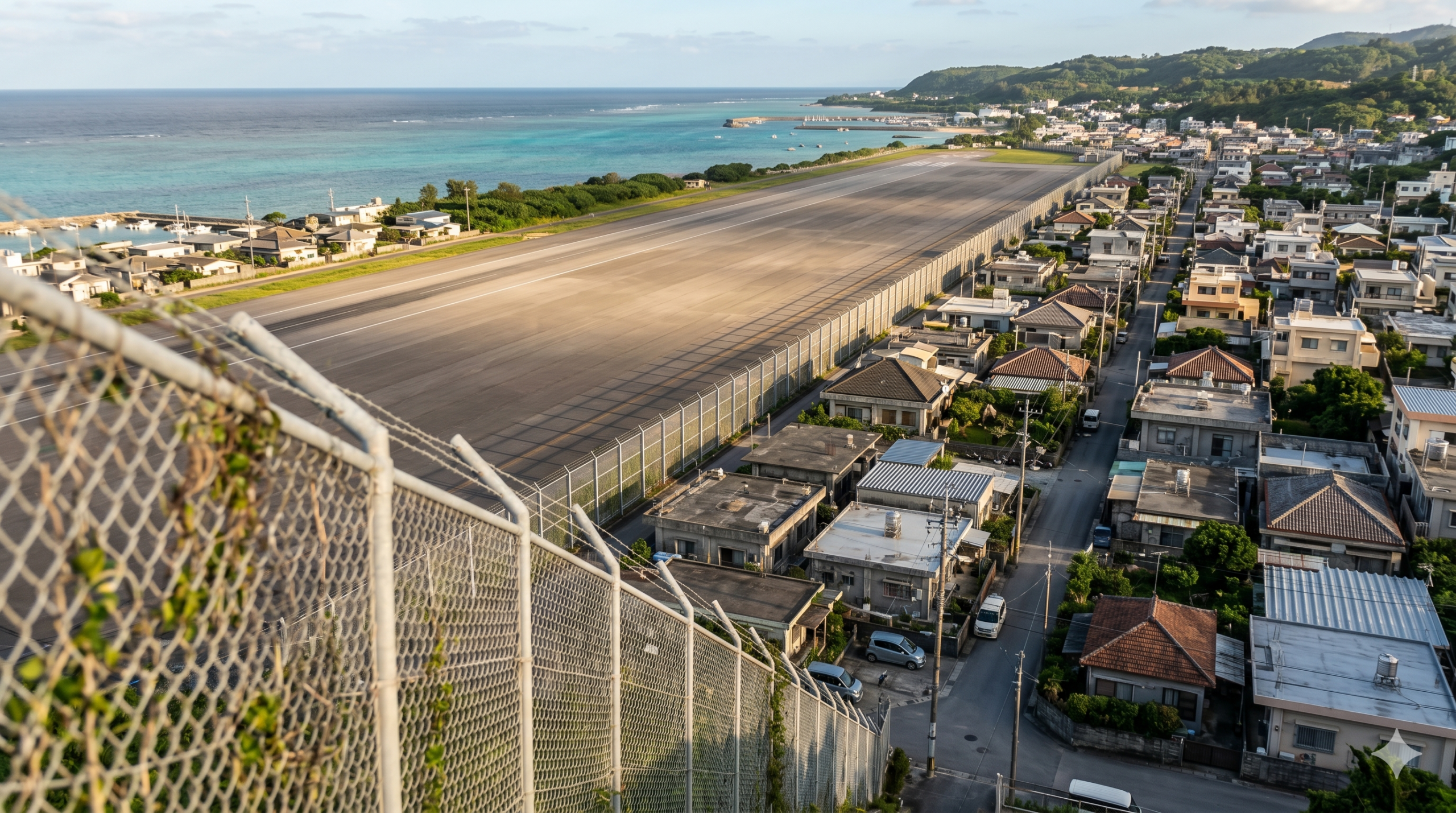
Record spending on a project barely begun.In fiscal year 2026, Japan’s Defense Ministry allocated a record ¥337.3 billion for the Henoko relocation project, according to the Okinawa Times. The project’s physical progress stands at roughly 16 to 17.5 percent completion, yet 70 to 80 percent of the total budget has already been consumed. Media coverage of Henoko typically focuses on these figures—the ballooning costs, the engineering challenges, the political standoff between Tokyo and Naha. What that coverage consistently omits is a different structure entirely: the thousands of private landowners whose economic survival depends on whether Marine Corps Air Station Futenma continues to exist, and whose silent economic interests may be the most powerful force shaping this debate.
Futenma sits on private land.This is the fact that changes the entire analysis. According to records from Japan’s House of Representatives, approximately 91 percent of Futenma Air Base occupies privately owned land. The number of individual landowners is estimated at between 3,400 and 4,200 people. The base was not built on government property. It was constructed on land that belonged to Okinawan families—land that was seized during and after the Battle of Okinawa in 1945, when residents were confined to internment camps while American forces appropriated their fields and homes. In the 1950s, the seizures continued through what Okinawans call “bayonets and bulldozers”—forced evictions backed by military hardware. Official Okinawa Prefecture records document this process in detail, tracing the systematic dispossession of farming communities that had cultivated those plots for generations. The 1956 “Island-Wide Struggle” saw 200,000 Okinawans protest the Price Report’s recommendations for continued land appropriation—one of the largest demonstrations in Okinawan history. That struggle did not end with victory. It ended with compromise. After Okinawa reverted to Japanese sovereignty in 1972, the Japanese government assumed the role of paying rental fees to the landowners whose property remained occupied. The mechanism changed. The occupation did not.
Three out of four landowners earn less than ¥2 million per year.According to Ryukyu Shimpo investigations and the aforementioned House of Representatives inquiry, more than 75 percent of Futenma’s military landowners receive annual rental payments of less than ¥2 million. Between 54 and 57 percent receive less than ¥1 million. In monthly terms, this translates to approximately ¥80,000 to ¥166,000—a sum that cannot sustain a family alone but constitutes an indispensable supplement to household income. These are not wealthy speculators. They are ordinary families whose monthly budgets depend on a payment that arrives once a year in August, with a supplemental adjustment for land value increases in February or March. The payments flow through the Okinawa Military Land Owners’ Federation, known as Tochiren, which serves as the formal negotiating body between landowners and the Ministry of Defense. Tochiren consolidates the interests of regional landowner associations and presents unified demands to the government. Within this system, individual landowners possess virtually no direct negotiating leverage. They depend entirely on Tochiren’s collective bargaining power—a structure that has been frozen in place for eight decades, creating a dependency that extends far beyond simple economic transaction into the fabric of daily life.
The numbers provoke something cold in me.When I look at these statistics, I feel a specific kind of anger—not heated, but glacial. The mainland narrative about Okinawan military landowners typically casts them as entrenched beneficiaries clinging to lucrative government payments. The data tells the opposite story. Seventy-five percent earning less than ¥2 million annually is not a portrait of privilege. It is a portrait of structural dependency created by historical injustice and perpetuated by institutional design. As the Minami-Nihon Shimbun has documented in detailed reporting, landowners themselves are bitterly divided. Some are labeled “traitors” for attending anti-base rallies. Others are called “rich exploiters” for seeking higher rental payments. One landowner told the paper: “If I could sell and make the base disappear, I’d do it immediately—but…” The sentence trails off because the reality does not permit clean choices. These are people whose land was taken by violence, who were subsequently made economically dependent on the entity occupying that land, and who are now trapped between the loss of income that return would bring and the moral weight of hosting a foreign military installation on soil that has been in their families for centuries. To call this “vested interest” requires ignoring how the interest was created. To call it “victimhood” requires ignoring the real economic benefit, however modest, that the current arrangement provides. The truth sits in a place that neither frame can reach.
Military land has become an investment product.The complexity deepens considerably when one examines how Okinawan military land has been financialized into a tradable asset class. Nikkei has reported that military land parcels trade at 40 to 60 times the annual rental income per tsubo, with yields ranging from 1.7 to 2.2 percent. The appeal to investors is straightforward and powerful: the Japanese government is the payer, so the risk of default is essentially zero. There are no vacancies, no maintenance costs, no tenant disputes, no property management headaches. The return is modest but guaranteed by sovereign credit. Okinawa Bank and other regional financial institutions offer specialized “military land loans” requiring no personal guarantor—an extraordinary concession that reflects the perceived safety of the underlying asset. With as little as 20 to 30 percent down payment, investors can acquire military land and begin collecting government-backed rental income. Information platforms like Gunyochi.com have emerged to serve this growing market, offering property listings, market analysis, and transaction support. Increasingly, buyers are coming from outside Okinawa—mainland Japanese investors purchasing what amounts to a government-guaranteed bond in the form of land ownership. The implications are deeply troubling on multiple levels. Okinawan land, seized by foreign military force in 1945, has been converted through decades of institutional evolution into a tradable financial asset whose value depends on the continued military occupation of that land. The people whose families originally owned those plots may now find them purchased by Tokyo-based investors seeking stable returns in a low-interest-rate environment. The base’s continued existence is no longer merely a security matter or a local livelihood issue. It sustains an entire investment market with its own stakeholders, its own logic, and its own political gravity.
Return would bring a 32-fold economic windfall—for the region.Okinawa Prefecture’s official projections estimate that returning Futenma would generate annual economic effects of ¥386.6 billion to ¥400 billion—approximately 32 times current military rental income from the base. The Cabinet Office’s Okinawa policy documents identify post-return land use as a central pillar of Okinawa’s long-term development strategy. The Okinawa Discussion Group points to the successful redevelopment of former base land in Chatan as an encouraging precedent, where commercial and residential districts now thrive on land that was once off-limits behind military fences. Futenma’s 476 hectares—roughly equivalent to 100 Tokyo Domes—could, if successfully developed, create over 30,000 jobs and transform the urban landscape of central Okinawa. The numbers are impressive. The vision is compelling. On paper, the case for return is overwhelming.
But the windfall bypasses the people who need it most.Here is the structural disconnect that defines the Futenma paradox and that virtually no public discussion acknowledges directly. The projected ¥400 billion in annual economic effects represents aggregate regional economic activity—GDP contribution, tax revenue, employment creation, commercial development. It does not represent direct payments to individual landowners. Under the Special Measures Law for Base Land Reuse, former landowners receive compensation equivalent to their previous rental payments for three years following base closure. After that three-year transition period, a landowner who had been receiving ¥2 million annually from military rental payments loses that income entirely. The land itself returns to private ownership, but the capacity to develop that land into something economically productive requires capital that small landowners do not possess, expertise that farming families have not accumulated, and institutional support that the current system does not adequately provide. Large-scale redevelopment inevitably involves land readjustment projects in which municipal governments, development corporations, and private investors play dominant roles. Individual landowners find their plots consolidated, rezoned, and reshaped in ways that may leave them with a fraction of their original territory or a one-time buyout payment that fails to replace decades of stable annual income. The aggregate economic development proceeds. The individual human cost is absorbed. Macroeconomic benefit and individual economic security are not merely misaligned—they actively conflict. The base’s closure would enrich the regional economy while potentially impoverishing many of the specific individuals whose families endured the original dispossession.
The opposition’s stated arguments are factually grounded.I want to be explicitly clear about what I am and am not arguing in this article. I am not dismissing the opposition to Henoko relocation. The environmental, technical, and fiscal objections are real, documented, and serious. WWF Japan has documented over 5,300 marine species, including 262 endangered species, inhabiting the waters around the proposed Henoko construction site. Ryukoku University researchers confirmed dugong presence near Henoko through DNA analysis in 2024, publishing their findings in the peer-reviewed journal Scientific Reports—a finding that gave scientific weight to what environmental advocates had long argued. The soft seabed at the construction site presents engineering challenges that have no clear solution: Okinawa Times reporting has detailed zones where the N-value—a standard geotechnical measure of ground bearing capacity—registers at zero, with soft clay and sand extending to depths of 90 meters below the seabed. As Nikkei has reported, the Defense Ministry’s revised construction design calls for approximately 16,000 piles driven to depths exceeding 70 meters—a scale of deep-sea ground improvement that has no verified precedent anywhere in the world. The cost trajectory tells its own story: initial estimates of ¥350 billion have escalated to Okinawa Prefecture’s current projection of ¥2.55 trillion—more than seven times the original figure, with less than 18 percent of the physical work completed. These are not ideological objections manufactured for political convenience. They are verifiable facts supported by scientific evidence, engineering assessments, and official fiscal records.
Democratic legitimacy reinforces the opposition case.The 2019 Okinawa referendum produced results that no democratic system can comfortably ignore: 71.7 percent of voters—434,273 people—opposed the Henoko landfill project. Turnout reached 52.48 percent, and the number of opposition votes constituted 37.65 percent of all eligible voters, far exceeding the 25 percent threshold required for the result to carry binding force under the referendum ordinance. Governor Denny Tamaki announced his candidacy for a third term in 2026, maintaining his core platform of blocking Henoko construction—a platform that has now won three consecutive gubernatorial elections. Ginowan City’s own documentation describes Futenma as “the world’s most dangerous airfield,” citing 115 aviation incidents since reversion—15 involving fixed-wing aircraft and 100 involving helicopters. The 2004 crash of a CH-53D helicopter into Okinawa International University, which occurred while students were on campus, remains the defining symbol of that danger. These democratic expressions and safety concerns form the legitimate, indispensable foundation of the opposition movement. I do not question their validity.
Yet the land rights structure remains unspoken.My question is not whether the opposition arguments are valid—they are. My question is whether those arguments, precisely because they are valid and emotionally compelling, function simultaneously as a screen that obscures the economic structure underneath. Environmental destruction, engineering impossibility, fiscal irresponsibility, democratic mandate—each of these frames the debate in terms that exclude the landowners’ economic reality from view. Why do more than 3,000 landowners, earning between ¥80,000 and ¥166,000 per month from the base’s existence, remain largely invisible in the public discourse about Henoko? Their silence is not accidental. It is structural. A landowner who publicly opposes relocation risks being labeled a profiteer clinging to base income. A landowner who publicly supports relocation risks losing the income that sustains their family. The rational response is silence—and silence, in a democracy, means political invisibility. When opposition movements foreground environmental and fiscal arguments, the economic dependency of thousands of families moves to the margins of the conversation where it attracts no attention and generates no political pressure. Whether this marginalization occurs by deliberate strategic choice or by the natural dynamics of political communication is something I genuinely cannot determine. But its effect is observable and consequential: the most directly affected stakeholders in the entire debate are the least visible participants in it.
Landowners are not monolithic.Testimony from a former Tochiren executive reveals the diversity and internal conflict within the landowner population. The large-scale owners earning millions of yen annually are a small minority. The overwhelming majority are smallholders for whom military rental payments represent a modest but essential income supplement—the difference between financial stability and precariousness. Meanwhile, the One-Tsubo Anti-War Landowners Association—active since its founding in 1982—represents a principled minority of landowners who demand base return regardless of economic consequences to themselves. Their existence underscores the moral and practical complexity of the landowner position. Some landowners face social ostracism for attending anti-base demonstrations. Others face criticism within their communities for seeking higher rental rates from the government. The internal conflict within the landowner community mirrors, at a personal and familial scale, the broader contradiction of the base issue itself: the same individuals are simultaneously victims of historical injustice, economic dependents of the system that perpetuates that injustice, and potential beneficiaries or casualties of any proposed resolution. Media coverage that frames the issue as “Okinawan people versus the Japanese government” erases this internal complexity entirely, producing a narrative that is emotionally satisfying but structurally incomplete.
Defense spending flows regardless of outcome.Beyond the ¥337.3 billion in Henoko relocation costs, the Tokyo Shimbun has reported that the Japanese government has spent ¥21.7 billion on Futenma maintenance and repairs since 2013 alone. As long as relocation remains incomplete, Futenma continues to operate as an active military facility, and its upkeep costs continue to accumulate—borne not by Okinawa alone but by Japanese taxpayers nationwide. Whether relocation proceeds to completion or stalls indefinitely, public funds will continue to flow into the Futenma-Henoko system. The choice facing Japanese policymakers is not between spending and not spending. It is between different forms of spending, directed at different beneficiaries, producing different consequences for different communities, over different time horizons. This fiscal reality transcends the binary framing that dominates public discourse about the relocation project.
Beyond the binary.The conventional framing of the Henoko debate presents two options: relocate to Henoko and close Futenma, or block relocation and maintain the status quo. Both options leave critical problems unsolved. If relocation succeeds, Futenma’s danger is eliminated and Okinawa’s economic development accelerates—but thousands of landowners lose their income after a three-year transition period, and the ¥400 billion economic windfall benefits regional aggregates rather than the specific individuals whose families endured the original dispossession. If relocation fails, Futenma’s danger persists, its 115-incident safety record continues to accumulate, and the environmental concerns about Henoko remain hypothetical rather than actualized—but the landowners’ rental payments continue, the investment market in military land remains intact, and the structural dependency that has defined these families’ economic lives for eighty years extends further into the future. Neither path addresses the intersection of four simultaneous tensions: strategic necessity, environmental protection, democratic will, and individual economic survival. Political compromise can manage these tensions temporarily. It cannot resolve a problem that exists at this level of structural complexity, where every stakeholder’s legitimate interest conflicts with every other stakeholder’s equally legitimate interest.
The mainland gaze distorts the picture.Two characteristic biases shape how mainland Japan views the Okinawa base issue, and both obscure the land rights structure. The first is the assumption that Okinawa prospers from base hosting—that military land payments represent a generous subsidy. The data showing 75 percent of landowners earning less than ¥2 million annually demolishes this assumption categorically. The second bias is the simplification that all Okinawans uniformly oppose the base presence. While the 2019 referendum demonstrated overwhelming opposition to Henoko specifically, the economic position of landowners represents a third category that is neither pro-base nor anti-base but simply pro-survival. Mainland media tends to counter the first bias by deploying the second—constructing a narrative of unified Okinawan resistance that feels righteous but fails to account for the several thousand families whose economic circumstances make political silence the only rational choice. The land rights dimension falls into the gap between these two distortions and disappears from public consciousness.
History repeats its structure, not its events.Viewed across a longer time horizon, the Okinawa base issue reveals a recurring pattern. The 1945 land seizures. The 1956 Island-Wide Struggle. The 1972 reversion to Japanese sovereignty. The 1995 assault of a schoolgirl by three U.S. servicemen that catalyzed mass protests. The 1996 SACO agreement. The 2006 cabinet decision on Henoko relocation. The 2019 referendum. At each of these inflection points, Futenma’s danger occupied the center of public attention, relocation proposals emerged, cost and engineering objections were raised—and the economic reality of the landowners receded into the background where it attracted no sustained analysis. The structure of the problem remains unchanged while the surface discussion cycles. The ¥21.7 billion spent on Futenma repairs since 2013 represents the fiscal cost of this stalemate in miniature: relocation does not advance, Futenma deteriorates, and Japanese taxpayers fund its maintenance indefinitely. Who benefits most from this paralysis? Not the landowners subsisting on ¥166,000 per month. Not the residents of Ginowan living under flight paths. Not the taxpayers funding both a stalled construction project and an aging airfield. The beneficiaries of stalemate are diffuse and structural—the investment market, the political actors who can invoke Henoko without resolving it, the institutional inertia that sustains itself. The human cost, as always, is concentrated and specific.
I leave this without a conclusion.Framing Henoko as a contest between justice and injustice is the easiest thing in the world. The facts are real. The environmental damage is real. The democratic mandate is real. The fiscal absurdity is real. But when you learn that 91 percent of Futenma is privately owned, that 75 percent of those owners earn less than ¥2 million per year, that their land was taken by force and their livelihoods were subsequently tethered to the occupying presence through a payment structure they did not design and cannot escape—the moral clarity that seemed so solid begins to dissolve at its edges. These are people trapped in a cycle that they did not create: dispossessed by war, made dependent by institutional design, then rendered silent by that dependency in a political debate that will determine their economic future. To dismiss their situation as vested interest is to ignore how that interest was manufactured by others. To champion their cause as anti-base resistance is to paper over the economic reality that constrains their choices. What I want—what I think honesty requires—is for the existence of these several thousand people to be acknowledged as part of the debate’s foundation. Not as an inconvenient detail to be managed by transitional payments. Not as a propaganda point for either side. But as a legitimate, human dimension of the problem that demands genuine resolution rather than rhetorical erasure. When their faces become visible in this discussion, what exactly can we claim to know about Henoko? What can we claim to be deciding?
この記事を書いた人
灰島
30代の日本人。国際情勢・地政学・経済を日常的に読み続けている。歴史の文脈から現代を読むアプローチで、世界のニュースを考察している。専門家ではないが、誠実に、感情も交えながら書く。


コメント