“No blank check for the US military,” said in a short sentence that night. Between May 14 and 15, at the Beijing summit, US President Trump left reporters with two short lines. One was “I’m not looking to have somebody go independent.” The other was that the United States military would not be offering “a blank check.” The Washington Post recorded these words as they came out of Trump’s mouth, walking out of Xi Jinping’s reception room. The $14 billion arms package for Taiwan, then awaiting congressional approval, was put on hold with a flat “not yet decided.” Forty-eight hours later, Lai Ching-te would mark his first anniversary as Taiwan’s president. The interval itself feels engineered. I cannot prove it, but the cold geometry of the timing is hard to read as accidental.
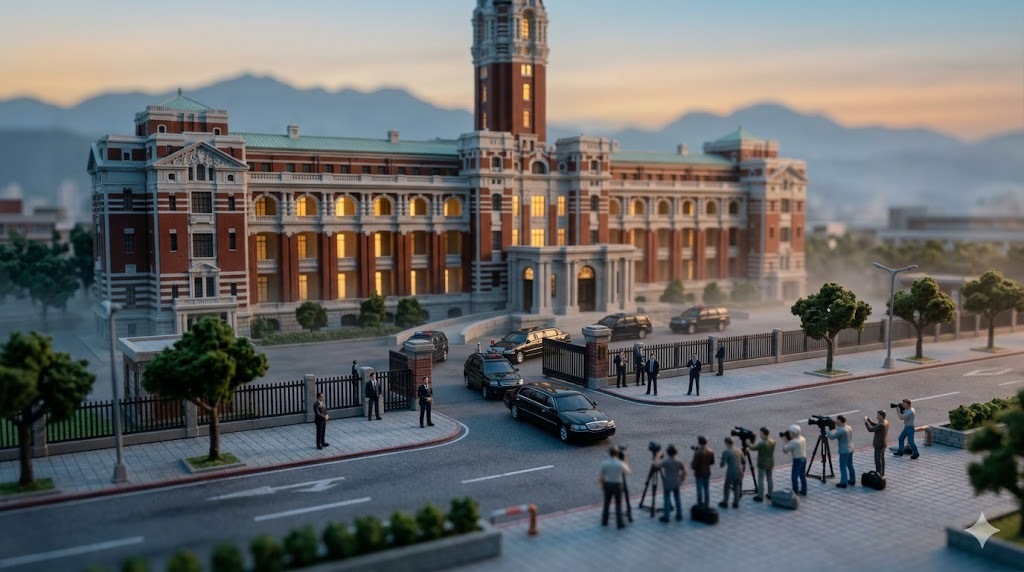
Let me lay out what Lai Ching-te’s first year actually contained. On May 20, 2025, Lai was sworn in as Taiwan’s president at the Presidential Office in Taipei, the third Democratic Progressive Party president after Chen Shui-bian and Tsai Ing-wen. His inaugural speech contained the line “the Republic of China and the People’s Republic of China are not subordinate to each other,” a phrasing that pushed one step beyond Tsai’s careful constructions. Beijing responded on May 23 with the “Joint Sword 2024A” exercises, on a scale not seen in years. Looking back across the year, three decisions define Lai’s first term so far. First, Taiwan deepened its semiconductor partnership with the United States, with TSMC’s third Arizona fab breaking ground and the fourth fab securing land within his first twelve months. Second, Taipei rebuilt its Pacific diplomatic network, visiting five island states and especially deepening security dialogue with Tuvalu. Third, Lai modified the energy roadmap he inherited, effectively freezing the 2025 nuclear-exit target and leaving open the possibility of restarting the second and third nuclear plants. Read together, the three decisions show where Lai conceded and where he held the line during a year when international and domestic realities both moved against him.
The outline of what was “understood” inside that Beijing reception room is still not visible. The May 14-15 Beijing summit goes on record as the first Trump-Xi face-to-face of this term. Time reported that the joint statement contained no language about Taiwan at all. In diplomacy, what is missing from a communique often weighs more than what is in it. Past US-China summits have routinely attached the boilerplate of “one China policy,” “the three communiques,” and “the Taiwan Relations Act.” This time the set of three vanished. Whether it disappeared because “it no longer needed to be said” or because “it could no longer be said,” I cannot yet tell. Trump told reporters that he and Xi were “very good friends,” and on Taiwan he said only that he did not want them to “go independent.” The specific understandings actually reached inside that room will be revealed gradually, with different nuances from Washington, Beijing, and Taipei. Reading that delta will be the most important diplomatic work of the early summer.
Taipei returned a short answer within 48 hours: “already sovereign and independent.” On May 16, Taiwan’s Ministry of Foreign Affairs issued a brief statement. According to Al Jazeera, the statement read: “The Republic of China Taiwan is already a sovereign and independent country, and has no need to pursue independence”. The Japan Times recorded the same statement as the Lai administration’s official position. The construction is precise. By saying “has no need to pursue independence,” the sentence aligns on the surface with Trump’s “do not go independent.” By prefacing it with “already a sovereign and independent country,” it surrenders nothing about the present condition. As a piece of diplomatic drafting it is admirable. Yet the more admirable the tightrope walk, the more breath the spectators hold.
The markets moved faster than the statement that morning. In Asian trading on May 15, the TAIEX opened down 0.8% within minutes, and TSMC fell 1.4%. The Taiwanese dollar softened 0.4% against the US dollar, the largest daily move in two weeks. Markets always run ahead of political language, because they trade on what is about to be settled, not on what has been settled. What struck me was the simultaneous move in the yen, which weakened by 0.3% briefly. That can be read two ways at once. One reading: the probability that Japan absorbs more of the Taiwan-contingency burden has gone up. The other reading: with reduced US engagement, yen-denominated safe-haven assets lose part of their premium. When the market tries to price both interpretations at the same time, that itself is evidence that the institutional premise underneath is shaking.
I am quietly counting the lines the $14 billion arms hold has drawn. The shelved package included NASAMS surface-to-air missiles, extended-range Harpoon anti-ship missiles, and precision-guided munitions for the F-16V fleet. Time reported that congressional approval may be paused indefinitely. That hold cascades into Taiwan’s own procurement plan. Taiwan’s defense ministry had budgeted a 9.4% year-on-year increase for US arms purchases in fiscal 2024, but undelivered hardware means unexecuted budget. The fielding timeline for systems already on order slips backward. What matters here is that this is not Taiwan’s problem alone. US defense industry tends to shrink production lines when political holds drag on. Restoring a contracted line takes years. Allies waiting for the same equipment, Japan, South Korea, Australia, start looking at alternatives. That is the path that lifts European demand for air-defense systems and pushes orders toward Kongsberg in Norway, Diehl in Germany, and Rafael in Israel. The security supply chain responds to political holds on a clock measured in months and years. That clock has just started.
From Naha to Yonaguni is 1,300 kilometers, and the meaning of that distance is being rewritten. Japan’s southwest island defense plan, the so-called southwest shift, is built on a specific division of labor with the US inside the first island chain. The 15th Brigade is based in Naha on Okinawa main island, and Ground Self-Defense Force garrisons have been newly placed on Miyako, Ishigaki, and Yonaguni between 2016 and 2023. Japan Coast Guard cutters operate continuously around the Taiwan Strait, and joint US-Japan exercises run multiple times per year. The premise of this entire posture is “if something happens in the Taiwan Strait, the US intervenes immediately, and Japan provides rear support.” Trump’s “no blank check” line softens the first half of that premise. When “immediate intervention” becomes “conditional intervention,” the quality of “rear support” changes too. Rear support is structured around a functional front line. If the front itself becomes uncertain, the rear carries the risk of becoming the front. That has implications for US base roles in Japan, for Self-Defense Force readiness levels, and for civilian use plans for Kyushu and Shikoku ports and airports. From Yonaguni to Taiwan’s main island is 110 kilometers, closer than Fukuoka to Seoul. The distance has not moved. Its political meaning has, in 48 hours.
The pressure on Lai inside his own party shifts character at the one-year mark. Within the DPP, criticism of Lai’s heavy reliance on Washington has been quietly building. Some legislators, especially the so-called “new generation” in their forties, argue that as US engagement softens, Taipei should more consciously maintain a working dialogue channel with Beijing. This is not “independence versus unification.” It is a third path that keeps both options suspended and tries to buy time. Meanwhile the opposition Kuomintang held its party congress on May 17, electing a new chair who carries forward the line of former chair Eric Chu. The KMT’s posture remains “dialogue-first” after the 2024 election cycle, but in the wake of Trump’s statement the party has issued an internal document arguing that “if US engagement fades, we will need to become more pragmatic.” These movements feed directly into the legislative dynamics of Lai’s second year. A Taiwanese president without a parliamentary majority faces a structural fragility, and foreign policy tends to get pulled into legislative bargaining. Beijing is, of course, watching this dynamic.
The semiconductor geopolitics moves in the same frame. TSMC’s Arizona project entered mass production on its first fab in 2025, with the second fab on track for 2027, the third for 2028, and the fourth for 2030. The third and fourth fab decisions, locked in during Lai’s first year, represent a substantial Taiwanese concession: moving leading-edge logic capacity onto US soil. What Taipei expected in return was the stable continuation of US arms sales and an assurance of US military engagement in a Strait contingency. Trump’s “no blank check” line shakes the premise underneath that expectation. Inside Taiwan’s semiconductor industry, conversations about how much further US production share to push have re-accelerated since May 17. I see a paradox here. If US engagement is receding, Taipei has less incentive to move more capacity offshore. At the same time, the need to keep Taiwan’s main island strategically indispensable to the US grows. Push concessions further and faster and Washington may stay engaged, but if production capacity drains out of Taiwan, the “value of defending the island” itself drops in any contingency calculus. Which direction does the Lai administration intend to resolve that contradiction?
The MOFA travel advisory still lists Taiwan with no risk designation. For Japanese travelers, Taiwan is a near-domestic destination. In 2025, roughly 2.3 million Japanese visited on the post-COVID recovery trajectory. The Foreign Ministry’s overseas safety site shows Taiwan with no risk designation at all, not even the Level 1 “exercise normal caution.” That is unusual in East Asia, where mainland China sits at Level 1 for major cities, Hong Kong at Level 1, and Macau at Level 1. Taiwan stands alone in the region as “no information posted.” The Japanese government treats Taiwan as a substantially safe destination while maintaining no formal diplomatic relations, a twisted arrangement that does not strain in peacetime. In a contingency, the questions become real: evacuation planning, the operational scope of the Japan-Taiwan Exchange Association in Taipei, and protection of Japanese nationals. After Trump’s statement, those questions reportedly moved from theoretical to operational inside the MOFA consular bureau, which held an informal internal review on May 17. The work of “who moves when, and how” tends to begin in operational rooms long before the language of statements changes.
Lai’s first-anniversary speech on May 20 is the first inflection point to watch. The Presidential Office has scheduled the address. It is an important moment for summing up year one and signaling year two. I will be watching three vocabulary choices in particular. First, how he frames “status quo.” Second, which of “Republic of China,” “Republic of China Taiwan,” or simply “Taiwan” anchors the speech. Third, whether he directly addresses US-China relations or steps around them. Each of these three choices sends a distinct signal to different audiences in Beijing, in Washington, and inside Taipei. After May 20 come further inflection points: a reportedly planned second Trump-Xi summit on June 1, the Pacific Islands Forum leaders’ meeting at the end of July, and the DPP’s national congress in August. Across those dates, the Taipei-Beijing-Washington-Tokyo quadrilateral will move and settle into new positions. So which moments should we be watching next? The three vocabulary choices in the May 20 speech, the joint statement language after the June 1 summit, and the scale of the planned US-Japan joint exercises on Yonaguni and Ishigaki, each of which answers the same underlying question from a different angle.
Sources: The Washington Post / Time / Al Jazeera / The Japan Times
この記事を書いた人
灰島
30代の日本人。国際情勢・地政学・経済を日常的に読み続けている。歴史の文脈から現代を読むアプローチで、世界のニュースを考察している。専門家ではないが、誠実に、感情も交えながら書く。
コメント