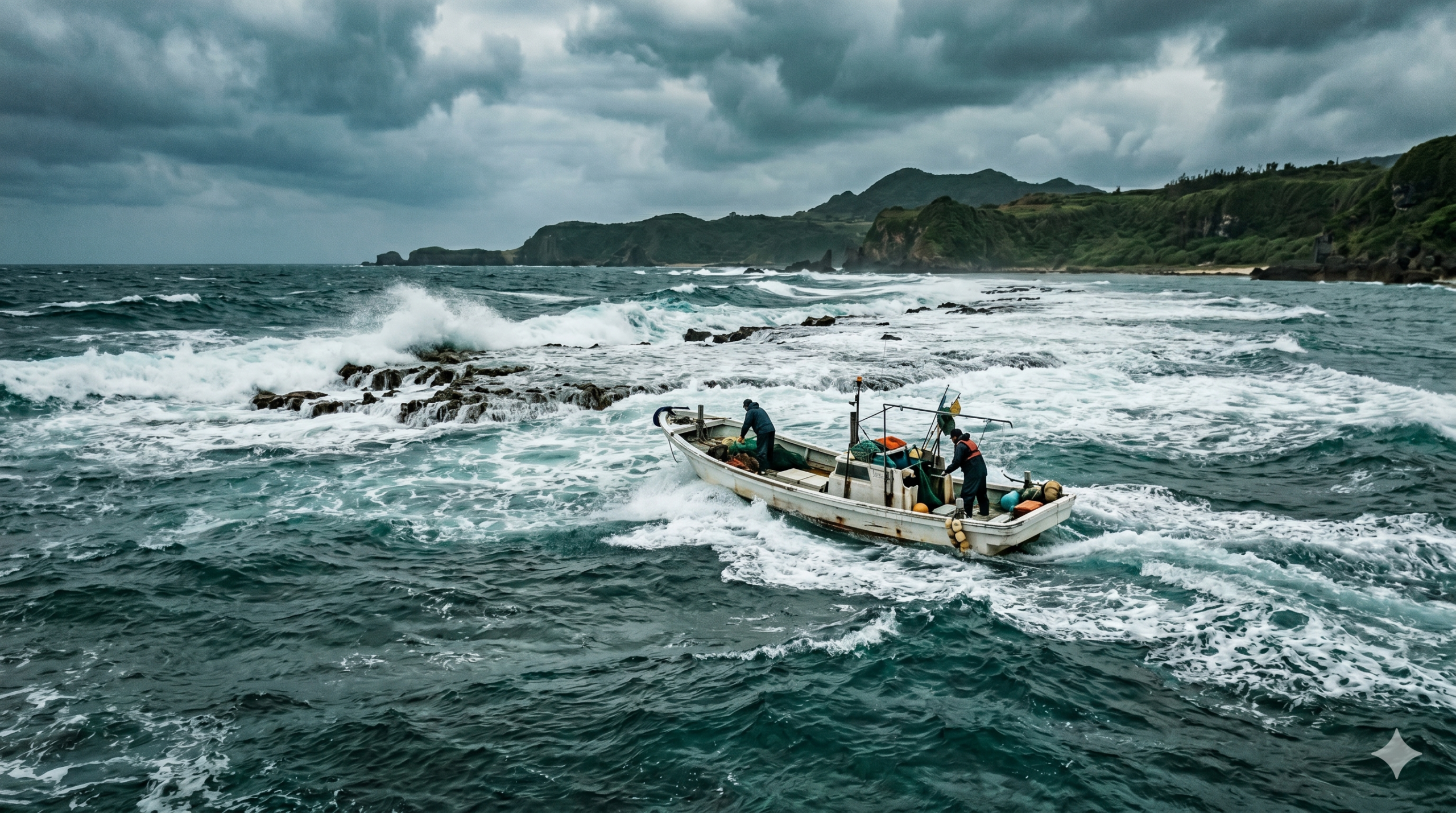
At approximately 10:10 a.m. on March 16, 2026, two small boats capsized in succession roughly 1,540 meters off the coast of Henoko, Nago City, Okinawa. Aboard were 18 second-year students from Doshisha International Senior High School in Kyotanabe, Kyoto Prefecture, and three crew members, totaling 21 people. The first boat to capsize, the Fukutsu (approximately 1.9 tons), was followed about two minutes later by the Heiwa Maru (under 5 tons), which had gone to its aid and was swallowed by waves in the same area. All 21 people were thrown into the sea. Takeishi Chika, a 17-year-old student who had been aboard the Heiwa Maru, and Kanai Hajime, the 71-year-old captain of the Fukutsu and a pastor at Saseki Church of the United Church of Christ in Japan, lost their lives. Sixteen others were injured. I began tracing the facts of this incident because each detail pointed not to random misfortune but to structural inevitability. This was not a story of bad luck on a bad day. It was a story of systems that were never built in the first place.
The sea that day was rough enough to halt construction work worth billions of yen. The Okinawa Meteorological Observatory had issued a wave advisory for the area. At the U.S. military base construction site off Henoko, some work had been suspended because significant wave heights exceeded the safety thresholds established by the Okinawa Defense Bureau. A massive public infrastructure project, coordinated by the central government with rigorous safety protocols, made the determination that conditions were too dangerous to continue operations on the water. Yet in that very same stretch of sea, small boats carrying high school students departed for what was described as an educational excursion. The Japan Coast Guard patrol boats in the area had used megaphones to warn that weather and sea conditions were hazardous. Winds of approximately four meters per second blew across the waters, accompanied by swells compounded by the wave advisory. In the shallow waters where coral reefs spread along the Henoko coastline, waves are amplified as they rise over the reef structure, generating swells significantly larger than what open-water conditions might suggest. Anyone with working knowledge of maritime conditions would understand how profoundly abnormal it was to take small, low-freeboard vessels out with passengers under these circumstances.
Yet the boats went out. They went out because no mechanism existed anywhere in the chain of responsibility to prevent departure. The operating entity, the Heli Base Opposition Council (formally the Council Opposing Construction of an Offshore Heliport Base and Seeking Peace and Democratization in Nago City), had not codified any departure criteria in written form. The captain reportedly used wind speeds of seven to eight meters per second as a personal guideline for deciding whether to sail, but this was an individual rule of thumb developed through personal experience, not an organizational standard backed by institutional accountability. No passenger manifests were maintained. No system existed to incorporate the wave advisory issued by the meteorological authority into the departure decision. The contrast with the nearby construction site is instructive: the construction operation had clear, quantified threshold values, and when measurements exceeded those values, work automatically halted. No human judgment call was required because the system was designed to remove discretion at the point of maximum danger. The boats carrying high school students had nothing remotely comparable. The decision to go or not to go rested entirely with one individual, with no institutional check, no written criteria, and no override mechanism.
Neither boat was registered under Japan’s Maritime Transportation Act, and neither carried passenger insurance. The act requires registration as an irregular route maritime transportation business for any operation that transports passengers in response to external demand, regardless of whether the service is paid or unpaid, even for vessels with a passenger capacity of 12 or fewer. This is not an obscure technicality. Registration brings with it mandatory safety management regulations, codified departure decision criteria, crew qualification requirements, and oversight by maritime authorities. Operators who fail to register face penalties including up to one year of imprisonment. The absence of registration meant that none of these safety structures applied. In April 2022, the sightseeing boat Kazu I sank off Shiretoko, Hokkaido, killing all 26 people aboard. That disaster prompted the Ministry of Land, Infrastructure, Transport and Tourism to significantly tighten safety standards for small passenger vessels, including mandatory inspections, communication equipment requirements, and enhanced crew training. The Shiretoko reforms were among the most sweeping maritime safety overhauls in recent Japanese history. But they applied only to registered operators. The lessons of Shiretoko, purchased at the cost of 26 lives, never reached the unregistered protest boats off Henoko. The legal framework created a category of vessel operations that existed entirely outside the safety regime. This was the gap through which two lives fell.
The Heli Base Opposition Council maintained that the service was volunteer work provided without charge. However, Sankei Shimbun reported that Doshisha International Senior High School had in fact paid a total of 15,000 yen, distributing 5,000 yen to each of the three captains as a boat usage fee. The Yomiuri Shimbun independently confirmed the 5,000-yen-per-captain payments. When confronted with this discrepancy, the council acknowledged the monetary exchange but recharacterized it as a voluntary contribution, a donation. The gap between these two accounts matters enormously in legal terms, because the Maritime Transportation Act applies regardless of whether compensation is formally structured as a fee or informally structured as a gratuity. But even setting aside the legal question, the discrepancy reveals something about the organizational culture. An entity that describes a paid service as unpaid volunteer work is an entity that has not subjected its own operations to rigorous self-examination. If the organization could not accurately characterize its own financial arrangements, what confidence could anyone have in its assessment of maritime safety conditions?
On the day of the accident, neither of the two accompanying teachers boarded the boats with their students. Of the 37 students participating in the Okinawa study trip, an advance group of 18 boarded the two boats while the remaining 19 waited on the beach. The two teachers assigned to accompany the group remained on the beach as well. The question this raises is fundamental: on what pedagogical or safety basis was it deemed acceptable for teachers not to accompany high school students boarding small vessels in open water during a school-organized excursion? In a press conference following the accident, the principal of Doshisha International Senior High School addressed the failure to verify the boats’ legal registration status. His response was candid in a way that was itself revealing: “Honestly, it simply did not occur to us.” Tobu Top Tours, the travel agency that had been engaged to handle logistics for the broader school trip, stated that the protest boat boarding fell outside its contracted scope of responsibility. The resulting picture is one of complete fragmentation: the teachers were not on the water, the travel agency disclaimed involvement, and the operating organization maintained no safety standards. Every party involved appears to have assumed that responsibility for the students’ safety lay somewhere else. The result was that it lay nowhere. The People Behind the Protest Boats
The boat excursion was incorporated as one of seven courses available to students during the school trip, framed under the rubric of peace education. Doshisha International Senior High School offered multiple course options for its Okinawa study trip, with students selecting their preferred itinerary. The offshore Henoko boat ride was presented as one component of a peace learning program. However, according to detailed information published on the note platform by the bereaved family, parents were not adequately informed about the nature of this particular course. The family states that parents received no detailed explanation of the individual courses, that parents were not told their children would board boats, that the boats were vessels used for protest activities, or that students would venture into offshore waters. The school had begun beach-based observation visits to Henoko as part of its peace education curriculum around 2015 and introduced the offshore boat course in 2023, reportedly at the suggestion of Captain Kanai. But Sankei Shimbun reported obtaining past trip itineraries that included language from the protest tent village soliciting student participation through sit-in demonstrations. What was actually conducted under the institutional banner of peace education is now the subject of investigation by a third-party committee established by the school. The distance between the label and the reality will be one of the central questions that investigation must answer.
Life jackets were distributed to students before departure, but whether they were properly fitted and worn is an entirely separate matter of safety management. According to testimony from the mother of the deceased student, shared through the X (formerly Twitter) account @Beloved_Tomoka, there was no instruction or assistance provided during the process of putting on life jackets. One student reportedly had the fastening straps crossed incorrectly and was unable to wear the jacket properly. Despite this visible problem, no teacher, crew member, or supervising adult intervened to correct it. A life jacket that is improperly worn can fail to keep an unconscious person’s head above water, or worse, can shift position and restrict movement during an emergency. The provision of safety equipment without proper instruction in its use creates a dangerous illusion of preparedness. The life jackets were present, but the safety management system that should have ensured their effective use was not.
For Takeishi Chika, the elapsed time from capsizing to rescue was approximately 70 minutes, and the elapsed time to death confirmation was approximately two hours and twenty minutes. The bereaved family has published a detailed, minute-by-minute timeline of the day of the accident, compiled from contemporaneous notes taken by the elder sister and cross-referenced with information obtained from the school, travel agency, Japan Coast Guard, and hotel staff. The accident occurred at approximately 10:10 a.m. The 11th Regional Coast Guard Headquarters established its emergency response command at 10:16. Eleven vessels were deployed for rescue operations. Twenty of the 21 people in the water were rescued within approximately 40 minutes. But Takeishi Chika was not found until 11:18, when she was discovered beneath one of the overturned boats, and was not brought to the rescue vessel until 11:39, roughly 70 minutes after the capsizing. She was transferred to an ambulance at 11:25 and arrived at the hospital at 11:59. Her death was confirmed at 12:29 p.m. I must reckon with every minute of this timeline as recorded by the family. But I also feel the weight of using this record in an article. For the family, these are not data points in a chronology. They are the minutes during which they lost their daughter, each one irreversible.
In the weeks following the accident, the family began publishing detailed accounts of their experience on the note platform and the social media service X. The note account (beloved_tomoka) opened by Takeishi Chika’s mother now contains a growing archive of carefully documented entries covering the timeline of the accident day, the systemic problems with the school trip program, and a deeply personal portrait of who Chika was as a person. The family’s posts on X have generated extraordinary public engagement, with individual posts receiving over 94,000 likes and exceeding 20 million views. This level of response is itself significant, because it reveals the scale of public interest in a story that much of the mainstream media had not adequately covered. The family explicitly states in their publications that the content has been fact-checked with the school, travel agency, Japan Coast Guard, and hotel staff, lending these accounts high credibility as primary source material. The elder sister’s detailed contemporaneous notes provide a factual backbone that few journalistic reconstructions could match.
Among the most viscerally affecting details in the family’s account is the handling of Chika’s personal belongings by the travel company. Her effects were returned to the family in two parcels: a suitcase and a torn cardboard box. Inside the cardboard box, clothing and personal items were strewn without having been folded or organized. This detail, the torn cardboard box, generated particularly intense reactions across social media. A 17-year-old girl’s belongings, the physical remnants of her interrupted life, carelessly stuffed into a damaged container and shipped to her grieving family. What this fact communicates extends beyond the failure of safety management that preceded the accident. It speaks to a failure of basic human regard in the aftermath. Even after the worst had already happened, the systems and institutions surrounding this event did not rise to the minimum standard of treating this young person’s memory with dignity.
The entertainer Tsuruno Takeshi captured a widespread sentiment when he wrote that the reality of a bereaved family having no choice but to publish their own account on note, amid an unnaturally sparse level of media coverage of such a major accident, was heartbreaking. Ishido Satoru, a former Mainichi Shimbun reporter and respected nonfiction writer, offered a more analytical observation: it was indeed a fact that Sankei Shimbun’s coverage was extensive while Asahi Shimbun’s was sparse, and even reading the verification articles that did appear, many questions remained about why facts that reporters clearly possessed were never developed into follow-up stories. The structural reasons why this accident received comparatively little coverage from Japan’s major media outlets will be examined in detail in Part 3 of this series. For now, I will note only that many facts that have since become central to public understanding of this event would have remained buried had the family not undertaken the extraordinary effort of publishing them independently. 90,000 People Turned to a Bereaved Mother’s Blog
Takeishi Chika was born in October 2008 and was 17 years old at the time of her death. According to information her family has chosen to share publicly, she had attended a Harvard University summer program where she studied philosophy and astronomy. She was described by those who knew her as a bright, intellectually curious student with an expansive sense of the world. She participated in one of the courses her school had established as part of a standard school trip. She did not choose danger of her own volition. She trusted her school and followed its instructions, as students are expected to do, and as a result she was placed aboard an unregistered, uninsured vessel, without a teacher present, in a sea under a wave advisory that had already caused the nearby construction site to suspend operations. Her father has expressed his anguish in words that are difficult to read without pausing: if only he had been more alert to the implications of the words Henoko and boat appearing together in descriptions of the school trip program, perhaps he could have intervened. That sentence carries the full weight of parental grief, the unbearable retrospective clarity of a danger that was invisible until it was too late.
Kanai Hajime was 71 years old and had served as pastor of Saseki Church of the United Church of Christ in Japan in Nanjo City, Okinawa, since 2006. Born in Hokkaido, he graduated from Waseda University and completed a master’s program at Tokyo Theological Seminary. His pastoral career included positions at Fujimimachi Church and as chaplain at Meiji Gakuin before he moved to Okinawa. In 2014, he organized fundraising through the Okinawa Christian Peace Research Institute to purchase the protest boat Fukutsu, setting a fundraising target of two million yen. He purchased the vessel in Osaka and sailed it to Naha. For the final twelve years of his life, he served as the Fukutsu’s captain for maritime protest activities opposing the U.S. military base construction off Henoko. He authored a book titled Letters from the Henoko Protest Boat Fukutsu. There is no question that Kanai acted from conviction, and that his commitment to what he understood as a cause of peace and justice was deeply held. But conviction and safety management exist on different planes, and the gap between his beliefs and the operational reality of transporting high school students on unregistered vessels in hazardous waters proved fatal. This is not a judgment of his character. It is an observation about the structural failure that his individual dedication could not compensate for.
The Japan Coast Guard launched its criminal investigation on the day of the accident, establishing a response headquarters at the 11th Regional Coast Guard Headquarters and opening inquiries on suspicion of professional negligence resulting in death and injury, as well as professional negligence endangering maritime traffic. On March 20, investigators conducted searches of the Heli Base Opposition Council offices and the residence of the Heiwa Maru captain. On March 25, Saseki Church, where Kanai had served as pastor, was also searched by maritime investigators. Doshisha International Senior High School announced the establishment of a third-party investigation committee on March 31, tasking external attorneys with analyzing the causes of the accident. On April 15, the ruling Liberal Democratic Party compiled a set of policy recommendations to the government calling for thorough investigation of the causes, assurance of safety in school activities, and confirmation that educational activities had been conducted in compliance with the Fundamental Law of Education and national curriculum guidelines. The Ministry of Education, Culture, Sports, Science and Technology issued a notice urging schools to exercise vigilance against political activities during extracurricular educational programs. The Japan Transport Safety Board is conducting a parallel technical investigation. The criminal investigation by the Coast Guard remains ongoing as of this writing.
I find it impossible to apply the word coincidence to this accident. A wave advisory was in effect. The Japan Coast Guard had issued direct warnings. The nearby construction operation had suspended work. The boats carried no maritime transportation registration. They carried no passenger insurance. No departure criteria had been established in writing. The teachers did not accompany students onto the water. The travel agency stated the boat excursion was outside its contractual scope. Parents were not adequately informed that their children would board boats at all. When these facts are arranged in sequence, what becomes visible is not accidental misfortune but a space in which the concept of safety management was structurally absent. Every institution that might have served as a safeguard either did not know, did not check, or did not consider itself responsible. In that void of accountability stood a 17-year-old girl who had been sent there by her school.
After the Shiretoko disaster four years ago, Japanese society declared that such a tragedy must never be repeated. Laws were revised, standards raised, and regulatory oversight made more stringent. But the reformed safety net was woven only for operations that existed within the legal framework. It did not extend to vessels that operated without registration. The premise that volunteer work or political activity might create an exemption from basic safety obligations was never explicitly endorsed by any authority, yet it functioned as a de facto exemption in practice. For four years after Shiretoko, the gap in the system remained open. And through that gap, two lives were lost.
The boats that capsized off Henoko were protest boats, used in the maritime campaign opposing the relocation of U.S. military facilities. Who operated them, what organizational structure stood behind them, and what happened in the weeks following the accident when certain facts were withheld from public disclosure, these questions will be examined in the next installment of this series. What I want to ask here is something that precedes those questions, something more elementary. Why did no one close the gap in the system? Why was a space with no one accountable for safety management allowed to persist year after year? And what are we to make of the fact that a 17-year-old, sent into that space not by her own choice but by institutional direction, is the one who paid the price for that collective failure?
この記事を書いた人
灰島
30代の日本人。国際情勢・地政学・経済を日常的に読み続けている。歴史の文脈から現代を読むアプローチで、世界のニュースを考察している。専門家ではないが、誠実に、感情も交えながら書く。

コメント