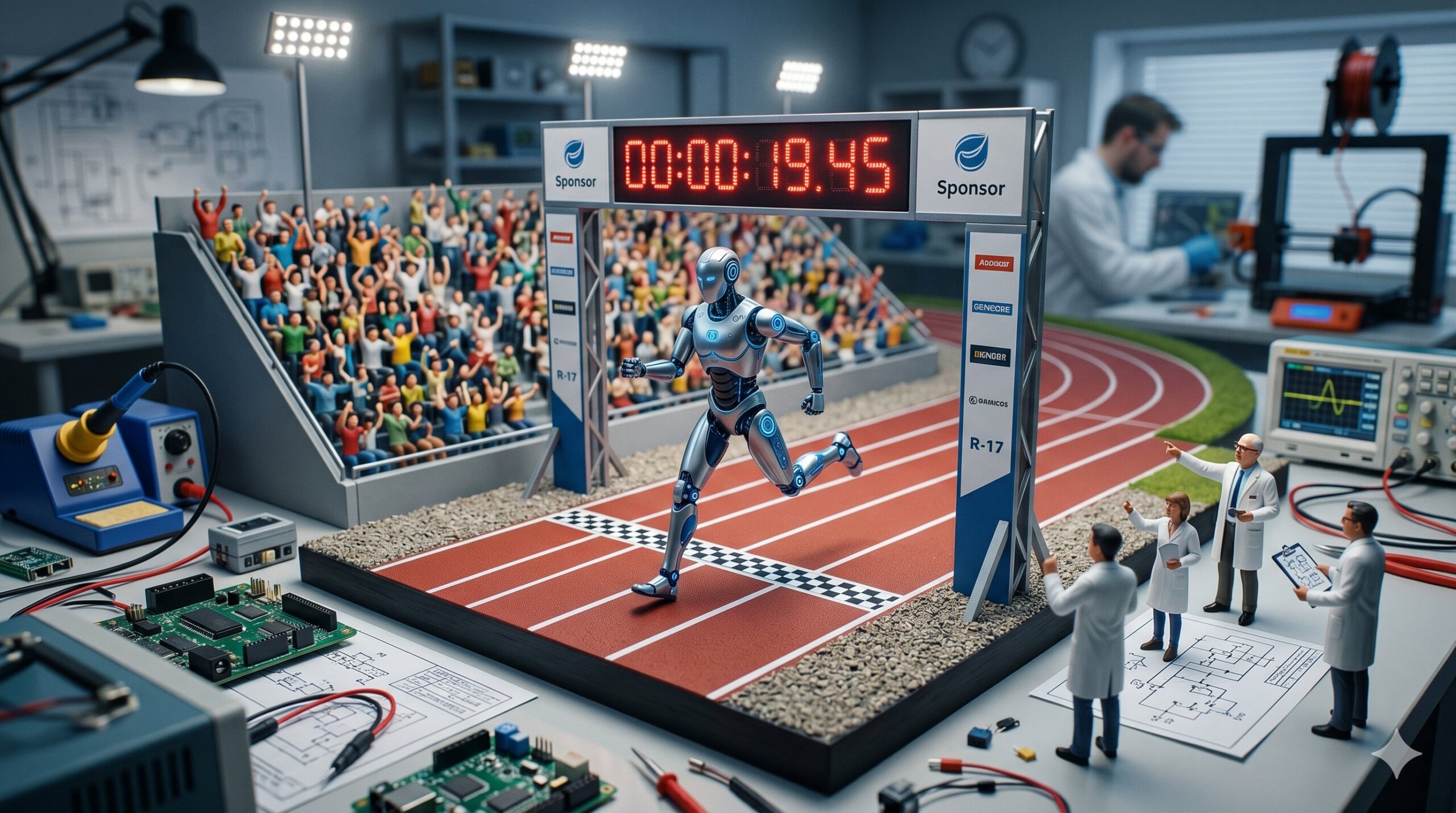
A robot did not beat humans—rather, it became possible to beat them. That’s the more precise way to frame the news that arrived last week. Honor’s humanoid robot “Lightning” completed a half-marathon on April 19, 2026, during Beijing’s E-Town Marathon Festival in 50 minutes and 26 seconds. For comparison, the human world record is held by Uganda’s Jacob Kiplimo, who ran 57 minutes and 20 seconds in Lisbon in 2020. In other words, Lightning covered the same distance roughly 7 minutes faster than the fastest human runner on record.
What lies behind these numbers is not a simple “machine beats human” narrative. The event featured over 300 robots and 12,000 runners—it functioned as a lively marathon festival. The robots did not monopolize the course; they merely ran it faster than humans. Yet that “merely” conceals something more significant: a structural shift in the entire robotics industry.
Lightning’s technical specifications are formidable. Standing approximately 95 centimeters tall, its chassis houses a sophisticated liquid cooling system distributed throughout its body. This system manages heat dissipation during continuous operation, preventing performance degradation over long distances. Beneath each foot lies a dense array of pressure sensors, detecting microvariations in ground contact. In real time, as Lightning runs, these sensors feed data to its central processing system, which adjusts stride length and landing force hundreds of times per second. Even on a flat track, Lightning is continuously recalibrating itself in response to terrain imperceptibles imperceptible to human perception.
The year-over-year comparison is dramatic. Last year’s champion, “Tian Gong Ultra,” required a human operator to grip a wireless remote control, issuing step-by-step instructions throughout the 157-minute course completion. An operator sat in a control booth, monitoring the robot’s sensors and adjusting power outputs and steering corrections in real time. Lightning did none of this. It received no operator input. It made route decisions autonomously. It managed its own energy budget, distributing power across leg motors and stabilization systems to optimize for speed while maintaining balance. This represents not an incremental improvement but a categorical leap—from remote puppetry to genuine autonomous navigation.
The acceleration in China’s humanoid industry is striking when viewed through quantitative projections. According to TrendForce, 2026 marks the critical inflection from R&D-phase development to commercialization. Global humanoid shipments are expected to exceed 50,000 units this year. That represents 700% year-over-year growth from 2025’s baseline of roughly 7,000 units. To contextualize: a 700% growth rate means the market is expanding sevenfold in a single year. This is not steady industry maturation. This is explosive expansion.
Unitree’s market position crystallizes the asymmetry. In 2025, this Shanghai-based company manufactured and shipped more humanoid units than Figure AI and Tesla combined—not by a small margin but by a factor of 36. That is: Unitree shipped 36 times the combined output of the two most-funded US robotics companies. Simultaneously, Shanghai-based Agibot demonstrated manufacturing scale by doubling production capacity from 5,000 to 10,000 units in just ninety days. Such velocity requires more than engineering talent. It requires supplier relationships, component stockpiling, factory optimization, and capital reserves—all mobilized simultaneously.
Behind these market numbers lies accumulated human effort compressed into visible form. Engineers across Chinese firms spent years refining motor control algorithms. Technicians perfected liquid cooling circuit designs. Supply chain specialists negotiated component contracts. Factory workers iterated assembly processes. That collective labor, individually unnamed and unheralded, crystallized on Beijing’s track in a single 50:26 completion. Lightning is not a machine. It is the materialization of ten thousand person-years of refinement.
The human marathon results compound the observation. Men’s champion Zhao Hai-Jie (China) finished in 1:07:47. Women’s champion Wang Qiao-Zia (China) finished in 1:18:06. The nation that deployed a world-record-breaking robot also fielded the fastest human marathoners. This is not random. It reflects systemic capability—a nation mobilizing capital, talent, training infrastructure, nutrition science, and competitive culture toward multiple domains simultaneously, and excelling in all of them.
China’s parallel initiative to establish international humanoid standards is perhaps more consequential than the marathon itself. Standards are not neutral specifications. Standards are power. The nation that writes the standard controls which specifications competitors must meet. A Chinese-authored standard favoring certain motor tolerances, energy consumption ratios, or sensor architectures will advantage Chinese manufacturers and disadvantage others. International standardization represents a shift from competing on innovation to controlling the parameters of future competition. It is a transition from the product level to the infrastructure level.
Where does Japan stand in this landscape? The South China Morning Post’s assertion that “Japan missed the AI-driven humanoid boom” requires serious scrutiny. Japan did not miss the boom. Japan chose a different strategic positioning. Rather than compete in humanoid manufacturing volume, Japan has concentrated on precision core components—the “picks and shovels” layer. Harmonic Drive supplies reduction gears with tolerances of 0.01 degrees—precision that enables smooth locomotion. Yaskawa Electric manufactures servo motors that respond to commands in microseconds. FANUC produces industrial robots and components that integrate seamlessly. These firms do not appear in headlines about “breakthrough humanoid robots,” but their components appear inside every advanced robot globally.
The paradox is that Lightning’s success depends partially on Japanese precision engineering. The smooth, efficient leg articulation that allows Lightning to run at 23.8 kilometers per hour is enabled by reduction gears of extraordinary precision. Those gears are likely Japanese-manufactured. Harmonic Drive’s 0.01-degree tolerances permit the fluid motion that makes Lightning’s run possible. Yet that Japanese contribution remains invisible. The headline reads “China’s Robot Breaks Human Record.” The footnote—that Japanese components enabled the physics—goes unwritten.
Multiple Japanese firms have set 2027 as their mass-production inflection point. Honda, Toyota, and other majors are planning to transition from prototype development to manufacturing at scale. Yet simultaneously, Japan confronts demographic headwinds of historic proportion. The working-age population will shrink 30% by 2050. Elderly populations requiring care will swell for another two decades. This means that for China, humanoid robots represent “a tool for industrial dominance and export revenue,” whereas for Japan they represent “a necessary solution to population contraction and care shortfalls.” The motivation differs fundamentally. China pursues market share. Japan pursues social necessity. Different motivations produce different strategies and different tolerance levels for capital investment and iterative failure.
Manufacturing scale comparisons reveal the gap starkly. Visualize 300 robots launching simultaneously from Beijing’s marathon start line. Coordinating such a deployment requires suppliers who can deliver 300 complete robotic systems within specified quality windows. It requires logistics networks capable of staging and managing hundreds of units. It requires quality-control systems that can validate 300 systems in parallel without slowing the process. Japan’s manufacturing tradition excels at precision and reliability, but scaling to “300 robots at once” requires different infrastructure—supplier redundancy, parallel production lines, just-in-time component delivery at massive volume. China’s recent investments have built exactly this. Japan is playing catch-up on scale metrics.
Yet “catch-up” mischaracterizes what’s happening. Japanese technology has not declined. Rather, Japan is consciously accepting a specialist role—high-precision components for a world market dominated by Chinese assembly. This is not humiliation. It is strategic positioning. The question is whether that positioning is sustainable or whether it contains structural vulnerabilities. If Chinese firms decide to vertically integrate—manufacturing their own reduction gears, their own servo motors—then Japanese component suppliers lose their customer base. That risk is real.
The pace of this industrial transition is disorienting. Three years ago, Chinese humanoids were viewed as crude, slow, and requiring constant remote supervision. That perception was accurate. Progress from crude to “world-record-breaking” in 36 months is extraordinary. What enabled this acceleration? Capital concentration (yes), government policy support (yes), talent mobilization (yes), supplier ecosystem readiness (yes). The difference between 2023 and 2026 is that all these factors aligned simultaneously. China mobilized capital, policy, talent, and supply in parallel. The nation that can do all four things at once, at scale, with coherent direction, dominates industrial competition.
Japan’s 2027 mass-production targets will determine the next phase. If Japanese firms successfully transition to volume manufacturing while maintaining their precision-component advantage, a duopoly structure could emerge: China supplies assembled robots and controls standards; Japan supplies core components. That division of labor might be stable. Alternatively, Chinese vertical integration could make Japanese components redundant, triggering a consolidation crisis. Or Japan could break out of the component-supply niche, competing directly in robot assembly, which would reignite direct competition with China on China’s preferred terrain—volume and cost.
The 2026 Beijing marathon was not merely a sporting event. It was a visualization of industrial capability and strategic positioning. The 300 robots running in parallel demonstrated China’s ability to mobilize resources and achieve reliable manufacturing at scale. Lightning’s 50:26 completion demonstrated autonomous navigation success. The human marathoners demonstrated excellence across multiple athletic domains. Collectively, they sketched China’s industrial trajectory: moving from “aspiring competitor” to “standard-setter and dominant player” within a single lustrum.
Beneath Beijing’s morning sky, unseen engineers from dozens of firms watched their contributions materialize on the track. Those engineers will never be named in publications. They will not receive athlete-style recognition. Yet every stride Lightning took, every course correction it made in real time, every adjustment to load distribution between legs—all reflected their accumulated labor. That labor was not spontaneous or accidental. It was the product of sustained capital investment, systematic refinement cycles, and competitive pressure within a market growing 700% annually.
The question Japan and other advanced economies now face is structural. Can a nation that champions precision and reliability maintain relevance in a world where volume production and standard-setting capacity determine competitive outcomes? Is the “picks and shovels” strategy sustainable, or does it contain a vulnerability—that those who write the requirements can exclude those who merely supply components? In the coming three years, as Japanese firms attempt mass production and as Chinese standards become international norms, that question will be answered in concrete terms.
The mechanics of China’s standard-setting strategy are worth examining explicitly. A technical standard is not neutral documentation. It is a codification of competitive advantage. Suppose China’s emerging humanoid standard specifies, for example, that autonomous navigation systems must employ LiDAR sensors with “refresh rate X” and “resolution Y.” If those specifications match what Chinese firms already produce—and are achievable only through Chinese suppliers—then compliance becomes de facto Chinese-dependency. Foreign companies manufacturing components to alternative specifications face exclusion from international markets.
Japan’s “picks and shovels” strategy contains a structural vulnerability. The metaphor implies that Harmonic Drive and Yaskawa will thrive by serving whoever dominates the market. But that logic assumes the market leader maintains an open supply chain. If China’s robot manufacturers achieve sufficient scale and fully control their supply chains, they can internalize component production. Harmonic Drive becomes redundant. Yaskawa’s servo motors are replaced by domestic Chinese alternatives. The “picks and shovels” merchant thrives only as long as the gold miners remain dependent on external suppliers—a dependency that can evaporate if vertical integration becomes economically feasible.
Japan’s demographic crisis is simultaneously constraint and opportunity. Constraint: Japan cannot afford to wait for a global robotics market to mature naturally. The care labor shortage demands robotic solutions now, not in a decade. That urgency constrains Japan’s ability to pursue high-risk strategies. Opportunity: Japan’s domestic care-robot demand is certain, large, and growing. A Japanese firm that dominates the care-robotics vertical market—even if it remains niche globally—can sustain profitability and R&D funding indefinitely. That niche dominance could be the foundation for future diversification.
The East Asian productivity paradox may shed light here. Japan (and increasingly South Korea and Taiwan) have all faced labor shortages. Their responses have varied. Japan pursued human-capital intensive strategies—high wages, comprehensive training, long job tenures. South Korea and Taiwan pursued export-volume strategies—manufacturing at massive scale for global markets. Now, as robots automate labor-intensive tasks, the Japanese approach faces disruption. The long-tenure, high-skill worker becomes less central to production. Yet Japan’s social contracts assume this worker exists. That contradiction cannot be resolved by market mechanisms alone.
What occurs between 2027 and 2030 will crystallize these tensions. Japanese mass-production initiatives will either succeed or fail. If successful, Japan enters direct competition with China on manufacturing volume—China’s preferred battleground. If they fail, Japan retreats further into component supply. Simultaneously, Chinese standard-setting will either achieve international adoption or fragment into multiple competing standards. If adoption succeeds, China’s dominance calcifies. If fragmentation occurs, multiple firms survive in different regulatory ecosystems. And the United States—currently trailing—may mobilize capital and technological resources at sufficient scale to disrupt both Chinese and Japanese incumbents.
The emotional labor of watching this transformation is real. Engineers in Japan, China, the US, and Europe are all working diligently, solving hard problems, advancing their respective industries’ capabilities. Yet many of them will lose in the competitive outcome. A brilliant Japanese roboticist working for a firm that fails to scale, or that becomes structurally dependent on Chinese standards, sees their career prospects dim despite their individual competence. That is not personal failure. That is structural sorting at the industrial level. Millions of such individual fates are being sorted by forces no person can individually resist.
What draws attention is the velocity of this transition itself. Three years ago, Chinese humanoid robotics were viewed as crude, slow, and requiring constant human remote supervision. That perception was grounded in observable facts. Progress from crude prototypes to “world-record-breaking autonomous systems” in 36 months represents extraordinary industrial acceleration. What enabled this speed? Capital concentration (undeniable). Government policy support (documented in industrial planning). Talent mobilization (universities training tens of thousands). Supply chain readiness (component suppliers scaling production). The difference between 2023 and 2026 is that all four factors aligned simultaneously. China mobilized capital, policy, talent, and supplier capacity in coordinated fashion. Nations that can achieve such coordination across four simultaneous fronts achieve industrial dominance. Few can.
Japan’s 2027 mass-production targets will determine the next industrial phase. If Japanese firms successfully transition to volume manufacturing while maintaining their precision-component advantage, a duopoly-like structure could emerge: China supplies assembled robots and controls standards; Japan supplies core precision components. That division of labor might prove durable and sustainable. Alternatively, Chinese vertical integration could accelerate, making Japanese components redundant. Third possibility: Japanese firms break out of the component-supply niche and compete directly in robot assembly. That path would pit Japan against China on China’s preferred terrain—volume production and cost efficiency. The outcome determines whether Japan thrives as a specialist supplier or faces structural marginalization.
The mechanics of standard-setting power deserve explicit examination. A technical standard is not neutral specification. It is a codification of competitive advantage. Suppose China’s humanoid standard specifies, for instance, that autonomous navigation sensors must employ LiDAR with specific refresh rate and resolution degrees. If those specifications match components already produced by Chinese suppliers and are difficult for non-Chinese suppliers to source, then compliance becomes de facto dependency. Foreign firms manufacturing components to alternative specifications face market exclusion. Standards are weapons. Those who write them control competition.
The risks in Japan’s parts-supply strategy are real and structural. The metaphor of picks and shovels comes from California’s gold rush: when gold miners proliferate, profits accrue to those selling picks and shovels, not to miners themselves. Japan’s strategy assumes Harmonic Drive, Yaskawa, FANUC will thrive by serving whoever dominates the assembled-robot market. But that logic depends on sustained external demand. If the market leader—in this case, Chinese firms—achieves sufficient scale and controls supply chains, they can internalize component production. They build their own reduction gears. They manufacture their own servo motors. Japan’s suppliers become redundant. The parts merchant thrives only as long as the robot makers remain dependent on external suppliers—a dependency that evaporates if vertical integration becomes economically viable.
Japan’s demographic reality creates both constraint and opportunity. Constraint: Japan cannot afford to wait for humanoid markets to mature naturally. Care labor shortages demand robotic solutions immediately, not in a decade. That urgency limits strategic flexibility. Opportunity: Japan’s domestic care-robot demand is certain, large, and growing exponentially. A Japanese firm that dominates care robotics—even if niche globally—can sustain profitability and R&D funding indefinitely. That niche dominance could fund diversification into other domains. Care robotics could be the beachhead for broader industry presence.
Consider East Asia’s productive paradox relevant here. Japan, South Korea, and Taiwan all faced labor shortages decades ago. Their responses diverged. Japan pursued human-capital-intensive strategies: high wages, comprehensive training, long job tenures, social investment. South Korea and Taiwan pursued export-volume strategies: massive manufacturing for global markets. Now, as automation advances, each model faces disruption differently. Japan’s social contracts assume long-tenure, high-skill workers. Robots threaten that assumption. Yet adapting those contracts creates political conflict. South Korea and Taiwan can more easily shift manufacturing location or worker categories. Their flexibility may provide advantage in the robotics transition.
What occurs between 2027 and 2030 will crystallize these structural tensions. Japanese mass-production initiatives will either succeed or fail. Success means Japan enters direct competition with China on manufacturing volume—China’s preferred competitive terrain. Failure means Japan retreats further into component supply, a strategically weaker position. Simultaneously, Chinese standard-setting will either achieve broad international adoption or fragment into competing standards. Adoption cements Chinese dominance. Fragmentation creates openings for alternative competitors. The United States—currently trailing in humanoid development—may mobilize capital and technological resources at sufficient scale to disrupt both Chinese and Japanese incumbents by 2030. Three competing futures, all possible.
The human cost of this industrial transition deserves acknowledgment. Engineers in Japan, China, the US, and Europe are all working diligently, solving hard technical problems, advancing their respective industries. Yet many will lose in the competitive outcome. A brilliant Japanese roboticist working for a firm that fails to scale or that becomes structurally dependent on Chinese standards sees career prospects dim despite individual competence. That is not personal failure. That is structural sorting at the industrial level. Millions of such fates—individual engineers, factory workers, supply chain specialists—are being sorted by forces no person can individually resist. That sorting is invisible, quiet, and inevitable.
One final thought on observation and watchfulness. The robots are running. China’s factories accelerate. Japan’s precision suppliers are embedded in systems but risk marginalization. The United States trails but controls capital. Europe has regulatory capacity but minimal manufacturing. The landscape is fragmenting into specializations rather than converging on victory. Projections made today will likely prove obsolete within 18 months. The only certainty is continued motion. The only honest intellectual stance is watchful observation—seeing clearly what is happening, understanding how it happened, and anticipating plausible futures without pretending to know which will occur. That clarity, combined with intellectual humility about the future, is all that can be honestly offered.
この記事を書いた人
灰島
30代の日本人。国際情勢・地政学・経済を日常的に読み続けている。歴史の文脈から現代を読むアプローチで、世界のニュースを考察している。専門家ではないが、誠実に、感情も交えながら書く。


コメント