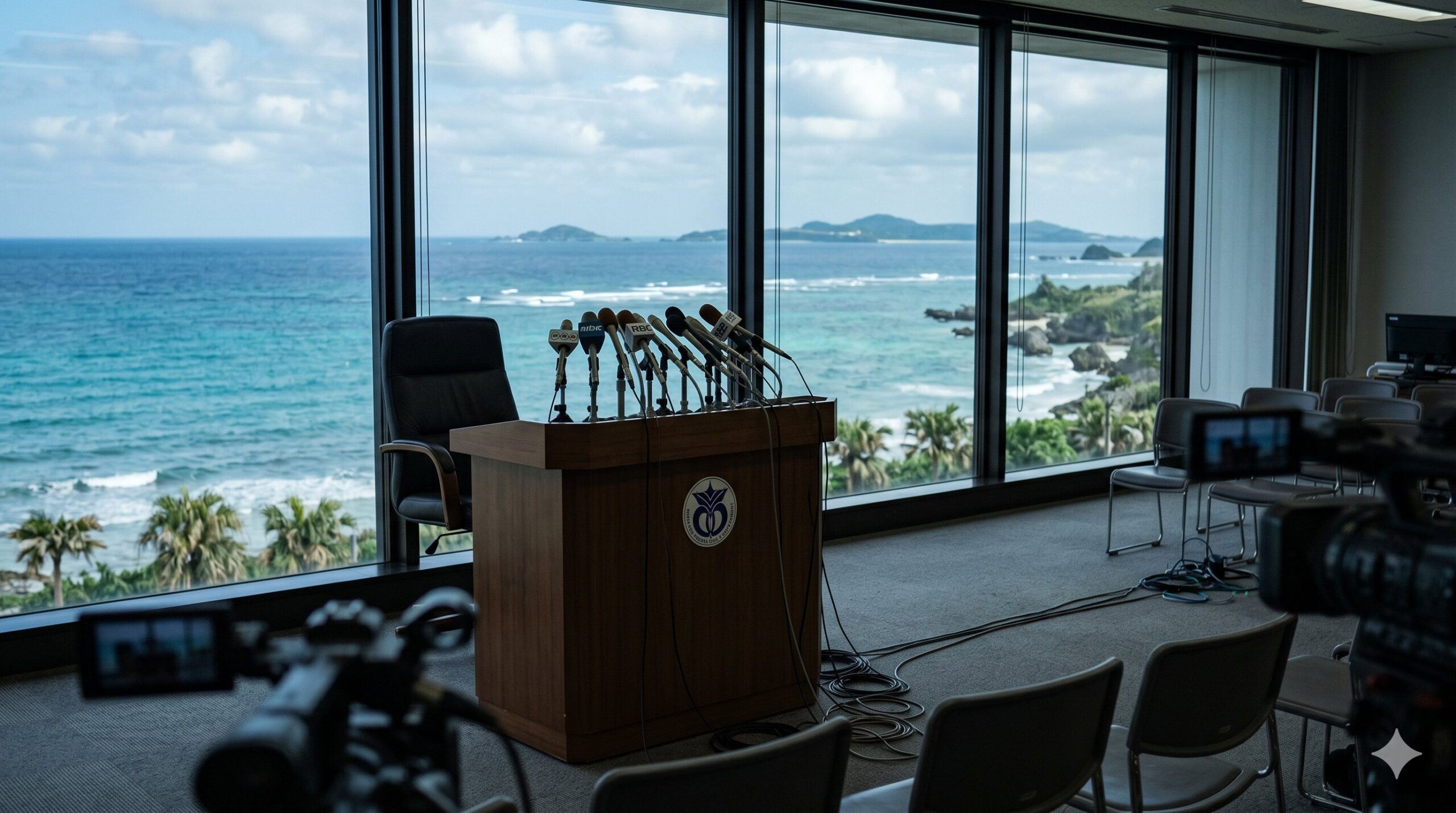
On March 27, Okinawa’s governor chose his words with surgical care. Asked about the two vessels that capsized off Henoko on March 16, killing two people and injuring sixteen, Governor Denny Tamaki declined to call them “protest boats.” Instead, he offered a circumlocution: “Rather than categorizing them as protest boats and saying there was a safety problem, these are boats used for protests among other purposes, boats used according to their intended function.” Eleven days after the accident that opened this series, the governor of Okinawa could not bring himself to name what everyone already knew. This was not a problem of vocabulary. It was a problem of structure. Behind those carefully chosen words lies a web of political alliances, organizational ties, and geopolitical pressures that stretches far beyond a single press conference in Naha.
The governor’s statements, traced chronologically, reveal a shift. On the day of the accident, March 16, Tamaki declared he would “urgently coordinate a response” and called the incident “a deeply painful accident that breaks my heart.” The following day, he appeared in mourning attire at the prefectural assembly’s budget committee and led a moment of silence. “We must take this situation with the utmost gravity,” he said. Up to this point, the governor was performing the role of a grieving leader appropriately. His condolences were prompt, his demeanor at the assembly solemn. There was no reason to question his sincerity at that stage.
But after March 21, the nature of his language began to change. He postponed his announcement of a bid for a third term in the September gubernatorial election, citing “consideration for the feelings of school officials and children” and “the painful Henoko accident.” A reasonable decision on its face. Yet around the same time, the Sankei Shimbun reported that members of his campaign team were voicing concern that “things aren’t going well”, worried about the accident’s impact on the election. The moment when mourning intersects with political calculation comes for every politician. But in Okinawa, that intersection has a peculiar shape, because the organization that operated the capsized boats is part of the governor’s own political support base.
Then came March 27, and the governor would not say “protest boat.” He acknowledged that “my opposition to the Henoko relocation is a view I share” with the operators, but added: “I am aware through media reports that protest activities were being conducted at sea, but I do not have detailed knowledge of the conditions under which they were carried out.” The governor placed distance between himself and the capsized vessels. The phrase “boats used according to their intended function” carries a neutral, multipurpose ring. But the reality is different. As the second installment of this series documented in detail, the Fukutsu was purchased in 2014 specifically for maritime protest operations off Henoko, and the Heiwa Maru had likewise been used in the anti-base movement. Calling them “boats used according to their intended function” may not constitute a distortion of fact, but it is a retreat from the core of the matter.
The reason for that retreat is explained by structure. The All Okinawa Conference was formed in 2015 as a cross-party coalition united by opposition to the construction of a new U.S. military base at Henoko. It brings together the Japanese Communist Party, the Social Democratic Party, the Okinawa Social Mass Party, civic groups, and labor organizations. Governor Tamaki was elected in 2018 and re-elected in 2022 with All Okinawa’s backing. In other words, All Okinawa is his electoral machine. And the Heli-Base Opposition Council, the organization that operated the two capsized boats, is a member organization of All Okinawa. The governor exists within a structure where part of the political coalition that made him governor bears operational responsibility for the accident. To call the vessels “protest boats” would be to acknowledge, on the record, his political connection to those boats. By calling them “boats used according to their intended function,” he sought to blur that connection. This is inference, but it is inference that the structure naturally points toward.
To be precise, the governor did not directly command the council. This must be stated clearly. All Okinawa is a coalition united on the single issue of opposing the Henoko relocation. The governor does not manage or supervise the individual activities of its member organizations. The Heli-Base Opposition Council’s departure decisions, its lack of safety protocols, and its failure to register under the Maritime Transportation Act are the council’s own failings. But when a constituent part of your political base commits a serious safety failure, the structural difficulty of publicly criticizing that failure is not hard to imagine. The governor’s continued avoidance of specific accountability demands directed at the council reflects this structural constraint. It is worth noting that no governor of Okinawa has ever publicly criticized the anti-base protest organizations, regardless of party. The political cost of doing so, in a prefecture where opposition to the U.S. military presence runs deep across generations, would be enormous. This is not a personal failing of Tamaki’s; it is the grammar of Okinawan politics itself. But when that grammar prevents a governor from naming what happened and holding responsible parties accountable for the deaths of two people, the grammar becomes part of the problem.
In April, another facet of the structure was exposed. At the prefectural assembly’s General Affairs and Planning Committee on April 15, it emerged that an advisor to the Okinawa Convention and Visitors Bureau’s (OCVB) educational travel promotion program was affiliated with the Heli-Base Opposition Council. A person connected to the organization that operated the accident vessels had been involved in a prefectural tourism initiative. This may not constitute a direct conflict of interest, but it is another indicator of the proximity between the prefectural government and the protest movement. An educational travel promotion advisor connected to an organization whose maritime activities lacked basic safety management. Before the accident, this link might never have surfaced. After it, the significance changes.
All Okinawa’s own post-accident conduct deserves examination. On March 17, it convened to discuss its response, and publicly announced “a suspension of all protest activities.” But according to a report by the Daily Shincho on April 11, the coalition subsequently issued a directive to resume protest operations. Roughly three weeks from suspension to resumption. Two people died in an accident operated by one of its member organizations, yet with both the Japan Transport Safety Board investigation and the Japan Coast Guard criminal inquiry still underway, activities resumed. The governor has not publicly commented on this resumption. His silence continues. The Heli-Base Opposition Council, for its part, reportedly engaged a lawyer to seek permission for a direct apology to the bereaved family and the school, as of April 3. Whether that apology was accepted or delivered is not publicly known. What is publicly known is that the coalition to which the council belongs decided to resume the very activities that led to the accident while investigations were still ongoing, and that the governor said nothing about it.
On April 16, the governor announced he would visit the capsizing site. He expressed plans for a memorial visit, safety advisories for all tourists including school excursion groups, and a pledge to announce accident prevention measures before Golden Week. This was roughly one month after the accident, with prevention measures coming six weeks out. Meanwhile, my research found no evidence that Okinawa Prefecture established its own independent accident investigation committee. The Japan Transport Safety Board is conducting its investigation. The Coast Guard is pursuing criminal charges. Doshisha International High School set up a third-party committee. But the prefecture itself appears not to have launched an independent inquiry into an accident caused by an organization within the governor’s political support base and connected to a prefectural tourism program. There is structure in that absence, too.
On April 25, the governor is expected to announce his bid for a third term. He has indicated that Henoko will be a central issue. The candidacy announcement, delayed by the accident, will come approximately forty days after two people died on boats operated by an organization within his coalition. For Tamaki, Henoko is both a campaign issue and the core of his political identity. He has served two terms on the banner of opposing the Henoko relocation, backed by All Okinawa. Under that same banner, a fatal accident occurred. What words the governor chooses to address this accident, and what concrete safety measures he presents, will be a more important observation point than the content of his candidacy announcement itself.
Everything above traces confirmed facts and the structures they point to. What follows extends to a wider perimeter: the intersection with China. One thing must be stated at the outset. No primary source evidence exists that China was involved in the Henoko capsizing. No primary source evidence exists that Chinese funds flowed to the Heli-Base Opposition Council. The Henoko Fund has explicitly stated that nearly all donations came from individuals, that only one foreign donation was received from Europe, and that no donations came from China. With this premise established, there are structural overlaps that nonetheless warrant documentation.
In 2017, Japan’s Public Security Intelligence Agency left a notable assessment on the record. In its “Review and Prospects of Internal and External Situations,” the agency reported that Chinese universities and think tanks were advancing academic exchanges with Japanese individuals and groups advocating for “Ryukyu independence,” and assessed that behind these exchanges lay “a strategic aim to form public opinion favorable to China in Okinawa and to divide Japanese society.” This is an official report from Japan’s intelligence apparatus. At the same time, this assessment has been explicitly challenged. The Ryukyu Shimpo argued in an editorial that “academic exchange between Okinawan and Chinese researchers, who share deep historical ties, is natural,” and questioned the basis for claiming such exchanges aim to “divide Japan.” The Okinawa Times published expert commentary characterizing the framing of Okinawan media and anti-base movements as “Chinese proxies” as “state-sponsored hate that implants prejudice.” The intelligence agency’s analysis and the Okinawan media’s rebuttal both exist. This very opposition maps the terrain of the discourse surrounding Okinawa.
Governor Tamaki has multiple documented points of contact with China. This is confirmed fact. During a 2019 visit to China, he proposed to Vice Premier Hu Chunhua that Okinawa could serve as a hub for the Belt and Road Initiative. In July 2023, he traveled to Beijing as part of a delegation organized by the Japan International Trade Promotion Association (JITRA), headed by former Speaker of the House Yohei Kono, and met with Premier Li Qiang before visiting Fujian Province. JITRA is known for its friendly posture toward China and is frequently covered favorably in the People’s Daily. However, during the 2023 visit, the governor shifted to a more cautious stance, saying he “did not have sufficient information” about the Belt and Road Initiative. The shift from enthusiasm in 2019 to caution in 2023 suggests some recalibration occurred. What prompted that recalibration is not publicly documented. It may have been growing domestic scrutiny of Belt and Road participation, or a more sober assessment of the initiative’s economic realities. It may also have been connected to the changing geopolitical temperature between Japan and China. What is documented is the trajectory: from active proposal to deliberate distance, within four years.
The proximity of timing also belongs in the factual record. Shortly before Tamaki’s 2023 visit, Xi Jinping referenced Ming Dynasty records of Ryukyu envoys during a visit to Fujian Province, a statement multiple analysts noted evoked the “Ryukyu sovereignty undetermined” narrative. The Japan Forum for Strategic Studies (JFSS) published an analysis titled “China’s Designs to Divide Okinawa,” examining infiltration through academic exchange. JFSS is a security-focused institution, though it should be noted that its analysis comes from a conservative perspective. Temporal proximity does not prove causation. But the closeness is difficult to dismiss as mere coincidence.
These factual relationships are organized in the structural diagram below. The chart visualizes the political and organizational relationships surrounding the Henoko capsizing and the structural intersections with China. Each connection is labeled either “confirmed fact” or “structural intersection (causation unconfirmed).” Please distinguish consciously between lines where direct causation has been established and lines where an intersection exists but causation has not been confirmed.
Structural Relationship Map: The Henoko Capsizing
■ China’s Strategic Interest
├ Academic exchanges with Ryukyu independence advocates PSIA 2017 Report
├ Attempts to shape Okinawan public opinion Structural intersection (causation unconfirmed)
└ Governor’s JITRA-facilitated visits to China Confirmed fact
■ Henoko Anti-Base Movement
├ All Okinawa Conference (Governor’s electoral base) Confirmed fact
└ Heli-Base Opposition Council (accident operator) Confirmed fact
├ JCP local branch (constituent member) Confirmed fact
└ Pastor Kanai / Captain Shokita Confirmed fact
■ Governor Denny Tamaki
├ Elected twice with All Okinawa backing Confirmed fact
├ 2019: Proposed Belt & Road via Okinawa Confirmed fact
├ 2023: JITRA delegation, met Premier Li Qiang Confirmed fact
└ Xi Jinping’s “Ryukyu” remarks: temporal proximity Structural intersection (causation unconfirmed)
Confirmed fact = Verified via official statements or primary reporting
PSIA Report = Based on official government intelligence report
Structural intersection (causation unconfirmed) = Connection exists but direct causation not established
What this diagram shows is not a chain of command. It does not claim that China directed protest boats off Henoko, or that the governor ordered the council to launch its vessels. What it shows is overlap. The Henoko anti-relocation movement, the governor’s electoral coalition, the organization that operated the accident boats, and China’s strategic interest in Okinawa. These exist in separate contexts, yet they share structural overlap. Conservative commentators read this overlap as evidence of Chinese influence operations. Progressive voices dismiss it as state-sponsored prejudice. I take neither position. But the structure exists. To ignore it would be as dishonest as to overinterpret it.
The word “liberal” deserves a pause here. Classical liberalism, the tradition of defending individual freedoms and rights, monitoring the abuse of power, and guaranteeing the coexistence of diverse viewpoints, is indispensable to healthy democracy. Many of those who oppose the Henoko base relocation do so as a sincere protest against the disproportionate concentration of U.S. military bases in Okinawa. I have no intention of dismissing those voices. But when movements operating under the banner of peace and anti-war sentiment structurally align with the geopolitical interests of a specific power, that becomes something distinct from liberalism in its original sense. If the influence operations through academic exchange that the PSIA identified are indeed occurring, then what is at work is a different species of political activity borrowing the signage of a peace movement, one that leverages the genuine voices of well-meaning participants within the movement. Yet this logic, too, becomes “state-sponsored hate” if applied without solid evidence. The line between fact and inference is thinner than it appears. And in Okinawa, where the historical memory of wartime devastation, postwar military occupation, and ongoing base burden runs through every political conversation, the stakes of getting that line wrong are extraordinarily high. Labeling a legitimate peace movement as a foreign influence operation causes real harm. But so does refusing to examine structural alignments that may compromise the independence of that movement. Neither error is acceptable, and navigating between them requires the kind of evidentiary discipline that much of the commentary on this subject, from both sides, has lacked.
Let me return to the governor’s inability to say “protest boat.” That circumlocution was not merely a matter of word choice. The governor’s electoral base is All Okinawa. The Heli-Base Opposition Council is a member organization of All Okinawa. Two people died on boats operated by that council. Within this structure, for the governor to explicitly name the vessels as protest boats would mean publicly acknowledging the connection between his political foundation and the accident. And the prefecture has not established an independent investigation. No specific demands for accountability directed at the operator have been heard from the governor. Prevention measures are scheduled for announcement six weeks after the accident. Meanwhile, All Okinawa issued a directive to resume protest activities. Between the weight of two lost lives and the maintenance of political solidarity, what was prioritized? Where do the bereaved family’s words, documented in the third installment, fall in that order of priorities?
The structural intersections with China remain in view. No direct causal link has been confirmed. But the PSIA flagged academic exchanges with Ryukyu independence advocates. The governor traveled to China via JITRA. Xi Jinping invoked “Ryukyu.” The governor met Premier Li Qiang in Beijing shortly thereafter. This sequence of events on a single timeline is, at minimum, a point that warrants continued observation. No evidence shows Chinese money flowing into the Henoko Fund. But no primary source exists to prove that all funding channels are transparent, either. The absence of confirmation is not synonymous with denial. At the same time, treating the unconfirmed as confirmed is equally impermissible. Writing under this dual constraint is what honesty demands when engaging with this subject.
What remains after examining the structure is not a conclusion but a set of questions. Did the governor avoid saying “protest boat” because of political self-interest, or was there another reason? Is the prefecture refraining from an independent investigation because it judged one unnecessary, or because the structure makes investigation impossible? Are the intersections with China a coincidence of overlapping interests, or a deliberate convergence? I lack the evidence to answer any of these questions definitively. What I have is a map drawn by connecting factual dots and tracing where the lines overlap. On April 25, the governor will announce his candidacy. Whether his words contain any response to these questions, we will need to listen carefully to find out. The structure will still be there, regardless of what he says. The question is whether anyone will name it for what it is, or whether we will all continue to call it something else, the way the governor called protest boats “boats used according to their intended function.” The names we give things shape what we are willing to see. And what we refuse to name, we cannot begin to address.
この記事を書いた人
灰島
30代の日本人。国際情勢・地政学・経済を日常的に読み続けている。歴史の文脈から現代を読むアプローチで、世界のニュースを考察している。専門家ではないが、誠実に、感情も交えながら書く。

コメント