
Humanity’s most triumphant moment this week had nothing to do with geopolitics or stock markets. On April 7th, 2026, Artemis II’s Orion spacecraft swept within 6,540 kilometers of the lunar surface — a heart-stopping close approach that used the Moon’s gravity to slingshot the crew back toward Earth. Commander Reid Wiseman, Pilot Victor Glover, Mission Specialist Christina Koch, and Canadian Space Agency astronaut Jeremy Hansen are now riding that gravitational wave home, expected to splash down on April 11th. I watched the live feed from my desk here in Tokyo, and as the numbers ticked down — 10,000 km, 8,000 km, 6,540 km — I found my thoughts drifting not to orbital mechanics or mission objectives, but to something far more fundamental. How, exactly, do four people handle their most basic biological needs while hurtling around the Moon?
The question is less trivial than it sounds. In the fifty-plus years since Apollo, the engineering challenge of human waste management in space has evolved from a source of genuine mission risk and crew misery into one of the most carefully considered design problems in aerospace engineering. This is the story of that evolution — from the crude plastic bags of the Apollo era to the sophisticated Universal Waste Management System aboard Artemis II — and what it tells us about the human side of the greatest adventure our species has ever undertaken.
To understand why space toilets matter so deeply, you have to first appreciate what microgravity does to every assumption you have ever made about plumbing. On Earth, gravity is your silent partner in every trip to the bathroom. Water flows down. Waste drops away. Everything behaves predictably because a constant force is pulling it in a predictable direction. Remove that force, and the laws of your bathroom become entirely negotiable. Liquids form floating spheres. Solids drift. There is no “down” to fall toward, no suction to create negative pressure, no reliable way to separate the human body from its outputs without deliberate engineering intervention. NASA engineers, trying to explain this to the public in the 1960s, used the polite phrase “microgravity waste management.” What they meant was: this is genuinely, profoundly difficult, and we are somewhat embarrassed by how much of our engineering budget it requires.
The Apollo-era solution was, by any modern standard, an act of desperate improvisation. The fecal containment system used on Apollo missions was essentially an adhesive plastic bag with a collar designed to seal against the human body. Apollo 7 astronaut Walt Cunningham famously testified that a single “bathroom break” could take up to 45 minutes from start to finish. The procedure required astronauts to remove most of their clothing, find a relatively private corner of the cramped capsule, and then use their fingers — aided by what the official documentation charmingly called “finger cots,” small rubber sheaths — to manually separate waste from their bodies and guide it into the bag. After sealing, a germicide tablet had to be kneaded thoroughly into the contents to prevent bacterial fermentation, which could otherwise produce enough gas to rupture the bag. NASA’s own internal reports described the experience as “objectionable” and “distasteful.” Reading between the clinical language, you sense the engineers were being very, very diplomatic.
The most infamous episode in the history of space waste management occurred in May 1969, during Apollo 10. The mission was the final dress rehearsal before the Moon landing — everything except the actual landing itself. The crew of Commander Tom Stafford, Command Module Pilot John Young, and Lunar Module Pilot Gene Cernan came within 15 kilometers of the lunar surface before returning to lunar orbit. It was an extraordinary achievement. But what most history books omit is the floating turd incident. At approximately 100 kilometers above the Moon’s surface, a piece of fecal matter escaped from its bag and began drifting through the spacecraft. The mission’s audio recordings — which NASA eventually declassified — captured Stafford shouting “Give me a napkin quick, there’s a turd floating through the air.” Young denied ownership. Cernan denied ownership. Stafford, with considerably more urgency in his voice, simply wanted it dealt with. Internal NASA documents reportedly pointed to Young as the most likely source, but the true author of that rogue turd has never been officially confirmed. The incident became a symbol — albeit an uncomfortable one — of how space exploration, for all its grandeur, has always had to wrestle with the most stubbornly human aspects of the human body.
Apollo’s fecal bags were not just uncomfortable — they created real health and mission risks. The germicide kneading process was imperfect, and some bags developed positive pressure over time. Improperly sealed bags could contaminate the cabin atmosphere. More significantly, the system was so unpleasant that astronauts actively avoided using it, preferring to eat less and drink less in order to reduce the frequency of having to deal with it. This nutritional and hydration avoidance had measurable effects on crew performance and health during long missions. The system also produced no data — there was no way to track crew hydration levels or gastrointestinal health in real time. Astronauts were essentially managing a critical health parameter with no monitoring and a strong personal incentive to avoid dealing with it at all. The space toilet problem, in other words, was not merely an inconvenience. It was a genuine obstacle to longer, safer human spaceflight.
The transition to the Space Shuttle era brought meaningful improvements, though not without setbacks. The Shuttle’s waste collection system used airflow to draw urine and feces away from the body and into separate collection chambers — a concept borrowed from early Skylab experiments. The urine was processed through a filter and either stored or vented overboard as water vapor. Fecal waste was compacted, dried, and stored in sealed containers for disposal after landing. The system worked reasonably well for the Shuttle’s typical one-to-two-week missions. But it was notoriously temperamental, and multiple Shuttle missions experienced toilet malfunctions that required crews to revert to Apollo-style contingency bags. The memory of those contingency procedures was vivid enough that veteran astronauts would occasionally mention toilet reliability as one of their top quality-of-life concerns before launch.
The International Space Station represented the first serious attempt to engineer a genuinely comfortable and reliable waste management system for long-duration spaceflight. The Russian segment of the ISS used a system derived from Soviet-era technology aboard the Mir space station — a vacuum suction toilet that used differential air pressure to create a flow that carried waste away from the body and into collection chambers. The American segment’s toilet, installed in 2008, was a similar but independently developed system that cost approximately $19 million and occupied a closet-sized compartment in the Node 3 module. These systems were far superior to anything the Apollo or Shuttle programs had managed, but they were also large, heavy, and designed for a permanent station rather than a deep-space crew vehicle. They were not going to fit in Orion.
Japan’s contribution to space waste management and life support aboard the ISS has been quietly significant. JAXA — the Japan Aerospace Exploration Agency — has played a major role in developing water recycling technologies for the ISS. The Japanese Experiment Module “Kibo,” launched in 2008, is the largest single module on the station and includes sophisticated life support systems that convert crew urine and other waste water into potable water. Japanese engineering culture, with its deep tradition of monozukuri — the philosophy of meticulous craftsmanship and continuous refinement — has been well-suited to the iterative, detail-intensive work of making life support systems reliable enough for long-duration spaceflight. The water recovery and management systems developed with JAXA involvement have achieved remarkable efficiency rates, turning what was once purely a waste stream into a critical resource. In an environment where every kilogram of water launched from Earth costs thousands of dollars, this kind of closed-loop thinking is not just elegant — it is essential.
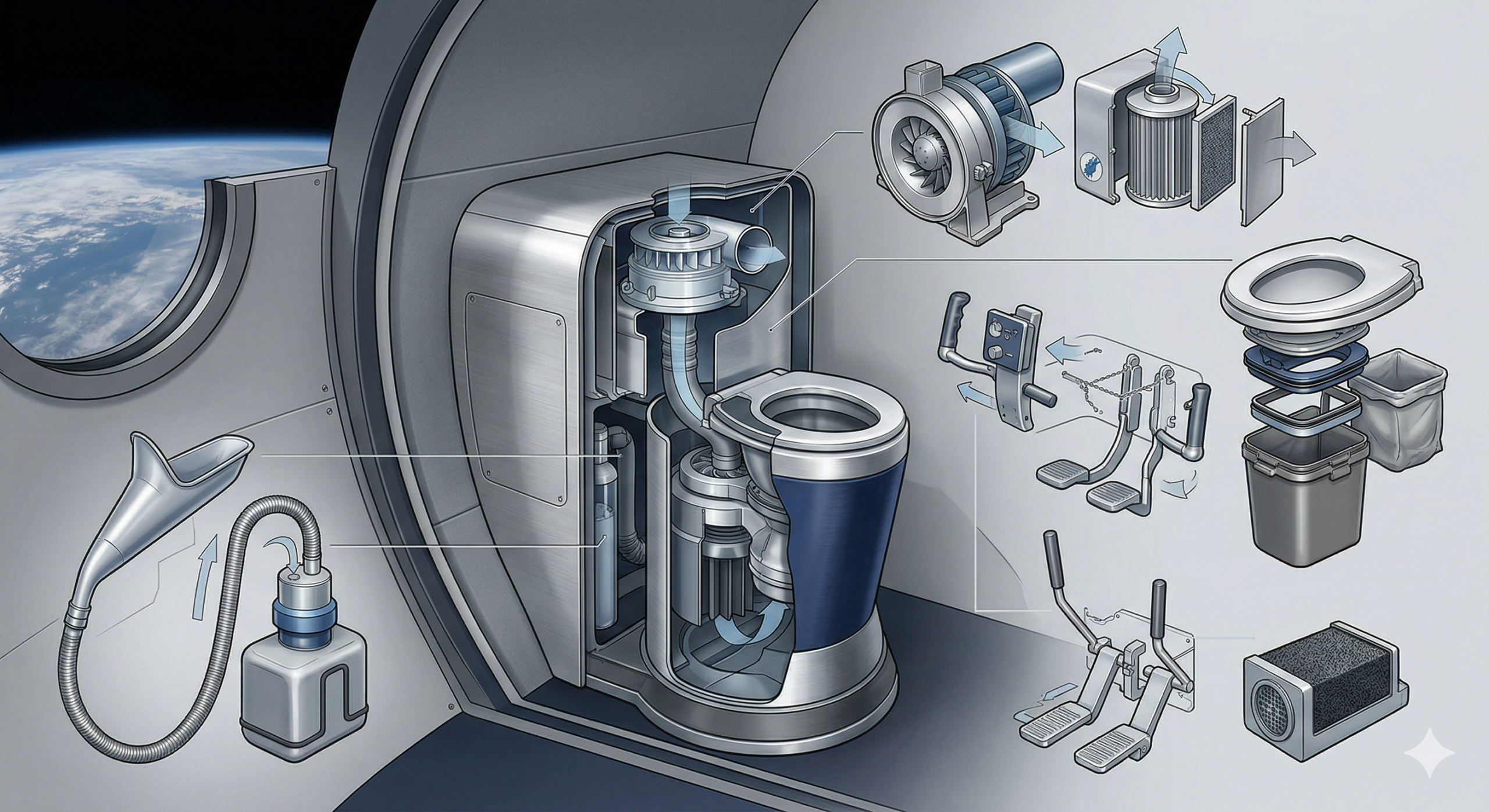
NASA began the development of the Universal Waste Management System in 2015, with a clear mandate: build a toilet that would actually work for Artemis. The contract went to Collins Aerospace, and the total development cost exceeded $23 million. The UWMS that flew on Artemis II represents the culmination of nearly a decade of engineering work driven by a remarkably specific set of requirements. It had to be significantly smaller and lighter than ISS toilet systems — the Orion capsule simply does not have room for a closet. It had to be reliable enough for missions lasting weeks without maintenance. It had to work for both male and female crew members, a requirement that previous systems had addressed poorly or not at all. And it had to do all of this while operating in the deep space radiation environment beyond Earth’s protective magnetosphere.
The size reduction achieved in the UWMS is remarkable by any engineering standard. Compared to the ISS’s toilet system, the UWMS is 65 percent smaller and 40 percent lighter. The fecal collection side uses a rotating mechanism that compacts and stores solid waste in a manner that can be managed without the kind of manual intervention that made Apollo so miserable. The urine side uses a funnel-and-tube system that can accommodate different anatomies, paired with an airflow system that maintains the separation between user and output that gravity provides on Earth. Critically, both functions can be used simultaneously — a design refinement that sounds almost trivially obvious but that previous systems had failed to achieve. Handles provide stability in microgravity, and a privacy door ensures basic dignity. These design elements may seem like small quality-of-life improvements, but they represent hard-won lessons from decades of astronaut feedback.
The UWMS experienced a minor malfunction in the early hours after Artemis II’s launch, and the incident is instructive. The pump system required more water than was initially available to operate correctly — a relatively straightforward problem that the crew identified and resolved quickly by adding sufficient water to the system. What is significant about this episode is not the malfunction itself but how it was handled. The crew diagnosed the issue, consulted with ground support, and implemented a fix without interrupting mission operations. The system had been designed with enough redundancy and enough documentation that a crew in the first hours of a complex mission could troubleshoot a toilet problem while simultaneously managing orbital insertion. That kind of human-centered design thinking — anticipating failure modes and building in the ability for crews to respond — reflects the maturation of space engineering philosophy over six decades.
Christina Koch’s presence on Artemis II is not merely symbolic; it is directly relevant to the design of the UWMS and to the broader trajectory of human spaceflight. Koch, who spent 328 days on the ISS in 2019 and 2020 — the longest single spaceflight by any woman in history — participated in the first all-female spacewalk and has been a consistent advocate for ensuring that space hardware works equally well for all body types and physiologies. The UWMS’s design, with its gender-neutral urine collection funnel system and its careful attention to ergonomics across different body sizes, reflects input from female astronauts who had spent years working around systems that were designed, often implicitly, around male bodies. When Apollo astronaut Wally Funk was finally able to fly to space in 2021 at the age of 82, she was using a different toilet than her Apollo-era male counterparts would have used. That difference is not trivial. It represents the difference between a space program that treats human space travel as a universal endeavor and one that treats it as an activity designed for a specific subset of humanity.
Japan’s role in the Artemis program extends well beyond ISS life support systems, and it is worth understanding the full scope of what is coming. In October 2020, Japan became one of the first nations to sign the Artemis Accords, the multilateral framework governing behavior in cislunar space and beyond. In December of the same year, JAXA and NASA signed a memorandum of understanding formally committing Japan to participate in the Lunar Gateway — the planned space station in lunar orbit that will serve as a staging point for surface missions. Japan is responsible for developing habitation modules for the Gateway and for supplying the station with cargo. These are not peripheral roles; they are central to the architecture of sustained lunar presence.
The most extraordinary element of Japan’s Artemis commitment is the pressurized lunar rover. In April 2024, the United States and Japan formally agreed on terms under which Japan would provide a pressurized rover for use on the lunar surface in exchange for two Japanese astronaut lunar landing opportunities. The rover — being developed in collaboration with Toyota — is designed to allow astronauts to travel hundreds of kilometers across the lunar surface while living inside a shirt-sleeve environment, without spacesuits. This is transformative. Apollo astronauts could venture only a few kilometers from their landing site; the range limitations imposed by the suit life support systems and the risk of walking home if the rover broke down kept them effectively tethered to the landing area. A pressurized rover removes that tether. It means Japanese engineers will have solved, among many other problems, the waste management challenge for a vehicle where astronauts might be living for days at a time — a vehicle where, once again, there will be nowhere to run and nowhere to hide from the fundamental biology of being human in space.
There is a philosophical thread running through this entire story that I find genuinely moving. The history of space waste management is, at its core, the history of humans refusing to accept that space is incompatible with human dignity. The Apollo engineers who designed those terrible plastic bags were not callous about the experience they were creating — they were constrained by physics, by budget, by a timeline driven by Cold War geopolitics. They built the best system they could within those constraints and sent human beings to the Moon anyway. The engineers who built the UWMS had more time, more resources, and the benefit of sixty years of accumulated experience. They built something that respects the people who will use it. That progression — from improvised discomfort to designed dignity — is one of the better stories in the history of technology.
Food technology tells a parallel story, and Japan has been central to that narrative as well. The development of space food — ensuring that human beings can eat nutritiously, enjoyably, and safely in microgravity — has followed the same arc from improvised functionality to human-centered design. Japanese food companies have contributed extensively to the ISS menu, developing vacuum-packed ramen, freeze-dried miso soup, and other foods that maintain cultural connection for Japanese astronauts far from home. The philosophy is the same one that drives waste management engineering: space is not a place where humans should be expected to abandon their humanity. It is a place where our engineering should rise to meet our humanity.
JAXA’s current astronaut corps includes names that will likely become household words in Japan before the decade is out. Satoshi Furukawa, a physician and veteran of two ISS missions, and Aki Hoshide, who has conducted multiple spacewalks and commanded the ISS, represent the generation of Japanese space explorers who have proven themselves in Earth orbit. The next generation — trained in the expectation that they will walk on the Moon — is waiting in the wings. Japan’s formal agreement to land a Japanese astronaut on the Moon through Artemis is not an aspiration; it is a contract, backed by the hardware commitments Japan is already building. When that landing happens, it will be the first time a human being from a non-superpower country has walked on the Moon — and the toilet they use on the way there will owe a debt to sixty years of incremental engineering improvements that began with a bag and a finger cot in a cramped Apollo capsule.
The last human being to walk on the Moon was Eugene Cernan, commander of Apollo 17, who lifted off from the lunar surface on December 14th, 1972. He said, before climbing the ladder for the last time: “We leave as we came and, God willing, as we shall return, with peace and hope for all mankind.” Fifty-four years passed. Apollo 17 landed in the Taurus-Littrow valley with hand-operated plastic bags for waste management. Artemis will land — in the south polar region, near deposits of water ice — with the UWMS and its sixty years of iterative improvement. The difference between those two systems is not just an engineering achievement. It is a measure of how seriously we have learned, in the intervening decades, to take the full complexity of human beings.
Watching Artemis II’s lunar swingby from Tokyo, I felt something I did not quite expect: a sense of continuity. The engineers who built those Apollo bags and the engineers who built the UWMS are part of the same project — the project of making space safe and habitable for human beings. They are connected by a chain of problems solved, lessons learned, and design improvements implemented. The astronauts who endured Apollo’s improvised systems and the astronauts who will benefit from Artemis’s careful design are part of the same story — the story of humanity deciding that the universe is worth the discomfort of getting to know it. Artemis II’s crew will splash down in the Pacific on April 11th. When they do, they will bring back data, photographs, and experience that will inform the next phase of humanity’s return to the Moon. They will also bring back, quietly and without ceremony, a slightly better understanding of what it takes to keep four human beings comfortable, healthy, and functional on a journey to the edge of human experience. The space toilet, of all things, is part of that story. I think that’s worth knowing.
The specific technical challenge of the lunar south pole adds another dimension to the waste management story. Unlike the equatorial landing sites of the Apollo missions — chosen partly for communication line-of-sight and partly because the terrain was better understood — the Artemis landing zones near the south pole will experience extreme temperature variations and near-permanent shadow in some craters. Water ice deposits in those permanently shadowed regions are the primary scientific and resource target of the Artemis surface missions. But the conditions also mean that hardware will be exposed to temperature ranges that exceed anything Apollo equipment had to endure. The UWMS and every other piece of crew support hardware has been designed and tested for this more demanding environment. Japan’s pressurized rover, which will operate in this same terrain, faces the same thermal engineering challenges. The solutions being developed will inform every subsequent human mission to the Moon, and eventually to Mars.
One final thought, as Artemis II prepares for splashdown. The Apollo program’s response to the waste management problem was to accept that astronauts would be uncomfortable, build the minimum viable system, and push forward anyway. The Artemis program’s response has been to accept that astronauts are full human beings who deserve engineering that honors their dignity, and to invest the time and money required to build it. Both approaches got humans to the Moon — or, in Artemis II’s case, around it. But only one of them is sustainable for the decades-long program of lunar and interplanetary exploration that lies ahead. You cannot ask people to spend months or years in space if space remains a place where their most basic needs are treated as afterthoughts. The UWMS, in its way, is a statement of intent: we are serious about this, we are in it for the long haul, and we are going to take care of the people we send into the void. That is the kind of seriousness that will get us to Mars.
この記事を書いた人
灰島
30代の日本人。国際情勢・地政学・経済を日常的に読み続けている。歴史の文脈から現代を読むアプローチで、世界のニュースを考察している。専門家ではないが、誠実に、感情も交えながら書く。
コメント